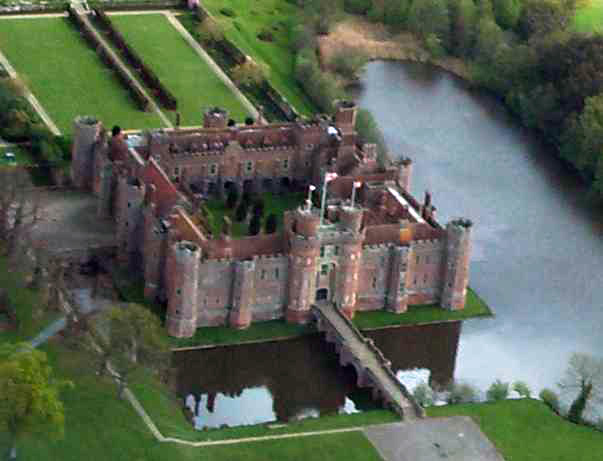
Herstmonceux Castle
50.8702° N · 0.3392° E · Castle
Photo: The original uploader was Welshie at English Wikipedia. · CC BY-SA 3.0 · Wikimedia Commons
Herstmonceux Castle is a castle near Herstmonceux, East Sussex, England; formerly a manor. Royal licence to crenellate granted to Sir Roger Fiennes in 1441. The free Lokali audio guide runs 8 minutes.
✓ Published October 2026 · how we write these guides
Visitor facts
| Lokali audio guide | 8 min · free |
|---|---|
| Type | Castle |
| Location | Eastbourne, United Kingdom |
| Coordinates | 50.8702, 0.3392 |
| Official website | herstmonceux-castle.com |
| Languages | 50+, in the Lokali app |
The story
Listen first to the water. The moat around Herstmonceux Castle is still and wide, and on a calm day it holds a second castle upside down. Ducks drift across that reflection. The air smells of cut grass and damp earth from the Sussex fields. Then look up at the walls. They are not grey stone at all. They are brick, warm red and soft orange, glowing even under cloud. That colour is the first clue to why this place matters.
You are standing in the countryside of East Sussex, a short drive inland from Eastbourne and the chalk cliffs of the south coast. The land here is low and green, close to the wide wetland known as the Pevensey Levels. For centuries this was a quiet corner of England. Farms, woods, small villages, and church towers. Into this gentle landscape, in the fifteenth century, a wealthy knight decided to build something that looked like a fortress. It was really something else.
The builder was Sir Roger Fiennes, a soldier who had served in the long wars in France. In 1441 he received a royal licence to crenellate. In medieval England, this was official permission to add battlements to a house, and it was a mark of status as much as defence. Fiennes had wealth, ambition, and connections at court. He wanted a home that said all of that clearly, to anyone riding past on the road.
And so we return to the brick. In fifteenth-century England, brick was still rare and fashionable. Stone was the normal material for great buildings. Herstmonceux is one of the oldest important brick buildings in the country. Many historians link the style to builders and ideas from Flanders and the Low Countries, where brick was common. Imagine local people watching these red walls rise. To them, it must have looked foreign, modern, and expensive.
Now look carefully at the great gatehouse facing you across the moat. Two tall towers frame the entrance. Near the top, the walls project outwards over openings in the floor of the parapet. These openings are called machicolations. Defenders could drop stones or other missiles through them onto attackers below. Lower down, look for small round openings in the brickwork. These are early gunports, built for a new age of firearms. Here is the surprise: the castle was probably never seriously attacked.
That is the quiet joke at the heart of Herstmonceux. It has the full costume of a fortress — moat, towers, battlements, gunports. But the brick walls were not designed to survive a heavy siege. This was a castle built to impress, a statement of power and good taste. Think of it less as a military base and more as a grand country house wearing armour. Many visitors walk away believing it was a front-line stronghold. It was really closer to a palace.
The story of the castle did not continue smoothly. Over the following centuries, it passed through several families. By the late eighteenth century, the owners had other plans. Much of the interior was stripped out, and materials were taken away to help build a new, more comfortable house nearby. The outer walls stayed standing, but the inside became a ruin. For well over a century, ivy and weather took their turn. Romantic painters and visitors came to admire the empty shell.
Then, in the early twentieth century, the castle was brought back to life. New owners began a long and costly restoration. Work started before the First World War and continued into the 1930s. The restorers rebuilt the interior behind the old medieval walls. So when you look at the castle today, you are seeing two stories together. The outer face is largely fifteenth century. Much of what lies inside belongs to a much later age of loving reconstruction.
Here is the second surprise. After the Second World War, this medieval-looking castle became home to astronomers. The Royal Greenwich Observatory moved here from London, where city lights and smoke made observing the night sky difficult. The dark Sussex skies were far better. For several decades, scientists worked in and around the castle grounds. Just beyond the estate, you can still see a group of green-domed telescope buildings. Today they form a science centre, with hands-on exhibits for visitors of all ages.
The observatory eventually moved away, and the castle entered yet another chapter. In the 1990s it was given to Queen's University, a Canadian university based in Ontario. The gift came through the generosity of a Canadian chemist and benefactor, Alfred Bader. Today the castle is an international study centre. Students from Canada and other countries live and learn here. So if you hear young voices and different accents in the grounds, this is part of the story. A medieval castle has become a campus.
Like most old English castles, Herstmonceux has its ghosts. Locals tell of a grey lady who walks the grounds. Another popular tale speaks of a phantom drummer heard on the battlements. According to one story, smugglers may have encouraged these legends. A frightening rumour kept curious people away at night, while goods moved quietly across the marshes. Nobody can prove that version either. But it is a good reminder that folklore often has very human, practical roots.
Beyond the walls, the gardens deserve slow attention. There is a walled garden, with old brick enclosing flower beds and quiet paths. Further out, woodland trails lead between tall trees, and open lawns run down towards the water. In spring and summer the borders fill with colour. In autumn, fallen leaves gather along the paths. Walk a little way from the castle, then turn back. From a distance, the building sits low in the landscape, reflected in its moat, framed by trees.
The interior is usually seen only on guided tours, because the building is a working study centre. If you join one, notice how the restored rooms combine old forms with twentieth-century craftsmanship. Outside, take your time with the brickwork itself. Look for darker bricks set into patterns, small repairs in slightly different colours, and worn edges near the gateway. Every patch shows a different moment of care. Different hands across nearly six centuries have kept these walls standing.
Before you leave, stand once more at the edge of the moat. Watch the water move gently against the base of the walls. Somewhere a bird calls from the reeds. A knight built this place to show the world his success. Ruin came, then rescue, then science, and now study. As you walk back across the grass, glance over your shoulder. The red brick keeps its warm glow, even as the light changes. That glow is the same colour Sir Roger Fiennes chose, all those centuries ago.
Key facts
What to look for
Practical tips
Common questions
Is there a free audio guide to Herstmonceux Castle?
Yes — the Lokali app narrates Herstmonceux Castle free of charge in 50+ languages. The guide runs about 8 minutes, covers the history, what to look for on site and practical tips, and works offline once downloaded.
Where is Herstmonceux Castle?
Herstmonceux Castle is near Eastbourne, United Kingdom, at 50.8702, 0.3392. Tap the map link on this page for directions from where you are.
What is Herstmonceux Castle known for?
Royal licence to crenellate granted to Sir Roger Fiennes in 1441. One of England's oldest important brick buildings.
What should you look for at Herstmonceux Castle?
Machicolations projecting from the top of the gatehouse towers. Small round gunports low in the brick walls. Patterns of darker bricks set into the red walls.
What should you know before visiting Herstmonceux Castle?
Book a guided tour to see the castle interior. Walk the woodland trails for wider views of the castle.
On the map
Opens directions to Herstmonceux Castle from your location.
More to see near Herstmonceux Castle



Hear Herstmonceux Castle in your language
The full story, narrated, in 50+ languages. Download it before you go and it plays offline, at your own pace, with no ticket and no tour group.