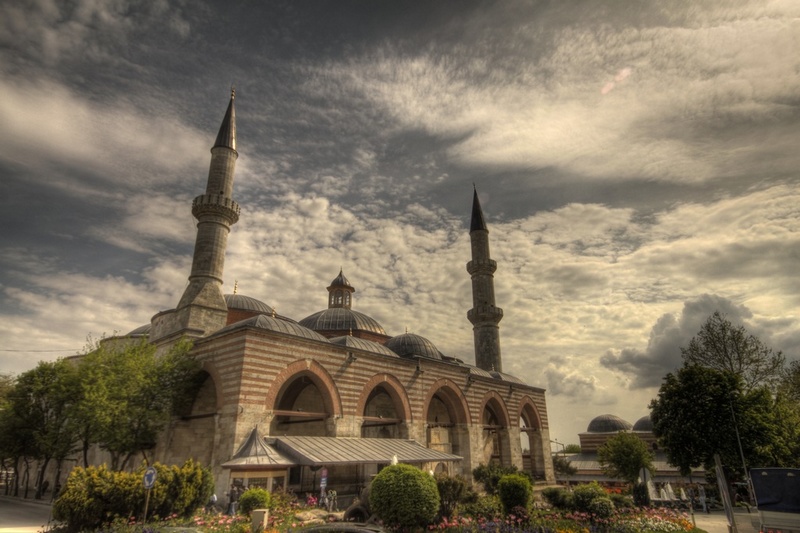
Photo: Özgür ZEYHAN · CC0 · Wikimedia Commons
Old Mosque, Edirne is a mosque in Edirne, northwestern Turkey. Construction began around 1403 under Emir Süleyman Çelebi. The free Lokali audio guide runs 7 minutes.
✓ Published October 2026 · how we write these guides
Visitor facts
| Lokali audio guide | 7 min · free |
|---|---|
| Type | Mosque |
| Location | Edirne, Türkiye |
| Coordinates | 41.6767, 26.5557 |
| Languages | 50+, in the Lokali app |
The story
Take off your shoes, and feel the change at once. The street outside is hard and warm. Here the carpet is soft and gives a little under your heel. The light drops to a softer shade, and the sound of traffic fades behind thick stone walls. Look up. Instead of one great dome, you see a field of them, lined up like squares on a board. This is the Old Mosque of Edirne, known in Turkish as Eski Cami, and it is older than nearly everything around it.
The name tells you something. When this mosque was built, it was not old at all. It was the newest and grandest place of prayer in the city. Later, the Ottoman sultans built even larger mosques a short walk away. Over time, this building became the old one, and the name stayed. So the word "old" here is a quiet compliment. It marks the mosque that came first, the one the later builders stood beside and tried to surpass.
To understand why it is here, you need to know what Edirne once was. Before the Ottomans took Constantinople in 1453, this city was their capital. Sultans lived here. Armies gathered here before marching into the Balkans. Edirne was the centre of a young and growing state. A capital needed a great mosque, a place where the ruler could pray with his people on Fridays. This building was one of the first answers to that need.
The work began in the early fifteenth century, around 1403, under Emir Süleyman Çelebi, one of the sons of Sultan Bayezid the First. Those were troubled years. After a crushing defeat in 1402, Bayezid's sons fought each other for the throne. The struggle lasted more than a decade. Süleyman did not live to see the mosque finished. It was his brother, Mehmed the First, who completed it in 1414, after he won the long civil war and reunited the state.
So think of the stones around you as a bridge across that conflict. One brother started the building, and another brother finished it. Construction went on while the family fought for power. When it was done, the mosque stood as a statement that the Ottoman house had survived its crisis. Prayer continued here while the empire grew from a regional power into something far larger.
Now look again at the ceiling. The plan is a square, divided into nine equal bays — three rows of three. Each bay carries its own dome, resting on heavy piers. This style is called a multi-domed great mosque. It was common in early Ottoman building, before architects learned to cover a whole prayer hall with one enormous dome. The Grand Mosque in Bursa, an earlier Ottoman capital, follows a similar idea on a larger scale.
Stand under the central dome for a moment, then walk to a corner. Notice how the space feels different. In a single-dome mosque, your eye goes straight up to one point. Here the space is more even, more like a forest of columns and arches. No one spot dominates. Many visitors find this calming. The piers break up your view, so the room reveals itself slowly as you move through it.
Here is a detail many people miss at first. Look at the walls and the piers. You will see Arabic calligraphy painted in enormous letters. Some words are so large that you read them from across the hall. Among them are the names of God and of the Prophet Muhammad. The paintings come from different periods of repair, but together they give the mosque its strong visual character. Much of the decoration is writing, not pictures.
And here is a second surprise. Near the mihrab, the prayer niche that points toward Mecca, look for a small piece of stone set into the wall. Local tradition holds that this fragment comes from the Kaaba, the holy shrine in Mecca. Its true origin is hard to confirm, so treat the story as belief rather than documented history. You may see visitors touch it, or pause beside it with a quiet prayer. That moment of devotion is real, whatever the stone's history.
Step back outside and look at the exterior. The walls are built of cut stone, simple and solid. Two minarets rise from the building, and they were not built at the same time. Compare their shapes and you can see small differences in style. A covered porch, called a portico, runs along the front. Over the centuries, fires and earthquakes damaged the mosque, and it has been repaired many times. The walls carry the marks of that long care.
Now turn toward the long stone building close by. This is the Bedesten, a covered market. Mehmed the First built it around the same time as the mosque, and the two were linked. The shops paid rent, and that income helped to support the mosque and its staff. This was a common Ottoman system. Trade paid for faith, and faith gave the market a respected neighbour. Even today, the area around you is full of shops and merchants.
From here, you are only a few minutes on foot from two other great mosques of Edirne. One is the Üç Şerefeli Mosque, with its famous minaret of three balconies. The other is the Selimiye Mosque, the masterpiece of the architect Sinan, with its single vast dome. Walk between all three and you can follow the story of Ottoman architecture. You move from many small domes, to bolder experiments, to one great dome over everything.
Before you leave, take one last look at the nine domes. They are not the largest in this city, and they do not try to be. They belong to a moment when the Ottoman state was still young, still uncertain, still learning how to build. People have prayed under this roof for more than six hundred years. As you put your shoes back on and step into the street, listen. The sound of the city returns slowly, and the old mosque stays quiet behind you.
Key facts
What to look for
Practical tips
Common questions
Is there a free audio guide to Old Mosque, Edirne?
Yes — the Lokali app narrates Old Mosque, Edirne free of charge in 50+ languages. The guide runs about 7 minutes, covers the history, what to look for on site and practical tips, and works offline once downloaded.
Where is Old Mosque, Edirne?
Old Mosque, Edirne is in Edirne, Türkiye, at 41.6767, 26.5557. Tap the map link on this page for directions from where you are.
What is Old Mosque, Edirne known for?
Construction began around 1403 under Emir Süleyman Çelebi. Sultan Mehmed the First completed the mosque in 1414.
What should you look for at Old Mosque, Edirne?
Giant Arabic calligraphy painted across the walls and piers. A small stone fragment set near the prayer niche. Three rows of three domes resting on heavy piers.
What should you know before visiting Old Mosque, Edirne?
Dress modestly and carry a scarf for covering hair. Avoid visiting during the five daily prayer times.
On the map
Opens directions to Old Mosque, Edirne from your location.
More to see in Edirne


Hear Old Mosque, Edirne in your language
The full story, narrated, in 50+ languages. Download it before you go and it plays offline, at your own pace, with no ticket and no tour group.