
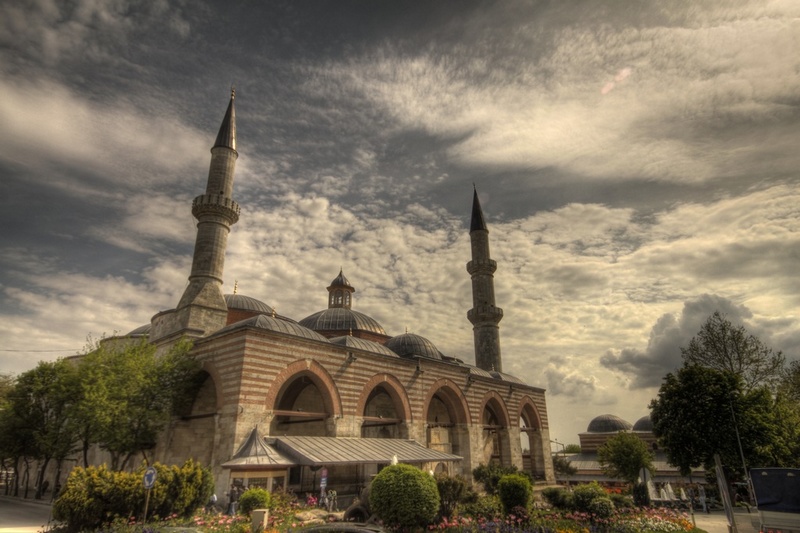
Photo: User:Ggia · CC BY-SA 3.0 · Wikimedia Commons
Üç Şerefeli Mosque is a mosque in Edirne, northwestern Turkey. Commissioned by Sultan Murad the Second, completed in the 1440s. The free Lokali audio guide runs 6 minutes.
✓ Published October 2026 · how we write these guides
Visitor facts
| Lokali audio guide | 6 min · free |
|---|---|
| Type | Mosque |
| Location | Edirne, Türkiye |
| Coordinates | 41.6781, 26.5535 |
| Languages | 50+, in the Lokali app |
The story
Stand in the courtyard for a moment and listen. The city traffic fades behind the outer wall. Your shoes meet worn stone slabs, smoothed by centuries of feet. Above you, arches of alternating red and pale stone curve one after another around the open square. Pigeons settle on the domed porches. Somewhere, water runs into the basin of the fountain at the centre.
This is the Üç Şerefeli Mosque, in the heart of Edirne. The name means "the mosque with three balconies." It takes its name from just one of its four minarets, the tallest one, which carries three separate balconies stacked up its shaft. From those balconies, the call to prayer once went out across the rooftops. Hold that detail in your mind. We will come back to it, because it hides a small engineering puzzle.
First, a little context. Before the Ottomans took Constantinople, Edirne was their capital. For several decades in the fourteenth and fifteenth centuries, this city was the political centre of a fast-growing empire. Sultans built here, ruled here, and tested new ideas here. This mosque was one of those tests. It was commissioned by Sultan Murad the Second, and it was completed in the 1440s, only a few years before his son, Mehmed, would conquer Constantinople.
That timing matters. Many visitors come to Edirne for the great Selimiye Mosque, a short walk from here. The Selimiye is the masterpiece of Sinan, the most celebrated Ottoman architect, built more than a century later. But Sinan did not start from nothing. Architectural historians often describe this building as a bridge. It sits between the smaller, early Ottoman mosques and the grand imperial mosques of Istanbul. You are standing inside an experiment.
Look around this courtyard again. It is a large, enclosed square, ringed by arcades and covered by a row of small domes. Today this layout feels normal, because nearly every great Ottoman mosque has one. But this is generally regarded as the first Ottoman mosque built with this kind of arcaded forecourt. The idea worked so well that it became a standard. Here, you can see the early version of a design that later spread across the empire.
Now turn your eyes upward, to the minarets. There are four of them, one at each corner of the courtyard. Look closely, and you will notice something many visitors miss. They are not the same. Each one has its own surface pattern. One has ribs that twist around the shaft in a spiral. Another carries a zigzag or diamond design. They differ in height, too. The builders seem to have enjoyed the variety.
And here is that puzzle from the beginning. The tallest minaret, with its three balconies, has three separate staircases inside it. They wind around each other within the same narrow shaft. Each staircase leads to its own balcony. This meant three muezzins, the men who give the call to prayer, could climb at the same time without ever meeting on the stairs. It is a quiet piece of fifteenth-century ingenuity, invisible from the outside.
When you are ready, walk through the main door into the prayer hall. Remember that this is a working mosque. Take off your shoes, keep your voice low, and avoid walking in front of anyone praying. Women should cover their hair, and everyone should cover shoulders and knees. Outside prayer times, visitors are usually welcome. If a service is in progress, wait in the courtyard until it ends.
Inside, the space changes. Look up at the main dome. In its time, it was the largest dome the Ottomans had built. To carry its weight, the builders used a mix of walls and two heavy freestanding piers. The result is a central space that feels wide but slightly asymmetrical. Smaller domes sit on either side. You can sense the architects working out a problem that Sinan would later solve with total confidence.
Notice the light. It comes in through rows of windows, low and high, and falls across the carpets in soft patches. Look at the painted decoration on the dome and arches. Some of this painting is old, and some has been restored over the years. Earthquakes and fires have damaged the building more than once in its long life. What you see today is the result of repeated care and repair.
Step back outside and look at the courtyard arches once more. That red and white banding is not paint. It comes from alternating blocks of coloured stone. The effect is simple, but it gives the courtyard its warm rhythm. In the afternoon, when the sun drops lower, the red stones deepen in colour. The shadows of the arches stretch across the paving like a row of dark doorways.
When you leave through the gate, look across the street. Edirne has kept a remarkable cluster of Ottoman buildings in this small central area. The Old Mosque, the Selimiye, an old bathhouse, and covered market streets all sit within easy walking distance. Together, they show how the city grew around its religious buildings. Trade, bathing, prayer, and daily life all happened side by side, within a few hundred metres.
Before you go, pause at the gate and turn around one last time. Find the tallest minaret again, and count its three balconies. Picture three men climbing in darkness, each on his own spiral stair, never crossing paths. Then let your eye travel across the other three minarets, each one a little different. You are looking at a building that taught an empire how to build. Take that thought with you as you walk on into Edirne.
Key facts
What to look for
Practical tips
Common questions
Is there a free audio guide to Üç Şerefeli Mosque?
Yes — the Lokali app narrates Üç Şerefeli Mosque free of charge in 50+ languages. The guide runs about 6 minutes, covers the history, what to look for on site and practical tips, and works offline once downloaded.
Where is Üç Şerefeli Mosque?
Üç Şerefeli Mosque is in Edirne, Türkiye, at 41.6781, 26.5535. Tap the map link on this page for directions from where you are.
What is Üç Şerefeli Mosque known for?
Commissioned by Sultan Murad the Second, completed in the 1440s. Name means mosque with three balconies.
What should you look for at Üç Şerefeli Mosque?
Spiral ribbed pattern on one of the minarets. Three stacked balconies on the tallest minaret. Red and pale stone bands on courtyard arches.
What should you know before visiting Üç Şerefeli Mosque?
Remove your shoes before entering the prayer hall. Bring a scarf to cover hair and shoulders.
When is the best time to visit Üç Şerefeli Mosque?
Come in late afternoon for warm light on the arches.
On the map
Opens directions to Üç Şerefeli Mosque from your location.
More to see in Edirne

Hear Üç Şerefeli Mosque in your language
The full story, narrated, in 50+ languages. Download it before you go and it plays offline, at your own pace, with no ticket and no tour group.