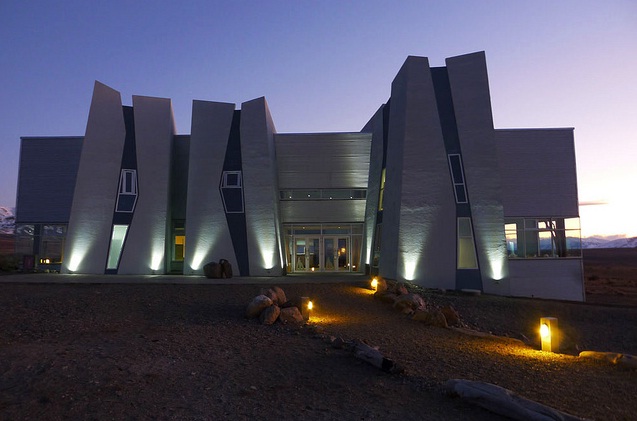
Glaciarium Museum is a modern museum in El Calafate dedicated to glaciology, Patagonian ice history, and climate science. It is in El Calafate, Argentina. Most visitors spend 1–2 hours here. The free Lokali audio guide runs 5 minutes.
✓ Verified August 2026 · how we write these guides
Visitor facts
| Time needed | 1–2 hours |
|---|---|
| Lokali audio guide | 5 min · free |
| Type | Museum |
| Best for | Family |
| Location | El Calafate, Argentina |
| Coordinates | -50.3395, -72.2545 |
| Languages | 45, in the Lokali app |
The story
After days of standing before glaciers in the open air, you step indoors, and the cold follows you in a new form. The building is quiet and bright. The walls rise in pale, angular shapes, like blocks of ice cut and set on end. This is the Glaciarium, a center built to explain the ice you have been watching.
The Glaciarium sits about six kilometers outside El Calafate, on a rise above the steppe. It opened in 2011. From the road its form stands out against the dry grassland, designed to call to mind a wall of glacier ice. A shuttle runs from the town center, so you do not need a car to reach it.
Inside, the exhibits set out to answer a simple question. What is a glacier, and how does it work? You learn that a glacier is not frozen lake water. It is snow, fallen over many years, pressed down by its own weight until it turns to dense ice. When the ice grows thick enough, it begins to flow slowly downhill.
The displays follow the ice from the mountains to the lake. Panels and models show the Southern Patagonian Ice Field, the great mass of ice that feeds the glaciers of this region. You see how the field gathers snow at height and releases it as moving tongues of ice, such as the Perito Moreno Glacier nearby.
Screens and films do much of the work here. Wide footage carries you over the ice field from above, across cracked surfaces and deep blue pools. Other films show glaciers calving in slow motion, the blocks falling and the water rising in a way the eye can rarely follow in real life. Seen from the air, the ice field looks less like a single sheet and more like a slow frozen river, with many branches feeding the valleys below.
The center also turns to the present day. Part of the visit deals with how glaciers respond to a warming climate. You see how scientists measure the ice, and how many glaciers around the world are growing thinner and shorter. The tone is plain and clear, built on measurement rather than alarm. Charts trace how the fronts of certain glaciers have moved over the past century, gaining ground in some places and pulling back in others.
There is a feature here that many visitors come for. Below the main floor lies a bar made almost entirely of ice. It is called the Glaciobar. The walls, the seats, and even the glasses are cut from ice, and the room is held below freezing all year round.
Before you enter the ice bar, the staff hand you a heavy coat and gloves. You step through an insulated door into the cold room. Your breath shows in the air. A drink is served in a cup of solid ice, and you hold it with your gloves while the blue light of the room glows around you.
The cold room is a short visit by design. Most people stay for a set number of minutes before the chill sends them back to the warm floor above. It is a small, strange experience, and it leaves you with a clearer sense of what real cold feels like.
The Glaciarium works well at either end of a glacier trip. Come before you visit the ice, and the glaciers out in the park make far more sense when you reach them. Come after, and the exhibits gather your loose impressions into a single, ordered picture.
It is also a good choice for a day of poor weather. Wind and rain are common in this part of Patagonia. When the open viewpoints turn grey and cold, the center offers a few warm and dry hours that still keep the glaciers at their heart.
One idea runs through the whole visit. The land you crossed to get here was shaped by ice. The wide valleys, the long lakes, and the rounded hills outside the windows were all carved by glaciers in colder times. The exhibits help you read that story in the ground itself. On the drive back, the view looks different than it did before.
When you walk back out to the road, the real ice fields lie somewhere beyond the hills. You cannot see them from here. But you carry a better sense of how they were made, and how slowly they move, and why their pale blue light has drawn you all this way.
Key facts
What to look for
Practical tips
Common questions
How long do you need at Glaciarium Museum?
Plan 1–2 hours. That is the time most visitors spend at Glaciarium Museum. The free Lokali audio guide adds about 5 minutes of narration you can listen to as you walk, so it fits inside your visit rather than adding to it.
Is there a free audio guide to Glaciarium Museum?
Yes — the Lokali app narrates Glaciarium Museum free of charge in 50+ languages. It covers the history, what to look for on site and practical tips, and it works offline once downloaded.
Where is Glaciarium Museum?
Glaciarium Museum is in El Calafate, Argentina, at -50.3395, -72.2545. Tap the map link on this page for directions from where you are.
What should you know before visiting Glaciarium Museum?
Take the shuttle from the town center to arrive.
What is Glaciarium Museum known for?
Glacier interpretive center that opened in 2011.
What is the best time to visit Glaciarium Museum?
The freezer room is gimmicky but effective—it resets your sense of cold before you see the real glaciers.
On the map
Opens directions to Glaciarium Museum from your location.
More to see in El Calafate


Hear Glaciarium Museum in your language
The full story, narrated, in 50+ languages. Download it before you go and it plays offline, at your own pace, with no ticket and no tour group.