
Photo: Pudelek · CC BY-SA 4.0 · Wikimedia Commons
Esztergom Basilica is a minor basilica. It is in Esztergom, Hungary. Largest church in Hungary, seat of the Primate. The free Lokali audio guide runs 7 minutes.
✓ Published October 2026 · how we write these guides
Visitor facts
| Lokali audio guide | 7 min · free |
|---|---|
| Type | Cathedral |
| Location | Esztergom, Hungary |
| Coordinates | 47.7989, 18.7364 |
| Official website | bazilika-esztergom.hu |
| Languages | 50+, in the Lokali app |
The story
Stand on the Slovak bank of the Danube in Štúrovo and look across the water. The river moves wide and grey-green, slow and heavy. On the far hill, a great green dome rises above a pale stone colonnade. On a clear morning the light catches the copper and the columns seem to glow. You are in one country, looking at the largest church in another. That is the first quiet surprise of this place, and the river sits between the two.
The building on the hill is Esztergom Basilica, in Hungary. Its full dedication is to the Assumption of the Virgin Mary and to Saint Adalbert. It is the largest church in Hungary. It is also the seat of the Archbishop of Esztergom-Budapest, who traditionally holds the title of Primate of Hungary. In simple terms, this is the mother church of Hungarian Catholicism. From where you stand, you can see why the builders chose the hill.
That hill is much older than the basilica. Esztergom was the first royal seat of the Kingdom of Hungary. Tradition holds that Saint Stephen, the first Christian king of Hungary, was born here. He was crowned around the year 1000, and he founded an archbishopric in this town. For centuries, a medieval cathedral and a royal palace stood together on this same ridge above the river. Almost none of that early cathedral survives today.
Wars and centuries of damage left the old church in ruins. The Ottoman Turks held Esztergom for long periods in the sixteenth and seventeenth centuries, and the town became a frontier fortress. The archbishops moved away for a long time. When they returned, they wanted a new cathedral that could carry the weight of their history. Construction of the present basilica began in 1822, and it continued for most of the nineteenth century.
The building passed through several hands. Pál Kühnel drew up the first plans. János Packh then led the work, but he was murdered in 1839, and the project needed a new leader. József Hild took over and carried the basilica to completion. Hild also worked on the great basilica at Eger. The style they chose is Neoclassical — an architecture that borrows the columns, domes and clean geometry of ancient Greece and Rome.
The church was consecrated in 1856, before the building was fully finished. For that ceremony, the composer Franz Liszt wrote a Mass. It is often called the Gran Mass, because Gran is the old German name for Esztergom. Liszt was Hungarian by birth, and he saw this as a national occasion. The work was finally completed in 1869. So the basilica you see is barely one and a half centuries old, standing on ground with a thousand years of history.
Now look at the front of the building. Wide steps lead up to a row of tall columns that hold a triangular pediment. Behind them, the dome sits on a ring of smaller columns, a design that gives it a light, open crown. Two bell towers frame the main front. The proportions are simple and calm. From this distance, the whole composition reads clearly, almost like a drawing. That clarity is exactly what Neoclassical builders wanted.
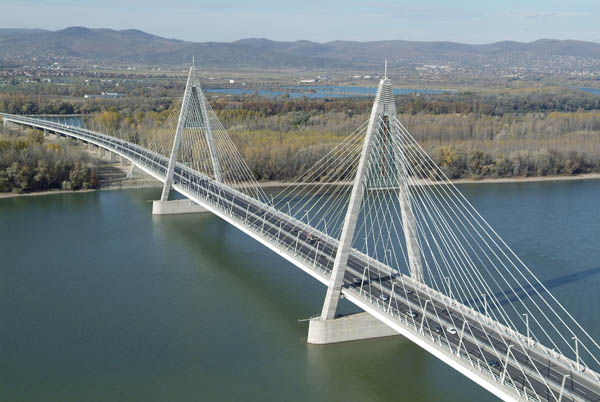
If you cross the river, you will walk over the Mária Valéria Bridge. It links Štúrovo directly to Esztergom. The bridge was destroyed in 1944, near the end of the Second World War. For more than half a century, the two towns had no bridge here at all. It was finally rebuilt and reopened in 2001. Today people walk and cycle across it without a second thought, but for older locals the crossing still carries meaning.
Inside the basilica, the scale changes everything. The interior is wide and tall, with marble surfaces and gilded details that pick up light from the windows. Above the main altar hangs a vast painting of the Assumption, by the Italian painter Michelangelo Grigoletti. It is based on a work by Titian, and it is often described as one of the largest paintings in the world on a single piece of canvas. Stand back, and let your eyes travel slowly upward.
The real treasure, many visitors say, is a small side chapel. The Bakócz Chapel is built of red marble in the Renaissance style of the early sixteenth century. It survived from the old medieval cathedral. When the new basilica was planned, workers took the chapel apart stone by stone — roughly 1,600 numbered pieces — and reassembled it inside the new walls. It is one of the finest Italian Renaissance works in Hungary, and it is older than everything around it.
Below the main floor lies a crypt, built in a heavy, ancient Egyptian-inspired style. Many archbishops of Esztergom rest here. Among them is Cardinal József Mindszenty, who openly resisted the Communist government after the Second World War and was imprisoned. He died in exile in Vienna, and his remains were brought back to Esztergom in 1991, after Communism ended. For many Hungarians, his tomb is a place of quiet respect. The basilica also holds a treasury of church gold and textiles.
For those with steady legs, the dome can be climbed. The stairs narrow as you go up, and the final stretch can feel tight. At the top, a walkway circles the outside of the dome. Below you, the Danube bends through low hills, and Štúrovo spreads out on the opposite bank. On a clear day you can follow the river far into the distance. It is the same view you have now, only reversed, and that is worth thinking about.
So take one more look across the water. The dome sits on its hill, and the bridge runs low beneath it. Behind you, Štúrovo goes about its ordinary day. Two towns, two countries, one river. Notice how the light shifts on the green copper as clouds pass. Listen to the water moving against the bank. When you walk away, turn once more — the basilica will still be there, watching the river as it has for generations.
Key facts
What to look for
Practical tips
Common questions
Is there a free audio guide to Esztergom Basilica?
Yes — the Lokali app narrates Esztergom Basilica free of charge in 50+ languages. The guide runs about 7 minutes, covers the history, what to look for on site and practical tips, and works offline once downloaded.
Where is Esztergom Basilica?
Esztergom Basilica is in Esztergom, Hungary, at 47.7989, 18.7364. Tap the map link on this page for directions from where you are.
What is Esztergom Basilica known for?
Largest church in Hungary, seat of the Primate. Construction began in 1822 and finished in 1869.
What should you look for at Esztergom Basilica?
Green copper dome ringed by a circle of columns. Grigoletti's huge Assumption painting above the main altar. Red marble walls inside the Renaissance Bakócz Chapel.
What should you know before visiting Esztergom Basilica?
View the dome from Štúrovo's riverbank before crossing over. Walk across the Mária Valéria Bridge into Esztergom.
When is the best time to visit Esztergom Basilica?
Come on a clear morning for the sharpest river views.
On the map
Opens directions to Esztergom Basilica from your location.
More to see near Esztergom Basilica



Hear Esztergom Basilica in your language
The full story, narrated, in 50+ languages. Download it before you go and it plays offline, at your own pace, with no ticket and no tour group.