
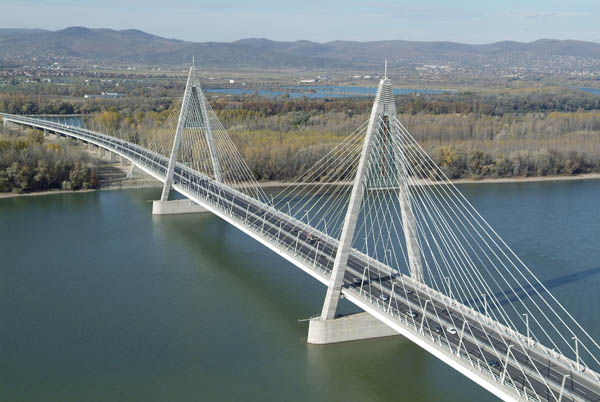
Photo: Pudelek · CC BY-SA 4.0 · Wikimedia Commons
Mária Valéria Bridge is a bridge across the Danube. It is near Esztergom, Hungary. Opened in 1895 between Štúrovo and Esztergom. The free Lokali audio guide runs 6 minutes.
✓ Published October 2026 · how we write these guides
Visitor facts
| Lokali audio guide | 6 min · free |
|---|---|
| Type | Bridge |
| Location | Esztergom, Hungary |
| Coordinates | 47.7953, 18.7303 |
| Languages | 50+, in the Lokali app |
The story
Stand still for a moment and feel the deck under your feet. When a car or a bus rolls past, the steel answers with a low, faint hum. Below you, the Danube moves wide and grey-green, carrying small whirls of foam toward the Black Sea. Across the water, a huge green dome rises above the far bank. You are standing on a bridge between two countries, and for most of the last century, this crossing did not exist.
This is the Mária Valéria Bridge. It joins Štúrovo, on the Slovak side, with Esztergom, on the Hungarian side. When it first opened in 1895, both towns belonged to the same kingdom, the Kingdom of Hungary, inside the larger Habsburg monarchy. There was no border here at all. The river was simply a river, and the bridge was a local link between a small market town and an old royal and church capital.
The name has a royal story behind it. Mária Valéria is the Hungarian form of Marie Valerie, an archduchess of the Habsburg family. She was the youngest daughter of Emperor Franz Joseph and Empress Elisabeth, the empress whom many people know today by her nickname, Sisi. Elisabeth had a deep affection for Hungary, and Marie Valerie was often called her favourite child. Naming a Danube bridge after her was a gesture of loyalty and pride.
Before the bridge, people crossed here by boat and ferry. Imagine the scene in the nineteenth century — carts waiting on the bank, horses stamping, boatmen shouting over the current. Ice in winter and floods in spring could stop the crossing for days. A fixed steel bridge changed daily life. Farmers, traders, pilgrims, and students could now walk across in a few minutes, in almost any weather.
Look at the structure around you. It is a steel truss bridge, built from many straight members joined into triangles. Triangles are strong shapes. They spread the weight of traffic across the whole frame, so no single beam carries too much. The rivets and plates you can see belong to an engineering tradition from the age of railways and great iron halls. Here is the first surprise, though... much of the steel you are touching is not original.
The bridge has been broken twice. The first time came in 1919. The First World War had ended, the old monarchy had fallen apart, and new borders were being drawn. The Danube here became the line between Hungary and the new state of Czechoslovakia. During the fighting of that year, part of the bridge was blown up. For several years, the two banks were cut apart again.
The damaged section was repaired in the 1920s, and traffic returned. But the peace did not last. In the final winter of the Second World War, late in 1944, retreating German forces destroyed the bridge to slow the advance of the Soviet army. The central spans fell into the river. This time, nobody rebuilt it. That is the second surprise: for more than half a century, only broken stumps stood here in the water.
Think about what that meant for the people on both banks. In the Cold War years, Czechoslovakia and Hungary were both in the Soviet bloc, yet the border was still a firm line. Families with relatives on the other side had to travel far around to another crossing. Many people in Štúrovo speak Hungarian, and many have family in Esztergom. They could see the other town every day, just across the water, but could not simply walk there.
Change came after the fall of communism. In the 1990s, Slovakia and Hungary began to talk about restoring the bridge. The European Union helped with funding, and the two governments shared the work. The rebuilt bridge opened in October 2001, using the original stone piers and a new steel structure in the old style. Crowds gathered on both banks for the opening. For many older residents, it was the first time in decades that they crossed here on foot.
Today, the change is even greater. Both Slovakia and Hungary are members of the European Union and of the Schengen Area, the zone of open borders inside Europe. Since the late 2000s, there are no regular passport checks here. You may notice small signs or markers for the border somewhere near the middle of the river. Many visitors cross without even realising they have entered another country. Locals walk over for coffee, shopping, or work.
Now turn toward the Hungarian bank and the great dome. That is Esztergom Basilica, the largest church in Hungary and the seat of the head of the Catholic Church in the country. Esztergom was the first capital of the medieval Hungarian kingdom, and Saint Stephen, the first king of Hungary, is linked to this place. From the bridge, you get one of the clearest views of the basilica above the river, with the castle hill around it.
Then look back toward Štúrovo. The town was long known by its Hungarian name, Párkány, and it received its current name in the twentieth century, after a Slovak national figure, Ľudovít Štúr. The town is quieter than its neighbour. It is known for its thermal baths and riverside promenade. Between the two banks, the bridge is more than a road. It is a daily thread between two languages, two states, and one shared history.
Before you move on, pause at the railing. Listen to the water against the stone piers — the same piers that survived both wars. Watch the boats and the slow swing of the current. Notice the cyclists, the families, the people who cross here every day without a second thought. Then, as you walk toward either bank, remember that this simple, ordinary walk was impossible here for most of the twentieth century.
Key facts
What to look for
Practical tips
Common questions
Is there a free audio guide to Mária Valéria Bridge?
Yes — the Lokali app narrates Mária Valéria Bridge free of charge in 50+ languages. The guide runs about 6 minutes, covers the history, what to look for on site and practical tips, and works offline once downloaded.
Where is Mária Valéria Bridge?
Mária Valéria Bridge is near Esztergom, Hungary, at 47.7953, 18.7303. Tap the map link on this page for directions from where you are.
What is Mária Valéria Bridge known for?
Opened in 1895 between Štúrovo and Esztergom. Named after Archduchess Marie Valerie, Sisi's youngest daughter.
What should you look for at Mária Valéria Bridge?
The green dome of Esztergom Basilica above the river. Triangular steel truss pattern overhead and alongside. Rivets and joined plates along the steel members.
What should you know before visiting Mária Valéria Bridge?
Walk across slowly to enjoy both riverbanks. Bring an ID card when crossing into Hungary.
When is the best time to visit Mária Valéria Bridge?
Visit near sunset for warm light on the basilica.
On the map
Opens directions to Mária Valéria Bridge from your location.
More to see near Mária Valéria Bridge



Hear Mária Valéria Bridge in your language
The full story, narrated, in 50+ languages. Download it before you go and it plays offline, at your own pace, with no ticket and no tour group.