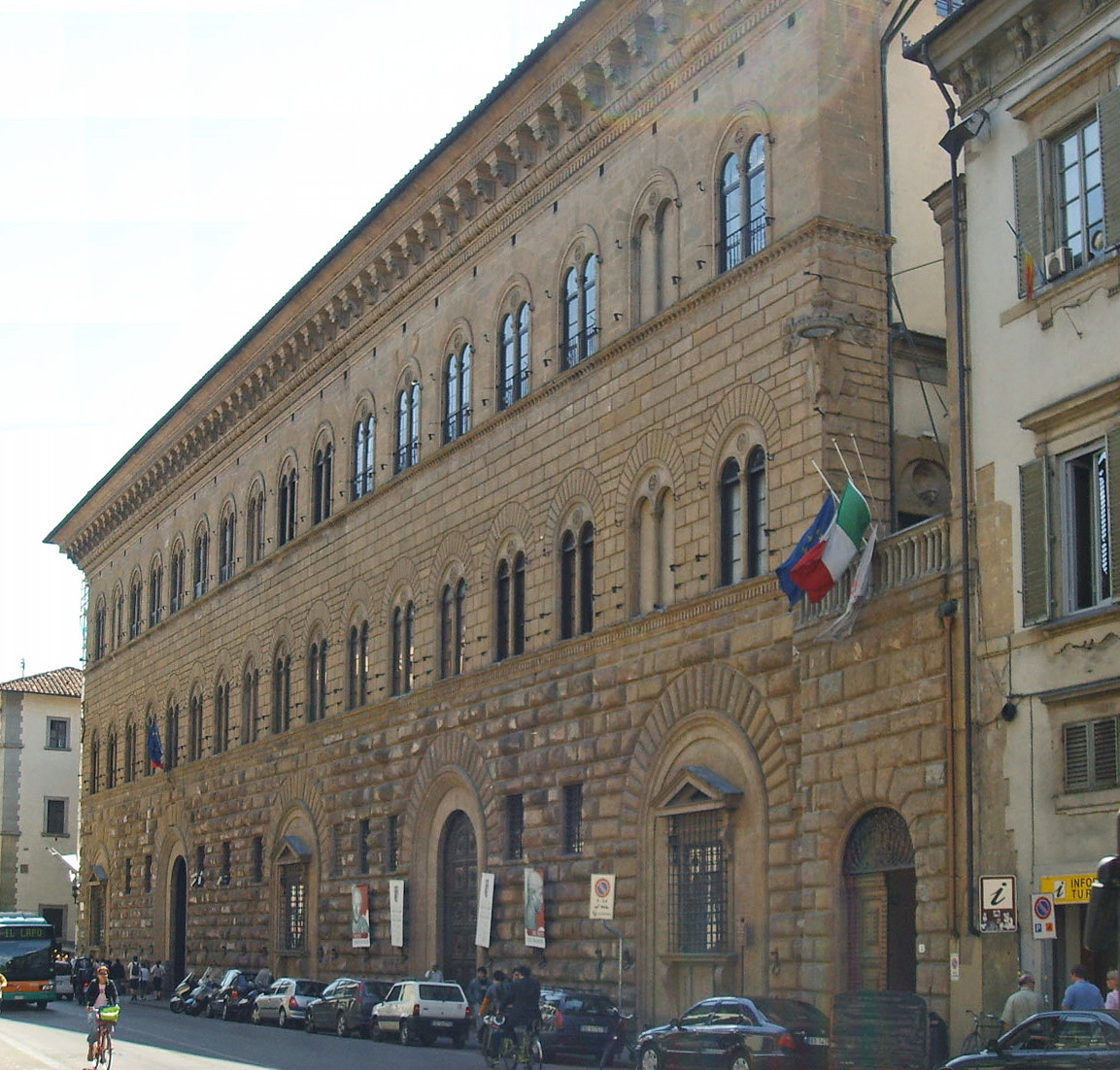
Palazzo Medici Riccardi
43.7753° N · 11.2560° E · Museum
Photo: Sailko · CC BY-SA 3.0 · Wikimedia Commons
Palazzo Medici Riccardi is a palace and museum in Florence, Italy. Construction began in the 1440s for Cosimo the Elder. The free Lokali audio guide runs 7 minutes.
✓ Published October 2026 · how we write these guides
Visitor facts
| Lokali audio guide | 7 min · free |
|---|---|
| Type | Museum |
| Location | Florence, Italy |
| Coordinates | 43.7753, 11.2560 |
| Official website | palazzomediciriccardi.it |
| Languages | 50+, in the Lokali app |
The story
Put your hand on the lowest course of stone. It is rough, almost raw, as if the blocks were pulled from the hillside yesterday. Now look up. With each floor the stone grows smoother, until near the roofline it is almost flat. Above that, a heavy cornice throws a deep band of shadow across the street. You are standing outside the house that taught Renaissance Florence how a powerful family should live.
This is Palazzo Medici Riccardi, on what is now Via Cavour. In the fifteenth century this street was called Via Larga, the broad street, one of the widest in the city. Cosimo de' Medici, often called Cosimo the Elder, began building here in the 1440s. He was a banker, not a king. Yet he guided the politics of the Florentine republic for decades. This palace was his home, his office, and his message to the city.
The architect was Michelozzo, a sculptor and builder who worked closely with Cosimo for years. There is a well-known story, told by the sixteenth-century writer Giorgio Vasari, about the choice. Brunelleschi, the man behind the cathedral dome, supposedly offered a far grander design. Cosimo turned it down. He feared that too much splendour would make his fellow citizens jealous. Whether every detail is true, the story fits the building. It is solid and serious — not a fairy-tale castle.
Look again at that stonework. The rough ground floor is called rustication, where the face of each block is left bold and uneven. It makes the base look strong, almost like a fortress. The smoother upper floors feel lighter and more refined. This graded pattern became a model. Many later palaces in Florence and beyond followed it. When you walk the old centre later today, you will start to see this idea again and again.
Now notice the long stone benches along the base of the walls. They were not decoration. People waited here to speak with the family, to ask for favours, or simply to rest in the shade. A palace like this was a public stage. Above you, iron rings and holders are fixed into the stone. They once held torches, banners, and the reins of horses. The street and the house were closely joined.
Here is a detail most visitors miss. On the ground floor, at the corner, there are large windows set on carved brackets. Their shape looks a little like a person kneeling, so they are called kneeling windows. The corner was originally an open loggia, a covered arcade facing the street. Later it was closed in. The design of these windows is traditionally linked to Michelangelo, who as a boy lived in the Medici household.
That household was remarkable. Cosimo's grandson, Lorenzo, known as Lorenzo the Magnificent, grew up in these rooms. Poets, philosophers, and artists gathered around him. Florence in his time was a centre of new ideas about art, learning, and the ancient world. Not every story about those gatherings is certain. But it is clear that this house was close to the heart of the Florentine Renaissance — the great revival of classical art and thought.
Step through the entrance into the courtyard. The noise of the traffic drops away. Slender columns carry round arches on all four sides, and the light falls softly from above. Above the arches runs a band of round stone medallions. Several of them copy designs from ancient carved gems and cameos that the Medici collected. For many years Donatello's bronze statue of David stood in this courtyard. Today that sculpture is in the Bargello museum, a short walk away.
Pass through to the garden behind. It is a small, quiet space, with gravel paths, citrus trees in pots, and sculpture along the walls. After the hard stone of the street, the green feels like a surprise. Pause for a moment and listen. You may hear birds, footsteps on gravel, and the faint sound of the city beyond the walls. For the family, this garden was a private room open to the sky.
Upstairs is the treasure of the palace — the Chapel of the Magi. It is a small room, and every wall is covered with colour. The painter Benozzo Gozzoli created these frescoes around the middle of the fifteenth century. They show the three wise men travelling to Bethlehem. But the landscape looks like the Tuscan hills, and the riders wear rich Florentine clothing. Gold, deep blue, and red shine in the low light.
Scholars generally agree that the procession includes portraits of the Medici and their circle. Look for riders in the crowd who seem to turn and look straight out at you. One of them is widely believed to be Gozzoli himself, with his name written on his red cap. The exact identity of each figure is still debated. But the idea is clear. The family placed themselves inside a holy story, on the walls of their own home.
The palace did not stay with the Medici forever. In the seventeenth century the Riccardi family bought it, which is why both names are joined today. The Riccardi extended the façade along the street and added rooms in the taste of their own time. Their most striking addition is a long gallery with a ceiling painted by the Neapolitan artist Luca Giordano. It shows the Medici family raised into the heavens, among gods and allegories.
The contrast is worth noticing. Downstairs, the fifteenth-century house is calm, measured, and restrained. Upstairs, the seventeenth-century gallery is all movement, mirrors, and gold. Two centuries of taste sit inside one building. Today the palace is not only a museum. It is also home to offices of the local government of the Florence area. So, as in the time of Cosimo, power still works behind these walls.
When you step back out onto Via Cavour, turn around once more. Follow the stone from rough to smooth, up to the shadow of the cornice. Look at the benches, where people have waited for more than five centuries. Then look down the street toward the cathedral dome. The Medici could see it from here. As you walk away, notice how many palaces nearby seem to carry an echo of this one.
Key facts
What to look for
Practical tips
Common questions
Is there a free audio guide to Palazzo Medici Riccardi?
Yes — the Lokali app narrates Palazzo Medici Riccardi free of charge in 50+ languages. The guide runs about 7 minutes, covers the history, what to look for on site and practical tips, and works offline once downloaded.
Where is Palazzo Medici Riccardi?
Palazzo Medici Riccardi is in Florence, Italy, at 43.7753, 11.2560. Tap the map link on this page for directions from where you are.
What is Palazzo Medici Riccardi known for?
Construction began in the 1440s for Cosimo the Elder. Designed by the architect and sculptor Michelozzo.
What should you look for at Palazzo Medici Riccardi?
Stonework growing smoother from ground floor to top. Kneeling windows at the corner of the ground floor. Stone benches running along the base of the façade.
What should you know before visiting Palazzo Medici Riccardi?
Book the Magi Chapel ahead; visitor numbers in the room are limited. Stand across Via Cavour to see the full façade.
When is the best time to visit Palazzo Medici Riccardi?
Visit early to enjoy the courtyard before larger groups arrive.
On the map
Opens directions to Palazzo Medici Riccardi from your location.
More to see in Florence


Hear Palazzo Medici Riccardi in your language
The full story, narrated, in 50+ languages. Download it before you go and it plays offline, at your own pace, with no ticket and no tour group.