
Mastabat al-Fir'aun
29.8389° N · 31.2153° E · Archaeological Site
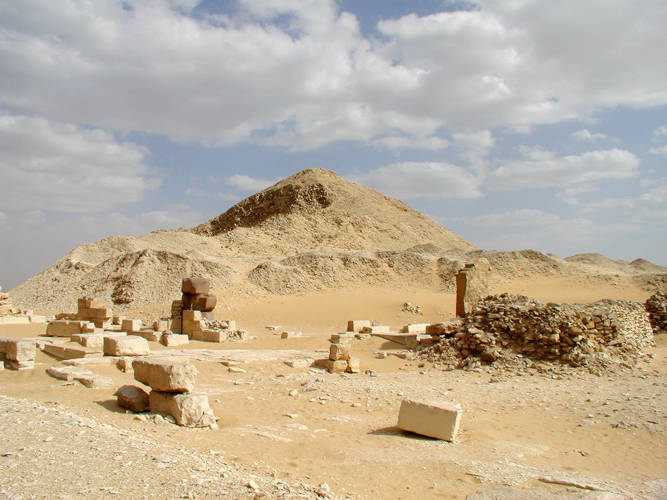
Photo: Jon Bodsworth · Copyrighted free use · Wikimedia Commons
Mastabat al-Fir'aun is an ancient Egyptian mastaba tomb. It is in Giza, Egypt. Built for Shepseskaf, last king of the Fourth Dynasty. The free Lokali audio guide runs 7 minutes.
✓ Published October 2026 · how we write these guides
Visitor facts
| Lokali audio guide | 7 min · free |
|---|---|
| Type | Archaeological Site |
| Location | Giza, Egypt |
| Coordinates | 29.8389, 31.2153 |
| Languages | 50+, in the Lokali app |
The story
Out here, the wind carries fine sand across the plateau. It ticks softly against stone and settles in the cracks between huge grey blocks. There are no tour-bus crowds and no row of camels. You hear the desert, maybe a distant dog, and your own footsteps on loose gravel. In front of you sits a long, low mass of limestone. It is shaped less like a pyramid and more like an enormous stone box... or a coffin lying on the sand.
This is Mastabat al-Fir'aun. In Arabic the name means "the Bench of the Pharaoh." The word mastaba is the everyday Arabic word for the mud-brick bench outside a village house. When early local diggers and travellers saw these flat-topped tombs, the comparison came naturally. It is a humble name for a royal monument. You are in South Saqqara, inside Giza Governorate, a short drive south of the famous Giza pyramids.
This tomb belonged to a king named Shepseskaf. He ruled at the very end of the Fourth Dynasty. That was the great age of pyramid building, the period of Khufu, Khafre and Menkaure. Shepseskaf was most likely Menkaure's son, and he completed his father's monuments at Giza. Then he did something surprising. When the time came to build his own tomb, he did not build a pyramid at all.
Think about how strange that choice must have looked. For generations, kings had raised larger and larger pyramids. The pyramid shape was closely linked to the sun and to the king's journey into the sky. Shepseskaf turned away from that tradition. Instead, he built this rectangular structure with sloping walls and a rounded, vaulted top. Egyptologists often describe it as a giant sarcophagus, the stone coffin of a king, made large enough to read from far away.
Why did he do it? Nobody knows for certain, and that uncertainty is part of the fascination here. One theory points to religion. Several kings before him carried the name of the sun god Ra inside their own names. Shepseskaf's name does not. Some scholars suggest that he wanted some distance from the powerful priests of the sun cult. Other scholars prefer a simpler answer — a short reign, and less time and money for a full pyramid.
There is also a third idea. The shape of this tomb looks a lot like very old shrines from Lower Egypt, especially from the ancient town of Buto in the Nile Delta. Those shrines had a similar curved roof. If that theory is right, Shepseskaf may have looked backwards, not forwards. He may have chosen a form that felt ancient and sacred to Egyptians even in his own time.
Now look at the building itself. The core is made of large local limestone blocks, laid in rough steps. Originally, a smooth outer casing covered all of this. Fine white limestone formed most of the facing. Red granite lined the lowest course, at the base. Over the centuries, stone robbers took much of that casing for other buildings. What you see today is mostly the rough inner body, the skeleton of the tomb.
Here is a detail many visitors miss. Under the ground, the plan is close to a pyramid's plan. A sloping corridor runs down into the bedrock. It leads to an antechamber, a burial chamber, and small storage rooms. Granite lines parts of these spaces. The layout is similar to the inner rooms of Menkaure's pyramid at Giza. So the outside looks completely new, but the inside follows the family tradition. Shepseskaf changed the shape, but not the deeper plan.
As with a pyramid, the tomb did not stand alone. On the east side there was a mortuary temple, where priests made offerings for the dead king. A long causeway connected it with the edge of the valley. Today these parts survive only as low traces in the sand. A mud-brick enclosure wall once surrounded the whole complex. Try to imagine it complete: white walls, a dark granite base, and a long processional path from the green fields to the desert.
The modern story of the tomb begins in the nineteenth century. The French archaeologist Auguste Mariette explored it, but he did not identify its owner correctly. In the 1920s, the Swiss Egyptologist Gustave Jéquier excavated it carefully. He found inscribed fragments that carried Shepseskaf's name. That evidence finally connected the monument with the king. It is a good reminder that one small fragment of text can solve a mystery that very large stones cannot.
Here is the second surprise. Shepseskaf's unusual tomb shape has a close relative at Giza. The tomb of Queen Khentkaus the First, near the Giza pyramids, has a similar sarcophagus-like form. She was an important royal woman at the end of the same dynasty. The link suggests that this design was not simply one king's experiment. It was part of a short moment when the royal family tried something different.
The experiment did not last. The kings of the Fifth Dynasty returned to pyramids, though they built smaller ones. They also built large sun temples. Turn around and look across the plateau. On a clear day you can see other pyramids on the horizon, including the stepped and bent shapes of Saqqara and Dahshur. From this low bench of stone, you can see Egypt's long history of royal tombs in a single wide view.
Before you leave, stand still for a moment. Feel the heat coming up from the stone, or the cool shadow on its western side late in the day. Notice how quiet it is, compared with the crowds at Giza. Look again at the long, sloping walls and the rough blocks. A king chose this shape more than four thousand years ago, and we still do not know exactly why. As you walk back across the sand, the shape will become low and soft on the horizon, almost like a bench resting in the desert.
Key facts
What to look for
Practical tips
Common questions
Is there a free audio guide to Mastabat al-Fir'aun?
Yes — the Lokali app narrates Mastabat al-Fir'aun free of charge in 50+ languages. The guide runs about 7 minutes, covers the history, what to look for on site and practical tips, and works offline once downloaded.
Where is Mastabat al-Fir'aun?
Mastabat al-Fir'aun is in Giza, Egypt, at 29.8389, 31.2153. Tap the map link on this page for directions from where you are.
What is Mastabat al-Fir'aun known for?
Built for Shepseskaf, last king of the Fourth Dynasty. Name means "Bench of the Pharaoh" in Arabic.
What should you look for at Mastabat al-Fir'aun?
Rough stepped core blocks where the casing was removed. Traces of red granite at the base. The rounded, vault-like line along the top.
What should you know before visiting Mastabat al-Fir'aun?
Combine your visit with the nearby pyramids of South Saqqara. Bring water and sun protection for the open desert.
When is the best time to visit Mastabat al-Fir'aun?
Visit late afternoon for softer light on the stone.
On the map
Opens directions to Mastabat al-Fir'aun from your location.
More to see in Giza


Hear Mastabat al-Fir'aun in your language
The full story, narrated, in 50+ languages. Download it before you go and it plays offline, at your own pace, with no ticket and no tour group.