
Pyramid of Khendjer
29.8324° N · 31.2238° E · Archaeological Site
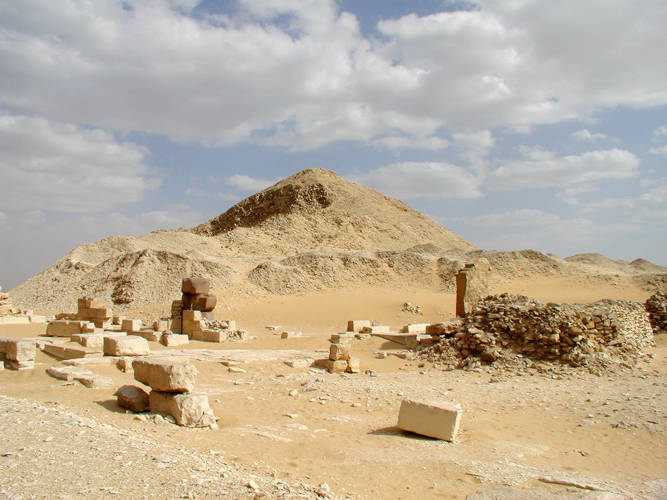
Photo: MONNIER Franck (monnierfranck@hotmail.com) · CC BY 2.5 · Wikimedia Commons
Pyramid of Khendjer is a smooth-sided pyramid. It is near Saqqara, Egypt. Built for Khendjer, a Thirteenth Dynasty Middle Kingdom king. The free Lokali audio guide runs 6 minutes.
✓ Published October 2026 · how we write these guides
Visitor facts
| Lokali audio guide | 6 min · free |
|---|---|
| Type | Archaeological Site |
| Location | Saqqara, Egypt |
| Coordinates | 29.8324, 31.2238 |
| Languages | 50+, in the Lokali app |
The story
Listen first. Out here in South Saqqara, the wind carries fine grit across the ground, and it ticks softly against stone and broken brick. There are no crowds, no vendors calling. Under your feet the desert is a mix of pale sand and dark crumbs of ancient mud. In front of you rises a low, weathered mound. It does not look like the pyramids on postcards. But it is a royal tomb, and a king meant to rest inside it forever.
This is the Pyramid of Khendjer. It belongs to a king of the Thirteenth Dynasty, a period in the Middle Kingdom, around the eighteenth century before Christ. That is many centuries after the great pyramids of Giza were built. By this time Egypt still buried its kings in pyramids, but the age of giant stone mountains had passed. Royal builders now worked with a different recipe. They built faster, and they built cheaper.
That recipe is the first thing to notice. The core of this pyramid was made mostly of mudbrick, not solid stone. Once, a smooth casing of fine white limestone covered the outside. It would have shone in the sun across the plateau. Over the centuries, people took that limestone away to use in other buildings. Without its outer shell, the mudbrick slowly slumped and eroded. What you see now is the core, softened by wind and time.
So who was Khendjer? Honestly, we know very little about him. The Thirteenth Dynasty had many kings, and many of them ruled for only a few years. Khendjer appears to be one of the better documented among them. His name appears on a stela, an inscribed stone slab, from Abydos, a sacred city in southern Egypt. That text links his reign to work on the temple of Osiris, the god of the dead.
Here is a detail that surprises many visitors. The name Khendjer does not sound Egyptian. Some scholars have suggested that it comes from a foreign language, possibly a Semitic one from the lands to the northeast. If that idea is correct, it may hint that people with foreign roots could rise to the throne in this period. But this is a theory, not a settled fact. Egyptologists still debate it, and the evidence is thin.
The site was excavated in the late 1920s by the Swiss archaeologist Gustave Jéquier. He spent years working in this southern part of Saqqara. When he cleared the area, he found more than a ruined mound. He found the outlines of a full pyramid complex. There were enclosure walls, the remains of a chapel on the eastern side, and the traces of a temple where priests once made offerings to the dead king.
His most remarkable find was the pyramidion. A pyramidion is the capstone, the small pointed stone that sat at the very top of a pyramid. Khendjer's capstone was carved from dark granite and covered with inscriptions. Jéquier found it in pieces, and it was later reassembled. Today it is in a museum in Cairo, not here. Picture that black point once sitting high above you, catching the first light of morning.
Now think about what lies beneath the mound. Below the pyramid, builders cut a system of corridors and chambers. The burial chamber itself was carved from a huge block of hard quartzite, a dense, reddish stone. Middle Kingdom architects were obsessed with stopping tomb robbers. They used heavy stone blocks that could slide into place and seal the passages. They added stairways, turns, and dead ends to confuse intruders.
Did it work? Like nearly every royal tomb in Egypt, this one was eventually robbed. Thieves in ancient times found their way in, despite the stone barriers. It is a quiet lesson that repeats across this desert. Kings spent enormous effort to protect their bodies and treasures. Yet patient, determined robbers usually got there first, sometimes within a generation of the burial.
Look around the edges of the site. Inside the enclosure, archaeologists also found a second, much smaller pyramid. It was probably built for a queen or a royal woman, though her identity is not certain. This pattern of a main pyramid with smaller companions was common in royal burials. It reminds us that a king's tomb was rarely about one person alone. Family, priests, and servants all had a place in this world.
Now lift your eyes to the wider landscape. South Saqqara is a crowded neighbourhood of the dead. Nearby stands the massive stone tomb known as the Mastabat Faraun, built for a much earlier king, Shepseskaf. To the south, on the horizon, you may see the pyramids of Dahshur, including the Bent Pyramid with its strange change of angle. Kings chose this ground again and again across many centuries.
Why here? The desert edge kept tombs dry and away from the floodwaters of the Nile. It also sat close to Memphis, the old royal capital, which lay in the green valley to the east. Turn toward the east and you may see the line where sand meets palm trees and fields. That sharp boundary between life and death shaped how Egyptians thought about the afterlife.
Before you leave, stand still for a moment. Feel the heat rising from the ground, or the cool air if the sun is low. This modest mound once held the body of a king whose name almost vanished. A few stones, a broken capstone, and a line of text keep his memory alive. As you walk away, look back once. Notice how the brick catches the light... and how the desert slowly reclaims its shape.
Key facts
What to look for
Practical tips
Common questions
Is there a free audio guide to Pyramid of Khendjer?
Yes — the Lokali app narrates Pyramid of Khendjer free of charge in 50+ languages. The guide runs about 6 minutes, covers the history, what to look for on site and practical tips, and works offline once downloaded.
Where is Pyramid of Khendjer?
Pyramid of Khendjer is near Saqqara, Egypt, at 29.8324, 31.2238. Tap the map link on this page for directions from where you are.
What is Pyramid of Khendjer known for?
Built for Khendjer, a Thirteenth Dynasty Middle Kingdom king. Core built mostly of mudbrick, once cased in limestone.
What should you look for at Pyramid of Khendjer?
Dark mudbrick layers exposed where limestone casing was stripped. Traces of the enclosure walls around the main mound. The smaller companion pyramid inside the enclosure.
What should you know before visiting Pyramid of Khendjer?
Confirm site access in advance; South Saqqara is often restricted. Bring a hat and water; there is almost no shade.
When is the best time to visit Pyramid of Khendjer?
Visit early morning when light is soft and air cooler.
On the map
Opens directions to Pyramid of Khendjer from your location.
More to see in Saqqara



Hear Pyramid of Khendjer in your language
The full story, narrated, in 50+ languages. Download it before you go and it plays offline, at your own pace, with no ticket and no tour group.