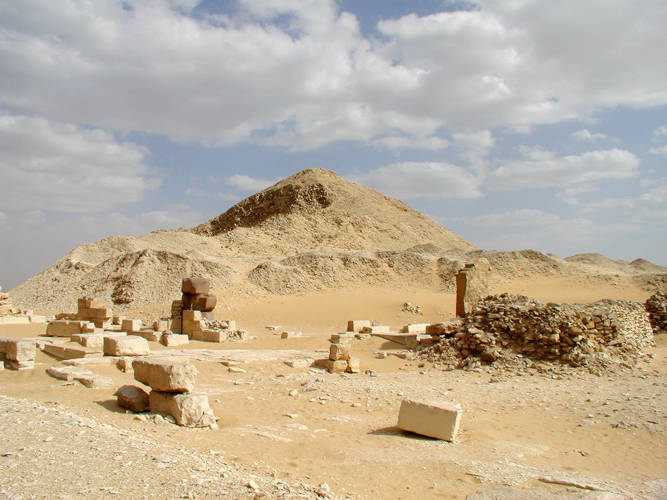
Pyramid of Pepi II
29.8403° N · 31.2133° E · Archaeological Site
Photo: Jon Bodsworth · Copyrighted free use · Wikimedia Commons
Pyramid of Pepi II is a smooth-sided pyramid. It is near Saqqara, Egypt. Pepi II ruled during Egypt's Sixth Dynasty. The free Lokali audio guide runs 7 minutes.
✓ Published October 2026 · how we write these guides
Visitor facts
| Lokali audio guide | 7 min · free |
|---|---|
| Type | Archaeological Site |
| Location | Saqqara, Egypt |
| Coordinates | 29.8403, 31.2133 |
| Languages | 50+, in the Lokali app |
The story
Listen for a moment. Out here in South Saqqara, the wind carries fine sand across the plateau. It ticks softly against stone and fills the gaps between fallen blocks. Underfoot, the ground is a mix of grit, broken limestone and pale desert dust. Ahead of you rises a low, weathered mound. It looks more like a hill than a monument. Yet this is a royal pyramid, and it marks the end of an age.
This is the Pyramid of Pepi II, a king of Egypt's Sixth Dynasty. He ruled near the close of the period historians call the Old Kingdom, the great age of pyramid building. The famous giants at Giza had stood for centuries by the time his builders arrived here. Pepi's pyramid is often described as the last major pyramid of that era. After it, the long tradition of royal pyramid complexes paused for generations.
Pepi II is remembered for one remarkable claim — the length of his reign. Ancient tradition, recorded much later by the Egyptian priest Manetho, says he came to the throne as a small child. The same tradition gives him a reign of more than ninety years. Many modern scholars doubt that figure. Some suggest a shorter reign of around sixty years. Either way, he probably ruled for longer than almost any other pharaoh.
Here is the first surprise. We have a letter written by this king when he was a boy. A royal official named Harkhuf led expeditions far to the south, beyond Egypt's borders. On one trip he reported that he was bringing back a dancing dwarf. The young king replied with great excitement. He told Harkhuf to guard the dwarf carefully, day and night. Harkhuf was so proud that he had the letter carved on his tomb, near modern Aswan.
Now look at the pyramid itself. It was once a smooth, bright structure, roughly fifty metres high. Its core was built from smaller local stone. Over that core, the builders laid a casing of fine white limestone, polished to a clean finish. Later generations took most of that casing away for their own buildings. What remains is the rough inner body. That is why the shape now looks soft and slumped against the sky.
As you study the base, look for a second surprise. At some point, builders added an extra band of masonry around the lower part of the pyramid. Archaeologists often call it a girdle. Nobody knows for certain why it was added. One idea is that the pyramid needed support after damage or settling. Another is that the change was part of a later building phase. It is an unusual feature, and most visitors walk past without noticing it.
The real treasure of this pyramid lies inside, deep underground. The walls of the burial chamber carry the Pyramid Texts. These are columns of carved hieroglyphs, the oldest large body of religious writing known from Egypt. They are spells and prayers meant to help the king rise to the sky and join the gods. The ceiling of the burial chamber was decorated with rows of stars. The dead king would lie beneath a carved night sky forever.
The Pyramid Texts were first recognised by modern scholars in the late nineteenth century. The French Egyptologist Gaston Maspero worked on these Saqqara pyramids in the early 1880s. Later, in the 1920s and 1930s, the Swiss archaeologist Gustave Jéquier excavated this whole complex in great detail. His careful work recorded the temples, the walls and the smaller pyramids around the king's tomb. Much of what we know about this site comes from his reports.
A pyramid was never just one building. It sat at the heart of a whole complex. On the east side stood a mortuary temple, where priests made offerings for the dead king. Its walls once carried fine painted reliefs of the king, his officials and the gods. A long causeway ran down toward a valley temple near the edge of the cultivated land. There was also a small satellite pyramid, a ritual structure linked to the king's spirit.
Pepi's queens were buried close by, each in her own small pyramid. Their names included Neith and Iput. What makes these tombs special is their writing. The queens' burial chambers also carried Pyramid Texts. Before this time, such texts appear only in the tombs of kings. Here, royal women received the same sacred words. It is a quiet detail, but it shows a shift in who could share the king's path to eternity.
The king also lives on in story. A later Egyptian tale tells of a king named Neferkare, which was Pepi II's throne name. In the tale, the king slips out of his palace at night to secretly visit a general. Scholars treat this as literature, not history. It was written long after Pepi's death, and its purpose is still debated. Still, it shows that later Egyptians remembered this long reign and wove stories around it.
After Pepi II, central power in Egypt weakened. The country entered a period of division that historians call the First Intermediate Period. Local rulers gained strength, and royal building on this scale slowed. Many reasons are proposed, from political strain to changes in climate and the Nile floods. No single cause is certain. But standing here, you are looking at the last great statement of a confident old order, before the long pause.
Take a slow look around you now. To the north, other pyramids and tombs dot the horizon across the Saqqara plateau. On a clear day, distant shapes rise above the sand in the hazy light. The desert edge is close. Behind you lies the green line of the Nile valley. That contrast mattered to the builders. The living farmed the green land. The dead rested in the dry, bright desert.
Before you walk away, look once more at the rough slope of the pyramid. Notice how the light falls across the broken stone, and how the sand gathers in its folds. A child king once wrote here about a dancing dwarf. An old king was laid beneath a ceiling of carved stars. The wind is still moving across the plateau. Listen to it for a few seconds as you turn back toward the road.
Key facts
What to look for
Practical tips
Common questions
Is there a free audio guide to Pyramid of Pepi II?
Yes — the Lokali app narrates Pyramid of Pepi II free of charge in 50+ languages. The guide runs about 7 minutes, covers the history, what to look for on site and practical tips, and works offline once downloaded.
Where is Pyramid of Pepi II?
Pyramid of Pepi II is near Saqqara, Egypt, at 29.8403, 31.2133. Tap the map link on this page for directions from where you are.
What is Pyramid of Pepi II known for?
Pepi II ruled during Egypt's Sixth Dynasty. Often called the last major Old Kingdom pyramid.
What should you look for at Pyramid of Pepi II?
The extra band of masonry around the pyramid's base. Exposed rough core where the white casing was removed. Remains of the mortuary temple on the east side.
What should you know before visiting Pyramid of Pepi II?
Combine this visit with other South Saqqara pyramids nearby. Bring water and sun protection for open desert ground.
When is the best time to visit Pyramid of Pepi II?
Visit early morning for softer light and cooler air.
On the map
Opens directions to Pyramid of Pepi II from your location.
More to see in Saqqara


Hear Pyramid of Pepi II in your language
The full story, narrated, in 50+ languages. Download it before you go and it plays offline, at your own pace, with no ticket and no tour group.