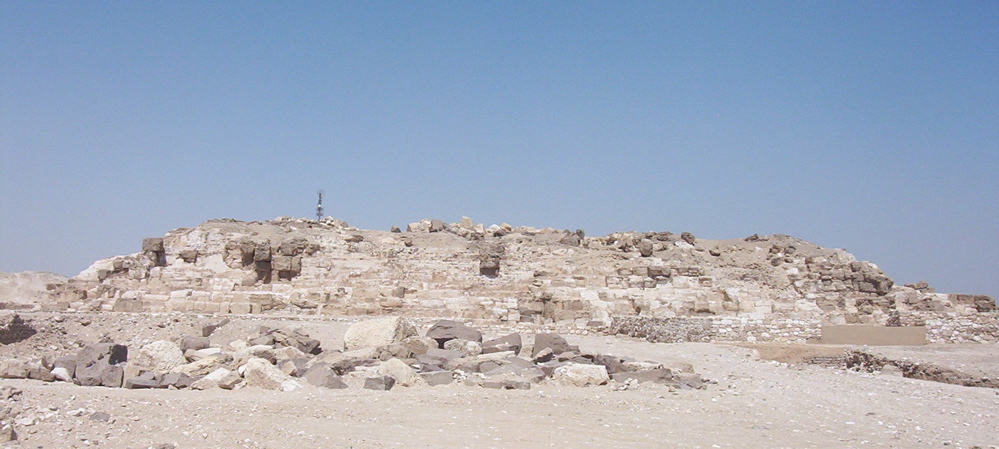
Pyramid of Djedefre
30.0322° N · 31.0747° E · Archaeological Site
Photo: No machine-readable author provided. AhlyMan assumed (based on copyright claims). · Public domain · Wikimedia Commons
Pyramid of Djedefre is a smooth-sided pyramid. It is in Giza, Egypt. Djedefre was a son and successor of Khufu. The free Lokali audio guide runs 7 minutes.
✓ Published October 2026 · how we write these guides
Visitor facts
| Lokali audio guide | 7 min · free |
|---|---|
| Type | Archaeological Site |
| Location | Giza, Egypt |
| Coordinates | 30.0322, 31.0747 |
| Languages | 50+, in the Lokali app |
The story
Listen to the wind up here. It comes off the open desert with nothing to stop it, and it carries fine sand that ticks against your sleeves. Underfoot, the ground is a mix of loose grit and broken limestone chips. To the south, on a clear day, a faint triangle sits on the horizon. That is Giza. You are standing on higher ground than those famous pyramids, at a place called Abu Rawash.
This ruined mound is the Pyramid of Djedefre. It lies roughly eight kilometres north of the Giza plateau, and it is the northernmost pyramid of the great royal cemeteries around ancient Memphis. Many visitors to Egypt never hear of it. Fewer still make the drive out here. So take a moment to enjoy that. You may have this whole hilltop almost to yourself.
Who was Djedefre? He was a son of Khufu, the king who built the Great Pyramid. When Khufu died, Djedefre took the throne. This was the Fourth Dynasty, the age of the largest pyramids ever raised in Egypt, more than four and a half thousand years ago. His reign appears to have been short. After him, power passed to his brother Khafre, the king whose pyramid stands beside his father's at Giza.
The name itself carries a clue. Djedefre contains the word Ra, the sun god. Earlier kings did not place Ra inside their names in this way. Djedefre is also linked by many Egyptologists to the early use of the royal title Son of Ra. That title would become a standard part of a pharaoh's name for the next two thousand years. Something about how kings saw themselves was changing during his time.
Now look at the shape in front of you. It does not look much like a pyramid anymore. What remains is a low, rough core. The builders made clever use of the landscape. They set the pyramid over a natural outcrop of rock. That rock forms part of the core, so less stone had to be cut and hauled. It also lifted the monument high above the Nile valley, where it could be seen from far away.
Here is the first surprise. For a long time, people assumed this pyramid was never finished. It looked too small, too broken, too empty. Then a French and Swiss archaeological team began new excavations here in the mid-1990s. Their work suggested a different story. The evidence pointed to a completed monument, with a temple, an enclosure, and a causeway. The pyramid did not fail. It was taken apart.
And it was taken apart over many centuries. From Roman times onward, and right into the modern era, people came here for ready-cut stone. Fine limestone and granite were carried away to build houses, walls, and other structures in the region. Travellers in the nineteenth century reported stone still being removed from the site. What you see today is what was left after people quarried it for centuries.
Walk toward the great cut in the rock. This is one of the most striking features of the site. A wide, deep trench runs down into the bedrock. It is open to the sky. Normally, a pyramid's burial chamber and its descending passage are hidden deep inside the stone mass. Here, because the upper structure is gone, you can look straight into the heart of the monument. You are seeing the plan of a royal tomb from above.
Look carefully at the stones lying near the base. Some are not pale limestone at all. They are red granite, speckled and hard. Granite does not occur here. It came from Aswan, far to the south, and travelled down the Nile by boat. The builders used it to clad the lower part of the pyramid. Even a few broken blocks give you a sense of how costly and impressive the finished surface once was.
The second surprise lies in what the excavators found in the rubble. Archaeologists recovered many fragments of royal statues here. Most were smashed into pieces. Among the finest survivors is a head of Djedefre carved in quartzite, which is now in the Louvre in Paris. Fragments from Abu Rawash also include an early sphinx. Some scholars think this sphinx portrayed a royal woman, possibly a queen of Djedefre. If so, it ranks among the oldest sphinxes known.
Why were the statues broken? For many years, some writers imagined a family feud. In that version, angry relatives destroyed Djedefre's images after his death. It is a dramatic story, but there is little firm evidence for it. Many researchers now think the damage came much later, from the same stone robbers and lime burners who stripped the pyramid. Treat the tale of a royal grudge as speculation, not history.
Turn and look around the edges of the site. Beyond the main pyramid, the ground holds traces of other structures. Archaeologists found a boat pit cut into the rock near the pyramid, a feature shared with other royal tombs of this period. Below the hill, the green line of fields marks the edge of the Nile valley. The contrast is sharp. On one side, farmland and the village of Abu Rawash. On the other, only stone and sand.
It is worth thinking about the view the builders chose. From this height, the pyramid would have been visible across the plain, gleaming with fine stone. It looked south toward his father's monument at Giza. Whatever Djedefre intended, he placed his tomb apart from Khufu, on a hill of its own. His brother returned to Giza. That choice left this hilltop as the resting place of a single king.
Before you leave, stand still for a moment at the rim of the trench. Feel the heat rising from the rock, and listen again to the wind. The polished casing has gone, the statues lie in museums, and the stone is scattered across villages. Yet the shape of the tomb is still cut into the hill beneath your feet. As you walk back down, glance south once more toward that faint triangle on the horizon.
Key facts
What to look for
Practical tips
Common questions
Is there a free audio guide to Pyramid of Djedefre?
Yes — the Lokali app narrates Pyramid of Djedefre free of charge in 50+ languages. The guide runs about 7 minutes, covers the history, what to look for on site and practical tips, and works offline once downloaded.
Where is Pyramid of Djedefre?
Pyramid of Djedefre is in Giza, Egypt, at 30.0322, 31.0747. Tap the map link on this page for directions from where you are.
What is Pyramid of Djedefre known for?
Djedefre was a son and successor of Khufu. Built during Egypt's Fourth Dynasty, over 4,500 years ago.
What should you look for at Pyramid of Djedefre?
The deep open trench cut into the bedrock. Scattered red granite blocks among the pale limestone. Natural rock outcrop forming part of the pyramid's core.
What should you know before visiting Pyramid of Djedefre?
Hire a driver; few organised tours stop at Abu Rawash. Bring plenty of water; there is little shade on site.
When is the best time to visit Pyramid of Djedefre?
Visit early morning to avoid the strongest desert heat.
On the map
Opens directions to Pyramid of Djedefre from your location.
More to see in Giza


Hear Pyramid of Djedefre in your language
The full story, narrated, in 50+ languages. Download it before you go and it plays offline, at your own pace, with no ticket and no tour group.