
Pyramid of Unas
29.8683° N · 31.2147° E · Archaeological Site
Photo: User:Roweromaniak · CC BY-SA 2.5 pl · Wikimedia Commons
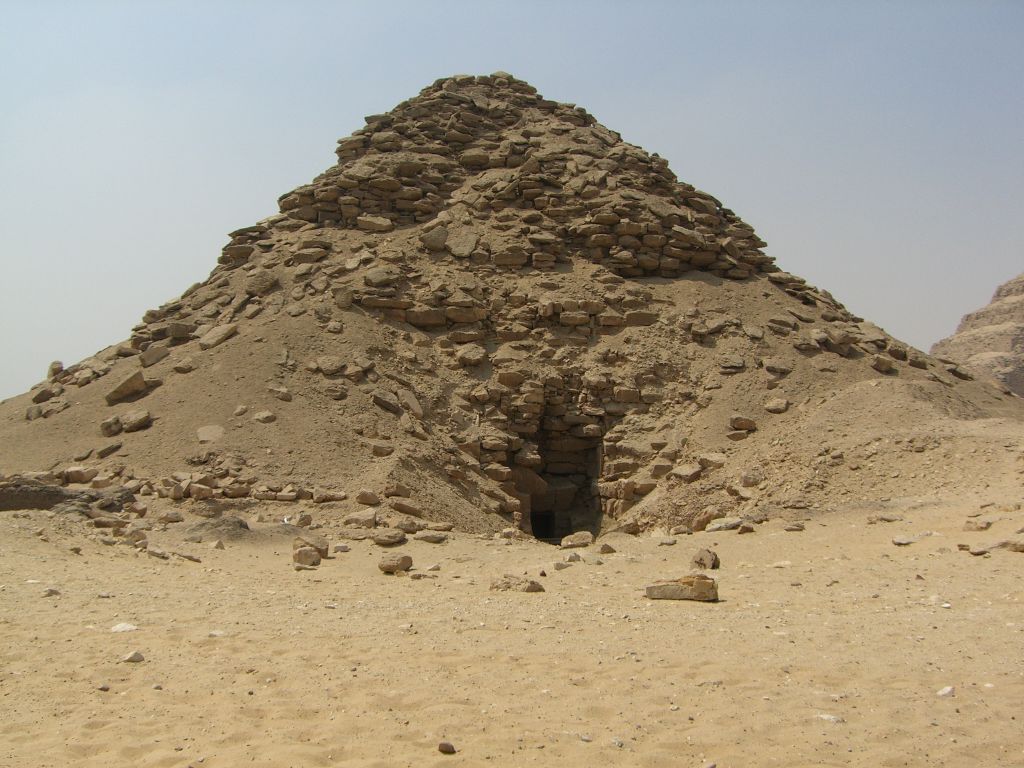
Pyramid of Unas is a smooth-sided pyramid. It is in Giza, Egypt. Unas was the last king of the Fifth Dynasty. The free Lokali audio guide runs 7 minutes.
✓ Published October 2026 · how we write these guides
Visitor facts
| Lokali audio guide | 7 min · free |
|---|---|
| Type | Archaeological Site |
| Location | Giza, Egypt |
| Coordinates | 29.8683, 31.2147 |
| Languages | 50+, in the Lokali app |
The story
Your shoes press into loose sand and broken limestone. The wind carries fine grit that settles on your lips. In front of you rises something that hardly looks like a pyramid at all. It is a low, slumped hill of rubble. Yet inside this modest mound is one of the most important rooms in the ancient world.
First, a word about where you are. This is not the Giza plateau with its three great pyramids. You are at Saqqara, the ancient burial ground of Memphis, south of Giza and within the wider Giza region. The Step Pyramid of Djoser stands close by, just to the north-east. The Pyramid of Unas sits near the south-west corner of Djoser's great enclosure, as if it chose to stay close to that older giant.
Unas was the last king of the Fifth Dynasty. He ruled in the twenty-fourth century BCE, more than four thousand years ago. Egypt was still in the Old Kingdom, the age of pyramid building. By his time, though, the great building projects had become smaller. His pyramid is the smallest royal pyramid of the Old Kingdom. When it was new, it probably stood a little over forty metres tall.
It did not always look like this. The core was built from local limestone blocks, rough and uneven. Over that core, builders laid a smooth casing of fine white limestone. Over the centuries, people took most of that casing away to reuse in other buildings. What you see now is mostly the core, worn down by time. Look at the base, though. In some places, a few casing blocks still sit in their original positions.
Here is the first surprise. On the south face, there is an inscription that is much younger than the pyramid. It was carved for Khaemwaset, a son of the pharaoh Ramesses the Second. He lived more than a thousand years after Unas. Khaemwaset took a deep interest in the monuments of the past. He restored old tombs and recorded the names of their owners. Some people call him the first Egyptologist. To him, this pyramid was already ancient.
Now to the reason people come here. Before Unas, the burial chambers of pyramids had plain walls. Unas changed that. His burial rooms are covered in carved hieroglyphs, column after column, from floor to ceiling. These are the Pyramid Texts. They are the oldest known large collection of religious writing from Egypt. They are also among the oldest religious texts anywhere in the world.
What do the texts say? They are spells and recitations to help the dead king on his journey after death. They describe him rising to the sky and joining the stars. They show him becoming one with the gods Osiris and Ra. Some spells protect him from snakes and other dangers. One famous passage, known today as the Cannibal Hymn, describes the king eating the power of the gods. It sounds shocking, but its meaning is symbolic. The king takes their strength into himself.
The second surprise is how these texts were found. For a long time, scholars believed that pyramids had no writing inside. In 1881, the French Egyptologist Gaston Maspero entered this pyramid. He saw walls full of inscriptions. It changed the study of Egyptian religion. Later pyramids, built by kings and queens after Unas, also carried Pyramid Texts. But this is where the tradition began.
If the interior is open during your visit, you go down a low, sloping passage. The air becomes still and warm. At the bottom, there is an antechamber and then the burial chamber. The hieroglyphs were filled with a blue-green pigment, and much of that colour remains. The ceiling is painted with five-pointed stars on a dark background. It is a night sky made of stone. At the far end lies the king's dark stone sarcophagus.
Look at the walls near the sarcophagus. They are lined with pale alabaster. Painted patterns there copy the look of woven reed mats and the decorated front of a palace. The idea seems to be that the king rests inside a royal home. The writing ends here. Next to the coffin, the walls show patterns rather than spells. It is a quiet, almost domestic touch inside a monument built for eternity.
Now turn your attention outside again. A pyramid was never only a pyramid. It was part of a complex. On the east side stood a mortuary temple, where priests made offerings for the king. From there, a long covered causeway ran down towards a valley temple near the edge of the cultivated land. Much of the causeway route can still be traced today, running across the sand towards the east.
The walls of that causeway were once carved with scenes. Some fragments survive and are well known. One shows workers moving granite columns on boats from the south. Another shows starving people, their ribs clearly visible. Scholars still discuss what this famine scene means. Some see a real hunger in the land. Others see a scene meant to show the king's power to bring relief. It is one of the most human images from the Old Kingdom.
Near the causeway, you can also see large boat-shaped pits cut into the rock. Boats had deep meaning for the ancient Egyptians, because the sun god travelled across the sky by boat. Around the complex, there are also tombs of officials and family members. In ancient times, people wanted to be buried close to their king, even in death. This ground is crowded with the dead of many centuries.
Before you leave, stand still for a moment and look at the mound again. From the outside, it is easy to walk past. It has no sharp edges and no gleaming stone. But under your feet, in a small room, the oldest words of an ancient faith are still on the walls. Feel the wind and the sand, and look north towards Djoser's steps. Then walk on slowly, with those carved stars in your mind.
Key facts
What to look for
Practical tips
Common questions
Is there a free audio guide to Pyramid of Unas?
Yes — the Lokali app narrates Pyramid of Unas free of charge in 50+ languages. The guide runs about 7 minutes, covers the history, what to look for on site and practical tips, and works offline once downloaded.
Where is Pyramid of Unas?
Pyramid of Unas is in Giza, Egypt, at 29.8683, 31.2147. Tap the map link on this page for directions from where you are.
What is Pyramid of Unas known for?
Unas was the last king of the Fifth Dynasty. Smallest royal pyramid of Egypt's Old Kingdom.
What should you look for at Pyramid of Unas?
Khaemwaset's restoration inscription on the south face. Surviving white casing blocks near the base. Painted stars covering the burial chamber ceiling.
What should you know before visiting Pyramid of Unas?
Check on site whether the interior is open today. Bring water and sun protection for open desert ground.
On the map
Opens directions to Pyramid of Unas from your location.
More to see in Giza



Hear Pyramid of Unas in your language
The full story, narrated, in 50+ languages. Download it before you go and it plays offline, at your own pace, with no ticket and no tour group.