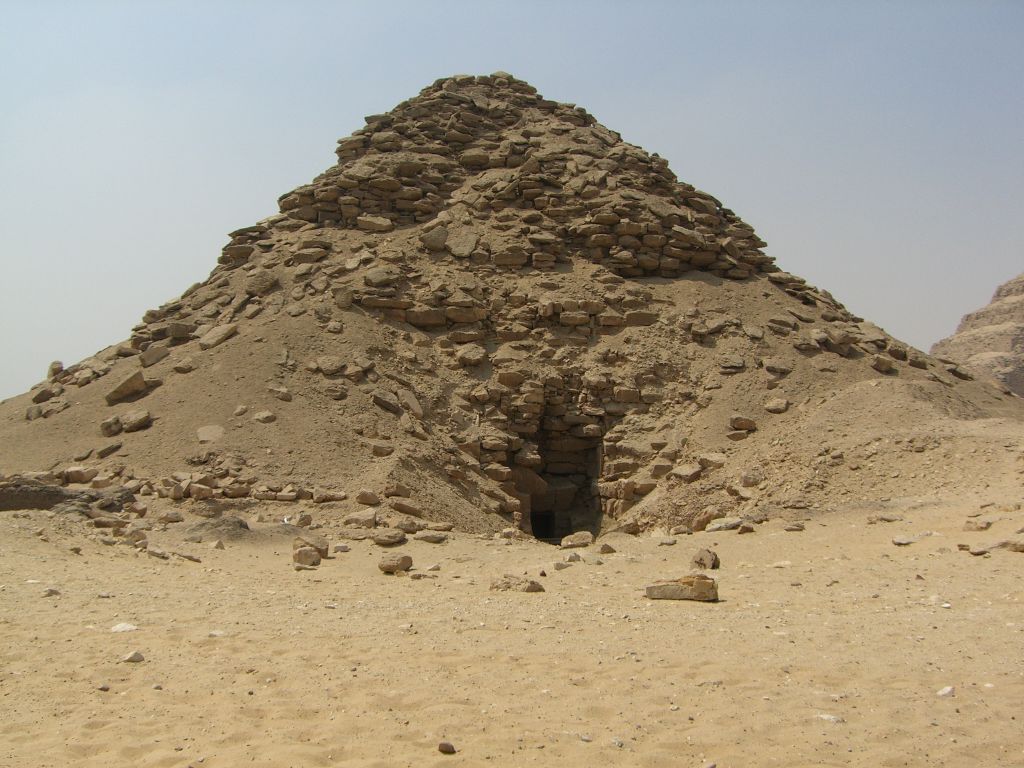
Pyramid of Userkaf
29.8734° N · 31.2189° E · Archaeological Site
Photo: No machine-readable author provided. Neithsabes assumed (based on copyright claims). · Public domain · Wikimedia Commons
Pyramid of Userkaf is a smooth-sided pyramid. It is near Saqqara, Egypt. Userkaf founded Egypt's Fifth Dynasty in the Old Kingdom. The free Lokali audio guide runs 7 minutes.
✓ Published October 2026 · how we write these guides
Visitor facts
| Lokali audio guide | 7 min · free |
|---|---|
| Type | Archaeological Site |
| Location | Saqqara, Egypt |
| Coordinates | 29.8734, 31.2189 |
| Languages | 50+, in the Lokali app |
The story
Listen to the ground under your shoes. It crunches. This is a mix of desert sand, flint chips, and small broken pieces of limestone, the dust of something that was once very large. In front of you rises a rough, slumped hill of pale stone. At first glance it looks more like a quarry heap than a royal tomb. But this mound is a pyramid. It belonged to a king called Userkaf, and it stands only a short walk from the oldest pyramid in Egypt.
Look north and west, and you can see that neighbour. The Step Pyramid of Djoser rises in its six great terraces, a monument already old when Userkaf came to power. His pyramid sits just outside the northeast corner of Djoser's vast enclosure. That placement is the first surprise here. Userkaf chose to build beside the most ancient royal tomb of all, rather than near the giant pyramids of Giza on the horizon to the north.
So who was Userkaf? He founded the Fifth Dynasty, a line of kings who ruled during Egypt's Old Kingdom, in the twenty-fifth century before Christ. The great builders of Giza belonged to the dynasty before him. His exact family links to those kings are still debated by historians. What is clear is that his reign marks a shift. The age of colossal pyramids was ending, and a new focus on the sun god Ra was beginning.
That shift is written into the stones around you. Userkaf's pyramid was smaller than the Giza giants. Its builders used a core of local limestone blocks, rough and often loosely fitted. Over this core they laid a smooth outer casing of fine white limestone, brought from the quarries at Tura, across the Nile. When it was new, the pyramid would have shone in the sun as a clean, sharp-edged shape. That bright skin was its real beauty.
The casing is almost entirely gone. Over many centuries, people took the fine, ready-cut blocks for new buildings. Once the casing was stripped away, the weaker core began to slump and crumble. That is why the pyramid now looks like a ragged hill. Locals have long called it by an Arabic name, el-Haram el-Makharbish, usually translated as the scratched or scrambled pyramid. Look at its broken flanks, and you will see why the name stuck.
Here is a detail that most visitors miss. In nearly every Old Kingdom pyramid complex, the main temple for the king's cult stands on the east side, facing the rising sun. Userkaf broke this pattern. His main mortuary temple was built on the south side of the pyramid instead. A mortuary temple was the place where priests made daily offerings to keep the dead king's spirit fed and honoured. Scholars still debate the reason for this unusual layout.
One idea is simple geography. The ground east of the pyramid may have been too cramped, close to the deep dry moat that surrounds Djoser's complex. Another idea links the south side to the path of the sun across the sky, which fits the king's devotion to Ra. Nobody knows for certain. It is a good reminder that even well-studied monuments still keep some of their reasons hidden.
The temple itself is now mostly foundations and scattered blocks. But it once held fine relief carvings, and fragments of them survive. Excavators also found pieces of royal statues here. The most famous is a large head of the king carved in red granite, far bigger than life. It now sits in the Egyptian Museum in Cairo. Imagine that calm, enormous face looking out over this courtyard. The scale of the statue suggests how grand the temple once felt.
Userkaf's devotion to the sun led to something new. A few kilometres to the north, at Abusir, he built the first known sun temple of ancient Egypt. A sun temple was an open-air sanctuary for Ra, centred on a raised platform and an altar under the open sky. Several kings after him copied the idea. So the man buried in this modest pyramid started a religious tradition that shaped his whole dynasty.
The inside of the pyramid tells another part of the story. As in most pyramids of this period, the entrance was on the north side, at ground level. A sloping passage led down to rooms cut into the bedrock beneath the monument. The burial chamber had a pointed roof made of huge limestone beams, set against each other like the pages of an open book. This design helped carry the great weight above. The interior is generally closed to visitors today.
Ancient robbers reached the burial chamber long before any archaeologist. They dug their own tunnel into the structure, and they took whatever treasures lay inside. Modern study of the site began in earnest in the twentieth century. The British archaeologist Cecil Firth worked here in the late 1920s, and the French architect Jean-Philippe Lauer, who spent much of his life at Saqqara, also studied the complex. Their work helped identify the owner and map the temple.
Take a moment to look south of the main mound. Just beyond it lies a smaller ruined pyramid. It is often attributed to a royal woman named Neferhetepes, who may have been Userkaf's wife or mother. The attribution is still discussed by Egyptologists. There are also traces of a small cult pyramid, a miniature pyramid that stood inside the king's own complex and had a ritual purpose. Together, these ruins form a small royal neighbourhood.
Now turn slowly in a circle. To one side, Djoser's terraces rise against the sky. Beyond them, on a clear day, the pyramids of Abusir and Giza appear as small points on the horizon. The wind carries fine sand across the plateau. You may hear the bells of camels or the call of a guide in the distance. This whole desert ridge is a cemetery, used across thousands of years.
Before you walk on, look once more at the broken face of the pyramid. Find a block that still has a straight edge, cut by a hand more than four thousand years ago. Then notice the loose rubble around it, the result of centuries of weather and stone collectors. Userkaf's tomb is no longer a perfect shape. But it still marks the beginning of a dynasty and a new devotion to the sun. And it is still here, under the same sky.
Key facts
What to look for
Practical tips
Common questions
Is there a free audio guide to Pyramid of Userkaf?
Yes — the Lokali app narrates Pyramid of Userkaf free of charge in 50+ languages. The guide runs about 7 minutes, covers the history, what to look for on site and practical tips, and works offline once downloaded.
Where is Pyramid of Userkaf?
Pyramid of Userkaf is near Saqqara, Egypt, at 29.8734, 31.2189. Tap the map link on this page for directions from where you are.
What is Pyramid of Userkaf known for?
Userkaf founded Egypt's Fifth Dynasty in the Old Kingdom. Built beside the northeast corner of Djoser's enclosure.
What should you look for at Pyramid of Userkaf?
Rough core blocks exposed where white casing was stripped. Scattered foundation blocks of the southern mortuary temple. Djoser's stepped terraces rising just to the northwest.
What should you know before visiting Pyramid of Userkaf?
Visit early morning before heat and tour groups arrive. Combine your visit with the nearby Step Pyramid complex.
When is the best time to visit Pyramid of Userkaf?
Visit early morning before heat and tour groups arrive.
On the map
Opens directions to Pyramid of Userkaf from your location.
More to see in Saqqara


Hear Pyramid of Userkaf in your language
The full story, narrated, in 50+ languages. Download it before you go and it plays offline, at your own pace, with no ticket and no tour group.