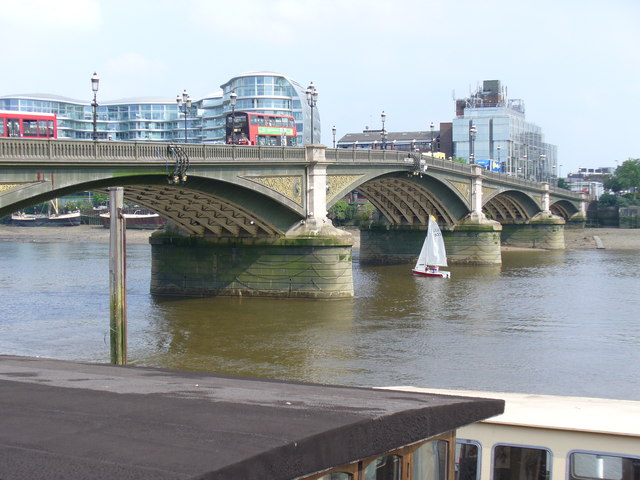
Photo: Colin Smith · CC BY-SA 2.0 · Wikimedia Commons
Battersea Bridge is an arch bridge with cast-iron girders and granite piers crossing the River Thames in London. Current bridge designed by engineer Sir Joseph Bazalgette. The free Lokali audio guide runs 7 minutes.
✓ Published October 2026 · how we write these guides
Visitor facts
| Lokali audio guide | 7 min · free |
|---|---|
| Type | Bridge |
| Location | London, United Kingdom |
| Coordinates | 51.4811, -0.1725 |
| Languages | 50+, in the Lokali app |
The story
Stand still for a moment and feel the bridge under your feet. Every passing bus sends a faint tremor up through the iron. Below you, the Thames moves fast and brown, slapping against granite. On a grey morning the light comes off the water in a flat, silvery sheet. It can make Chelsea and Battersea look like two pencil sketches facing each other across the river.
This is Battersea Bridge. It links Chelsea on the north bank with Battersea on the south. It is not the grandest crossing on the Thames, and it never tried to be. It is a working bridge, low and fairly narrow. It has carried traffic over this bend of the river for a very long time. The story of this crossing is really the story of two bridges: the one you are standing on, and the wooden one that came before it.
For centuries, people crossed here by ferry. Watermen rowed passengers between the village of Chelsea and the marshy fields of Battersea. In the 1770s, a private company replaced the ferry with a timber toll bridge. It was a practical, rather awkward structure. It stood on many closely spaced wooden piers, which turned the river beneath it into a maze for boats. Crossing it cost money, and the tolls helped pay back the people who built it.
That old wooden bridge became something its builders never expected — a subject for art. Painters loved its spindly legs and its silhouette against the evening sky. J. M. W. Turner painted along this stretch of river. So did the American-born artist James McNeill Whistler, who lived just a short walk away in Chelsea. For artists, the clumsy old bridge was beautiful precisely because it looked so fragile.
Here is the first surprise. One of Whistler's paintings of the old bridge ended up at the centre of a famous court case. It was a night scene in blue and gold, with the bridge as a dark shape above the water and fireworks in the sky beyond. The critic John Ruskin attacked Whistler's work in print. Whistler sued him for libel in 1878. He won the case, but the jury awarded him only a single farthing — one of the smallest coins in the country. The legal costs helped push him into bankruptcy.
The trial became a public argument about what art is for. Ruskin believed a painting should show careful labour and clear detail. Whistler argued that a painting could be about mood, colour and harmony, like a piece of music. That is why he called these river scenes "nocturnes". So when you look along the water at dusk, you are looking at the view that helped start that debate.
By the later nineteenth century, the timber bridge was failing. Boats kept hitting its piers, and the structure needed constant repair. It was taken into public ownership, and the tolls ended. Then it was pulled down. In its place came the bridge you are standing on now, designed by Sir Joseph Bazalgette and opened in 1890. Bazalgette is the engineer who built much of London's great Victorian sewer system, along with the embankments that line this river.
Look over the side and you can see his design clearly. The bridge has five arches of cast iron, resting on solid granite piers. Fewer piers meant wider openings for river traffic, which was the whole point of replacing the old wooden maze. The ironwork is painted, and the parapets carry decorative detail that is easy to miss if you are hurrying across. Bazalgette's engineering was practical, but he still gave the bridge a little Victorian ornament.
Here is the second surprise. Even with wider arches, this bridge has a long record of being struck by boats and barges. The tide here is strong, and the river bends just upstream. Vessels coming down on a fast ebb have sometimes misjudged the arches. Over the decades, several collisions have damaged the structure and closed it for repairs. So the old problem of boats meeting bridge never fully disappeared. It only became less frequent.
Turn now toward the north bank. This end of the bridge opens onto Cheyne Walk, one of the most admired riverside streets in London. Writers, painters and musicians have lived in these tall brick houses over the years, Whistler among them. Close to the bridge, on the embankment, you can find a statue of Whistler himself. Just upstream stands Chelsea Old Church, which has deep links to Sir Thomas More, the Tudor statesman and author.
Now look downstream, to the east. The next bridge along is Albert Bridge, with its pale cables and its towers strung with lights after dark. It makes a striking contrast with the bridge under your feet. Albert Bridge looks delicate and decorative. Battersea Bridge looks solid and low, almost modest. Many photographers frame the two together, especially when the evening lights come on along the river.
Watch the water for a while, too. The Thames here is tidal, so its level rises and falls twice a day. At low tide, banks of mud and shingle appear along the edges, and wading birds sometimes pick through them. At high tide, the river can swell close to the top of the embankment walls. The smell changes as well — salty and green at one moment, muddy and earthy the next. This stretch of river never looks quite the same twice.
On the south side lies Battersea. It was once a district of market gardens and industry, and it has changed a great deal in recent decades. New riverside buildings now stand where wharves and factories once worked. Walk a little east along the south bank and you will reach Battersea Park, with its trees and open lawns. The bridge still does what the ferry did long ago: it joins two very different neighbourhoods.
Before you move on, rest your hand on the cool iron of the parapet. Look along the river toward the west, where the light fades first in the evening. Whistler stood near here and painted the same water dissolving into blue darkness. The old wooden bridge is gone, but the view it framed is still here. As you walk away, listen for the slap of the tide against the piers — it has been the same sound for a very long time.
Key facts
What to look for
Practical tips
Common questions
Is there a free audio guide to Battersea Bridge?
Yes — the Lokali app narrates Battersea Bridge free of charge in 50+ languages. The guide runs about 7 minutes, covers the history, what to look for on site and practical tips, and works offline once downloaded.
Where is Battersea Bridge?
Battersea Bridge is in London, United Kingdom, at 51.4811, -0.1725. Tap the map link on this page for directions from where you are.
What is Battersea Bridge known for?
Current bridge designed by engineer Sir Joseph Bazalgette. Bazalgette's iron bridge opened to traffic in 1890.
What should you look for at Battersea Bridge?
Five cast iron arches resting on granite piers. Decorative ironwork along the painted parapets. Whistler's statue on the embankment near the Chelsea end.
What should you know before visiting Battersea Bridge?
Come at dusk for the river light Whistler painted. Check the tide times to see the exposed mudflats.
When is the best time to visit Battersea Bridge?
Come at dusk for the river light Whistler painted.
On the map
Opens directions to Battersea Bridge from your location.
More to see in London



Hear Battersea Bridge in your language
The full story, narrated, in 50+ languages. Download it before you go and it plays offline, at your own pace, with no ticket and no tour group.