
Photo: Wikimedia Commons contributor · Public domain · Wikimedia Commons
Millennium Bridge is a bridge in London. Opened in June 2000, closed within days for swaying. The free Lokali audio guide runs 7 minutes.
✓ Published October 2026 · how we write these guides
Visitor facts
| Lokali audio guide | 7 min · free |
|---|---|
| Type | Bridge |
| Location | London, United Kingdom |
| Coordinates | 51.5102, -0.0984 |
| Languages | 50+, in the Lokali app |
The story
Feel the deck under your feet. It is steel and aluminium, ribbed and slightly springy, and it hums faintly as hundreds of people cross it at once. Wind comes straight off the Thames here, cool and damp, carrying the smell of river mud at low tide. Gulls call overhead. To the north, a pale stone dome rises above the rooftops. To the south, a tall brick chimney stands against the sky. You are standing on a line drawn between them.
This is the Millennium Bridge, a footbridge for people only. No cars, no buses, no bicycles racing past. It links the City of London, the old financial heart of the capital, with Bankside on the south bank. For most of London's history these two shores felt far apart. The City was money and church. Bankside was theatres, taverns, and industry. Today the bridge joins them in a few minutes of easy walking.
When it opened in 2000, it was the first new crossing over the Thames in central London in more than a century. The last one before it was Tower Bridge, finished in the eighteen-nineties. So this slim structure carried a lot of expectation. It was meant to mark the new millennium and to show what modern British design could do. The team behind it was a partnership. The engineers were Arup, the architects were Foster and Partners, and the sculptor Anthony Caro also worked on the design.
Their idea was described as a blade of light across the river. Look at how low and flat the bridge sits. Most suspension bridges hang their deck from tall towers and high, curving cables. Here the cables barely rise at all. They run beside the walkway, close to your hands, stretched very tight. This shallow design keeps the view open. Nothing tall blocks your line of sight to the dome or to the chimney.
And now, the story most Londoners still remember. The bridge opened to the public in June 2000. Large crowds came on the first day — and the deck began to sway from side to side. People grabbed the rails. Some walked with their legs wide apart, like sailors on a ship. Within days the bridge was closed. Newspapers gave it a nickname that never quite went away: the Wobbly Bridge.
What went wrong is a surprise to most visitors. The problem was not the wind and not a weak structure. The problem was people. When a deck moves slightly sideways, walkers adjust their steps to keep their balance. Without thinking, many of them fall into the same rhythm. That shared rhythm pushes the bridge further, which makes even more people match their steps. Engineers call this effect synchronous lateral excitation. In simple words, a crowd and a bridge started walking in time together.
The fix took close to two years. Engineers fitted the bridge with dampers, devices that absorb movement the way shock absorbers do in a car. Some work like pistons filled with fluid. Others are heavy weights tuned to move against the sway. The bridge reopened in 2002 and has stayed steady ever since. The episode changed footbridge design around the world. Engineers now test for this crowd effect on new crossings, because of what happened right here.
Look north now, toward the City. The bridge points directly at Saint Paul's Cathedral, the great domed church designed by Sir Christopher Wren after the Great Fire of London in 1666. At the northern end, a wide stairway climbs toward the cathedral. As you walk that way, the dome grows larger with every step. This alignment is deliberate. The bridge was placed so that the walk itself would frame the church.
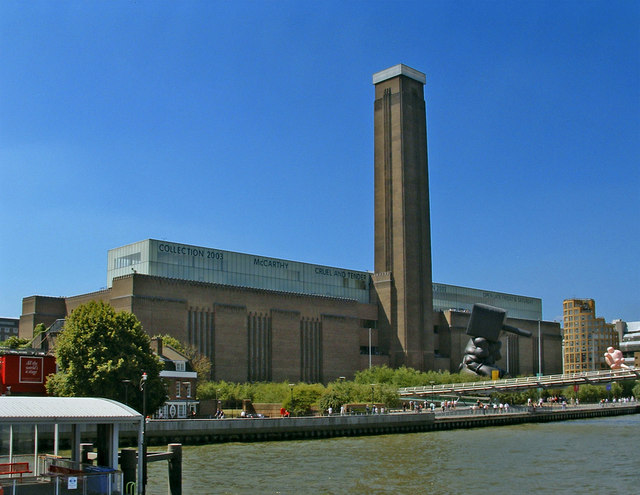
Now turn and face south. The tall brick building with the single chimney is Tate Modern, one of the world's major museums of modern and contemporary art. It was once Bankside Power Station, which burned fuel to make electricity for London. The power station closed, and in 2000 it reopened as a gallery, in the same year this bridge opened. The two projects were planned as partners. One crossing, two new public destinations on either shore.
To the left of Tate Modern, closer to the water, you may spot a round, white, timber-framed building with a thatched roof. That is Shakespeare's Globe, a modern reconstruction of the open-air theatre where many of his plays were performed. Thatch is rare in central London, so this roof stands out. On a summer afternoon you might hear the faint sound of an audience laughing, carried across the water from inside its walls.
Here is a second detail most people walk straight past. Look down at the deck as you cross. Between the metal ribs you may find tiny, bright paintings, each no bigger than a coin. They are painted on old pieces of chewing gum that people dropped and walked on. The London artist Ben Wilson made many of them, often lying on the deck to work. Some show scenes, some carry names or messages. They are small, and easy to miss.
Film fans may also recognise this place. In the 2009 film Harry Potter and the Half-Blood Prince, dark wizards twist and break this bridge, and it falls into the river. Do not worry — the real bridge is quite safe. But the scene shows how quickly the structure became part of how people picture London. Its thin silver line now appears in films, postcards, and countless photographs taken from the riverbank below.
Walk to the middle of the bridge and pause at the rail. Downstream, to the east, you can see more bridges crossing the Thames, and on the south bank the glass point of the Shard rising into the clouds. Upstream, the river bends west toward Westminster. Watch the water below. It is tidal here, so its level rises and falls through the day. At low tide, strips of grey shore appear along the edges, and people sometimes search them for old objects.
Before you step off, stand still for a moment. Feel the light movement of the deck, now calm and controlled. Listen to the mix of languages around you, the footsteps, the wind in the cables. Behind you is one London, of stone and prayer and trade. Ahead is another, of art, theatre, and old industry made new. As you walk on, notice how the dome or the chimney slowly fills your view... and how this simple walkway brings the two together.
Key facts
What to look for
Practical tips
Common questions
Is there a free audio guide to Millennium Bridge?
Yes — the Lokali app narrates Millennium Bridge free of charge in 50+ languages. The guide runs about 7 minutes, covers the history, what to look for on site and practical tips, and works offline once downloaded.
Where is Millennium Bridge?
Millennium Bridge is in London, United Kingdom, at 51.5102, -0.0984. Tap the map link on this page for directions from where you are.
What is Millennium Bridge known for?
Opened in June 2000, closed within days for swaying. Nicknamed the Wobbly Bridge after its shaky opening.
What should you look for at Millennium Bridge?
Tiny paintings on flattened chewing gum in the deck. Low suspension cables running beside the handrails. Saint Paul's dome framed directly at the northern end.
What should you know before visiting Millennium Bridge?
Cross early morning to avoid the heaviest weekend crowds. Walk north to watch Saint Paul's dome grow ahead.
When is the best time to visit Millennium Bridge?
Visit at dusk when the deck lighting comes on.
On the map
Opens directions to Millennium Bridge from your location.
More to see in London



Hear Millennium Bridge in your language
The full story, narrated, in 50+ languages. Download it before you go and it plays offline, at your own pace, with no ticket and no tour group.