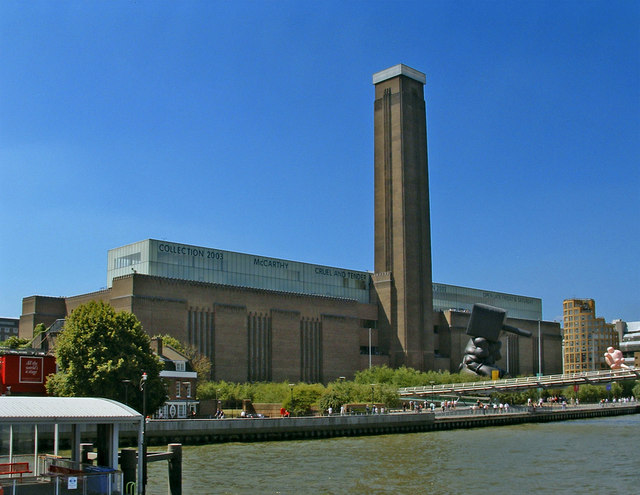
Photo: Christine Matthews · CC BY-SA 2.0 · Wikimedia Commons
Tate Modern is a modern art gallery located in Bankside, London, England. Tate Modern opened to the public in May 2000. The free Lokali audio guide runs 7 minutes.
✓ Published October 2026 · how we write these guides
Visitor facts
| Lokali audio guide | 7 min · free |
|---|---|
| Type | Museum |
| Location | London, United Kingdom |
| Coordinates | 51.5078, -0.0994 |
| Official website | tate.org.uk |
| Languages | 50+, in the Lokali app |
The story
Start with the floor beneath your feet. It slopes gently downward as you come in from the west side, a long ramp of concrete that pulls you inside almost before you decide to enter. The air cools. The sound changes. Voices that were sharp on the street outside spread out and soften, as if the building has swallowed them. Above you, high grey walls rise toward a ceiling of steel and glass. This is the Turbine Hall, and you are standing inside a power station.
Tate Modern opened in May 2000, but the building is older than the gallery by half a century. It began life as Bankside Power Station, built in stages after the Second World War on the south bank of the Thames. For decades it burned oil and pushed electricity into the city. Then, in 1981, it shut down. For years afterwards it stood empty — a dark brick hulk across the river from Saint Paul's Cathedral, waiting for someone to decide what it was for.
The man who designed the power station was Sir Giles Gilbert Scott. You may not know his name, but you almost certainly know his work. Scott designed the classic red telephone box, the one that appears on so many London postcards. He also worked on Battersea Power Station, further up the river. So the same mind that shaped a small red kiosk also shaped this enormous brick cathedral of industry. Look at the walls outside and you will see the same care with proportion.
When the Tate went looking for a home for its modern and contemporary collection, it chose this empty shell. The conversion went to the Swiss architects Herzog and de Meuron. Their decision was simple and bold: keep the industrial bones and do not hide them. The brick stayed. The steel stayed. The vast hall where the turbines once turned became open space. On the roof, they added a long glass box, known as the Light Beam, which glows over the river at night.
Now look up at the central chimney. It rises from the middle of the building like a single column, and it is the first thing most people see from across the water. There is a popular story about it. Londoners often say the chimney was deliberately kept lower than the dome of Saint Paul's, so the power station would never outrank the cathedral. Treat that as a nice tale rather than settled fact — but stand on the bridge later and judge the two skylines for yourself.
Back inside, the Turbine Hall has become one of the most talked-about rooms in modern art. Each year, one artist is invited to fill it. Over the years it has held a giant spider by Louise Bourgeois, a glowing artificial sun by Olafur Eliasson, and a floor covered in millions of hand-painted porcelain sunflower seeds by Ai Weiwei. Since 2015 the series has been sponsored by Hyundai. Whatever is here on your visit, notice how people behave around it — lying down, whispering, running.
Here is a detail many visitors miss. Beneath your feet, under the Turbine Hall, sit the old oil tanks that once fed the power station. They are round, raw concrete chambers, and they were never filled in. Today they are called the Tanks, and the gallery uses them for performance, film and live art. The walls still carry the marks of their industrial past. If the Tanks are open, go down. It feels like walking into the lungs of the building.
The main galleries rise on several floors along one side of the hall. The collection is not hung strictly by date. Instead, rooms are often arranged around ideas and themes, so a painting from the early twentieth century might sit near work made last decade. This can feel strange at first. Give it a few rooms. The arrangement asks you to compare, not just to follow a timeline. Many visitors find that freedom is the real point of the place.
Some of the most moving works here are also the quietest. Tate holds a group of dark, glowing canvases by the American painter Mark Rothko. He gave them to the gallery himself, and they arrived in London in 1970 — on the same day, as it turned out, that Rothko died in New York. When these paintings are on display, the room is usually kept dim. Sit on the bench and wait. The colours slowly seem to deepen the longer you look.
In 2016 the gallery grew. A new tower opened on the south side, now called the Blavatnik Building. It is a twisting, pyramid-like shape wrapped in a lattice of brick. The bricks are laid with gaps between them, so light passes through during the day and leaks out at night. The new tower used brick on purpose, to speak to Scott's old power station — the same material, used in a lighter, more open way. Walk around it and watch how its shape changes.
At the top of the Blavatnik Building is a viewing level that wraps around the tower. From up here, London spreads out in every direction. You can follow the river, pick out Saint Paul's, and see the glass towers of the City crowding behind it. The terrace has a modern footnote of its own. Residents of the glass flats next door took the gallery to court, unhappy that visitors could look straight into their homes. The case went all the way to the country's highest court.
When you step back outside, the river is right in front of you. Directly ahead, a slim steel footbridge — the Millennium Bridge — crosses the Thames toward Saint Paul's. It opened around the same time as the gallery and quickly gained a nickname, the Wobbly Bridge, because it swayed under the feet of the first crowds. Engineers fixed it, and it now feels steady. Crossing it links two very different ideas of London: the old cathedral and the old power station turned gallery.
Before you leave, pause on the riverside path and look back at the building one more time. The brick is a dark, warm brown, almost purple in some light. The chimney stands straight against the sky. Once, this place sent power out into the city through cables and wires. Now it sends out something harder to measure. Listen to the voices of people leaving around you — arguing, laughing, puzzled. That conversation, carried home across the river, is what this building produces today.
Key facts
What to look for
Practical tips
Common questions
Is there a free audio guide to Tate Modern?
Yes — the Lokali app narrates Tate Modern free of charge in 50+ languages. The guide runs about 7 minutes, covers the history, what to look for on site and practical tips, and works offline once downloaded.
Where is Tate Modern?
Tate Modern is in London, United Kingdom, at 51.5078, -0.0994. Tap the map link on this page for directions from where you are.
What is Tate Modern known for?
Tate Modern opened to the public in May 2000. Built inside the former Bankside Power Station.
What should you look for at Tate Modern?
The single central chimney rising above the river front. Gaps in the brick lattice of the Blavatnik Building. The glass Light Beam running along the main roof.
What should you know before visiting Tate Modern?
Enter by the west ramp for the full Turbine Hall reveal. Major temporary exhibitions need a separate ticket.
On the map
Opens directions to Tate Modern from your location.
More to see in London


Hear Tate Modern in your language
The full story, narrated, in 50+ languages. Download it before you go and it plays offline, at your own pace, with no ticket and no tour group.