
Photo: Katie Chan · CC BY-SA 3.0 · Wikimedia Commons
National Maritime Museum is a museum in London, England, United Kingdom. The museum opened to the public in 1937. The free Lokali audio guide runs 7 minutes.
✓ Published October 2026 · how we write these guides
Visitor facts
| Lokali audio guide | 7 min · free |
|---|---|
| Type | Museum |
| Location | London, United Kingdom |
| Coordinates | 51.4811, -0.0056 |
| Official website | rmg.co.uk |
| Languages | 50+, in the Lokali app |
The story
Stand still for a moment on the grass outside. You may catch the damp, mineral smell of the Thames drifting up from the riverbank. Gulls call over the water. To one side, white colonnades run in long, calm lines. Above you, the slope of Greenwich Park climbs toward the old observatory on the hill. This is a place built around water, even when the water is out of sight.
You are in Greenwich, on the south bank of the river, east of central London. The National Maritime Museum sits inside a cluster of buildings that UNESCO lists together as Maritime Greenwich. Nearby stand the Queen's House, the Old Royal Naval College by the river, and the Royal Observatory above. Together they form one of the most complete pieces of planned riverside landscape in Britain. The museum is the storyteller of the group.
The museum itself is younger than many visitors expect. It opened to the public in 1937, after Parliament created it a few years earlier. King George the Sixth performed the opening. The buildings you see, though, are older than the museum. For a long time they belonged to a school for the sons of seafarers. When that school moved away to the countryside in the 1930s, the empty halls found a new purpose... holding Britain's memory of the sea.
If you came in from the park side, look for the modern extension called the Sammy Ofer Wing, which opened in 2011. Outside it, you may spot something playful: a giant ship sealed inside a glass bottle. It is a work by the British-Nigerian artist Yinka Shonibare. It first stood on the Fourth Plinth in Trafalgar Square, before the museum acquired it. Look closely at the sails. They are not white canvas — they are bright patterned textiles, the kind often linked with West African fashion.
That detail matters. The sails point to a bigger idea inside this building. The history of the sea is not only about admirals and battles. It is also about trade, migration, and the movement of goods and people between continents. Some of those movements were painful. The museum's galleries address the transatlantic slave trade, empire, and the ways the oceans connected distant places. It is worth slowing down in those rooms, even if you came here for ships.
Now step into Neptune Court, the large central space under a glass roof. On a bright day, light pours straight down onto the floor. And the floor itself is a surprise. In this area you can often find a huge printed map of the world laid flat underfoot. Children run across oceans in a few steps. Adults tend to walk more slowly, searching for home. It is one of the simplest exhibits here, and one of the most popular.
Look up and around the court for one of the museum's most golden objects. Prince Frederick's Barge is a royal rowing boat from the eighteenth century, made for a son of King George the Second. It was designed for ceremony on the river, not for war or work. The stern is crowded with gilded carving — shells, scrolls, and decorative figures. Imagine it gliding along the Thames with oarsmen in livery. London's river was once its grandest road.
Upstairs, many visitors head straight for one small, quiet object. It is a naval coat, dark blue, with fading gold braid. This is the coat that Admiral Horatio Nelson wore at the Battle of Trafalgar in 1805. Look carefully near the left shoulder. There is a small hole where the musket ball struck him. Nelson died during the battle, at the moment of a victory that shaped British naval power for a century. Few objects carry a single afternoon so exactly.
Here is a detail many people do not know. Accounts from the time describe how Nelson's body was brought home preserved in a cask of spirits, so that he could receive a state funeral in London. Over the years, sailors' stories grew around this fact. Some tales claim the crew secretly drank from the cask. Treat that part as sailor folklore. The preserving barrel itself, though, appears in historical accounts of the voyage home.
Beyond Nelson, the collection is very wide. You will find ship models built with tiny rigging, carved figureheads that once sat at the front of wooden ships, and many paintings of the sea in storm and calm. There are navigational instruments too — tools sailors used to find their position with stars, angles, and patience. Galleries also cover exploration, including voyages into the polar regions, where wooden ships were trapped in ice for months.
The museum is one part of a family called Royal Museums Greenwich. The others are the Queen's House next door, the Royal Observatory up the hill, and the Cutty Sark, a nineteenth century sailing ship preserved near the river. You can plan a full day here without leaving Greenwich. The Queen's House is a short walk away, and its pale geometric architecture sets it apart from almost every building around it.
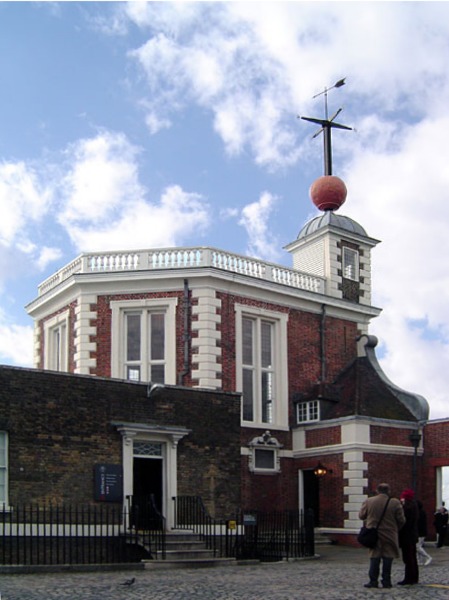
If you climb the hill afterwards, you reach the Royal Observatory. This is the home of the Prime Meridian, the line of zero degrees longitude that divides east from west. People queue to stand with one foot in each hemisphere. On top of the observatory, look for a red ball on a mast. Each day it rises and drops at one o'clock, an old signal that let ships on the river set their clocks.
The connection between that hill and this museum is simple. For sailors, knowing the exact time meant knowing where they were. Without it, ships were lost on open water. So the telescopes on the hill and the coats and charts in these galleries belong to one story. It is the story of people trying to cross something huge and dangerous, and finding their way home again.
Before you go, step back outside and face the river. Notice how the buildings line up toward the water, as if the whole site leans gently toward the Thames. Listen again for the gulls, and for the low hum of boats passing. Every object you saw inside came across water like this, in one way or another. And as you walk away, the river keeps moving east... toward the sea that started it all.
Key facts
What to look for
Practical tips
Common questions
Is there a free audio guide to National Maritime Museum?
Yes — the Lokali app narrates National Maritime Museum free of charge in 50+ languages. The guide runs about 7 minutes, covers the history, what to look for on site and practical tips, and works offline once downloaded.
Where is National Maritime Museum?
National Maritime Museum is in London, United Kingdom, at 51.4811, -0.0056. Tap the map link on this page for directions from where you are.
What is National Maritime Museum known for?
The museum opened to the public in 1937. King George the Sixth opened the museum.
What should you look for at National Maritime Museum?
The musket ball hole near Nelson's left shoulder. Patterned textile sails on Shonibare's ship in a bottle. Gilded shell carvings on Prince Frederick's Barge stern.
What should you know before visiting National Maritime Museum?
Walk up through Greenwich Park to the Royal Observatory afterwards. Book Royal Observatory tickets separately before you arrive.
On the map
Opens directions to National Maritime Museum from your location.
More to see in London


Hear National Maritime Museum in your language
The full story, narrated, in 50+ languages. Download it before you go and it plays offline, at your own pace, with no ticket and no tour group.