
Photo: No machine-readable author provided. Nichtbesserwisser assumed (based on copyright claims) · Public domain · Wikimedia Commons
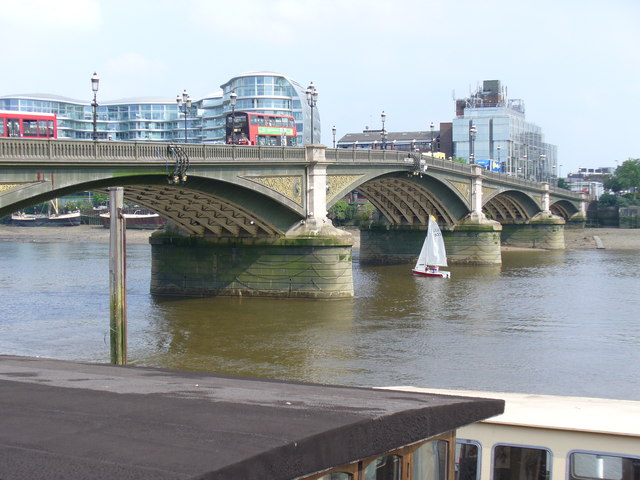
Putney Bridge is a grade II listed road bridge in London Boroughs of Wandsworth and Hammersmith and Fulham. The first bridge here, made of wood, opened in 1729. The free Lokali audio guide runs 6 minutes.
✓ Published October 2026 · how we write these guides
Visitor facts
| Lokali audio guide | 6 min · free |
|---|---|
| Type | Bridge |
| Location | London, United Kingdom |
| Coordinates | 51.4666, -0.2134 |
| Languages | 50+, in the Lokali app |
The story
Stand still for a moment and listen. Beneath you, the Thames moves with a low, steady pull, and if the tide is turning you may hear water slapping against the stone piers. Gulls call over the mud banks. Buses rumble across the roadway, and somewhere along the shore a coxswain's voice carries across the water, calling out a rhythm to a crew of rowers.
This is Putney Bridge. It links two old riverside villages that London long ago swallowed whole. To the south lies Putney, in the borough of Wandsworth. To the north lies Fulham. For centuries, the river here was a barrier. People crossed it by ferry, and the ferrymen did good business. A bridge, when it finally came, changed the shape of daily life on both banks.
That first bridge opened in 1729, and it was made of wood. At the time, it was a remarkable thing. Downstream, London Bridge was the only other crossing into the city, and upstream the next bridge stood at Kingston. So this timber structure, with its many narrow spans, became one of very few places where a traveller could cross the lower Thames on foot or by carriage. Crossing it, of course, meant paying a toll.
There is a popular story about why the bridge was built at all. According to the tale, the politician Robert Walpole, often called Britain's first prime minister, was once delayed at the riverbank while the ferryman was elsewhere. Frustrated, he is said to have supported the idea of a bridge. It is a good story, and locals still tell it. Treat it as tradition rather than documented fact.
The old wooden bridge also has a darker place in literary history. In 1795, the writer Mary Wollstonecraft, an early champion of women's rights, threw herself from it into the river during a period of deep despair. Watermen pulled her from the Thames, and she survived. She went on to write more, and later became the mother of Mary Shelley, the author of Frankenstein. Few people crossing the bridge today know this.
Wood and a tidal river make a poor partnership. Boats struck the many piers, and the closely spaced supports made navigation difficult. By the nineteenth century, the old bridge was a hazard and an obstacle. London was growing fast, and the city wanted crossings that were wider, stronger, and free of tolls. The timber bridge was eventually taken down, and a new one rose in its place.
The bridge you are standing on now opened in 1886. Its engineer was Sir Joseph Bazalgette. His name may not be familiar, but his work shaped modern London. He designed the great sewer system that ended the city's deadly cholera outbreaks, and he built the Thames embankments. Here, he chose granite. Look at the five broad arches and the pale, solid stone. This is a bridge built to last, and it carries far more traffic today than its builders could have imagined.
Now for one of the curiosities of this spot. Look to each end of the bridge. On the Putney side stands the church of Saint Mary. On the Fulham side stands the church of All Saints. Very few bridges anywhere have a church at both ends. Their towers face each other across the water, like two old neighbours who have watched the river traffic for centuries.
Saint Mary's church holds an important place in English political history. In 1647, after the first phase of the English Civil War, officers and soldiers of Parliament's New Model Army met inside it. They argued about who should have the right to vote and how the country should be governed. These meetings became known as the Putney Debates. Some of the ideas spoken there, about the rights of ordinary people, sound surprisingly modern even now.
If you visit in spring, this stretch of river may look very different. Putney Bridge marks the starting point of the Boat Race between the universities of Oxford and Cambridge. The crews set off just upstream of here and race against the tide toward Mortlake, a course of roughly four miles. On race day, thousands of people crowd the banks and the bridge itself. Near the Putney shore, a small marker stone shows the starting line.
Even without the Boat Race, rowing is everywhere here. Walk along the Putney Embankment and you will pass a line of boathouses, their wide doors opening straight onto the slipways. Early in the morning, crews carry long, narrow boats down to the water on their shoulders. On a calm day, you can watch them glide under the arches, the oars dipping in perfect time.
Here is another small surprise. If you arrived by Underground, you may have used Putney Bridge station. But that station is not in Putney at all. It sits on the Fulham side, north of the river. Travellers heading for Putney High Street often find they still have the whole bridge to cross. Consider it a gentle introduction to this stretch of the Thames.
On the Fulham bank, a short walk upstream takes you toward Bishop's Park and Fulham Palace, which for many centuries was the country home of the Bishops of London. The riverside path here is green and quiet, with tall trees leaning over the water. It is a good place to slow down after the noise of the road, and to look back at the bridge from a distance.
Before you move on, look down at the river one more time. Notice the colour of the water, the height of the tide against the stone, the line of mud or the lack of it. This river rises and falls twice every day, as it has done beneath every bridge that stood here. As you walk away, listen for the rowers, the gulls, and the bells of the two churches still facing each other across the Thames.
Key facts
What to look for
Practical tips
Common questions
Is there a free audio guide to Putney Bridge?
Yes — the Lokali app narrates Putney Bridge free of charge in 50+ languages. The guide runs about 6 minutes, covers the history, what to look for on site and practical tips, and works offline once downloaded.
Where is Putney Bridge?
Putney Bridge is in London, United Kingdom, at 51.4666, -0.2134. Tap the map link on this page for directions from where you are.
What is Putney Bridge known for?
The first bridge here, made of wood, opened in 1729. Sir Joseph Bazalgette designed the present granite bridge.
What should you look for at Putney Bridge?
A church tower standing at each end of the bridge. Five wide granite arches spanning the tidal river. The small stone marking the Boat Race starting line.
What should you know before visiting Putney Bridge?
Arrive early morning to watch rowing crews launch their boats. Walk the Fulham bank to Bishop's Park for a side view.
When is the best time to visit Putney Bridge?
Expect large crowds and closures on Boat Race day.
On the map
Opens directions to Putney Bridge from your location.
More to see in London



Hear Putney Bridge in your language
The full story, narrated, in 50+ languages. Download it before you go and it plays offline, at your own pace, with no ticket and no tour group.