
Photo: Graeme Kerr · CC BY 2.5 · Wikimedia Commons
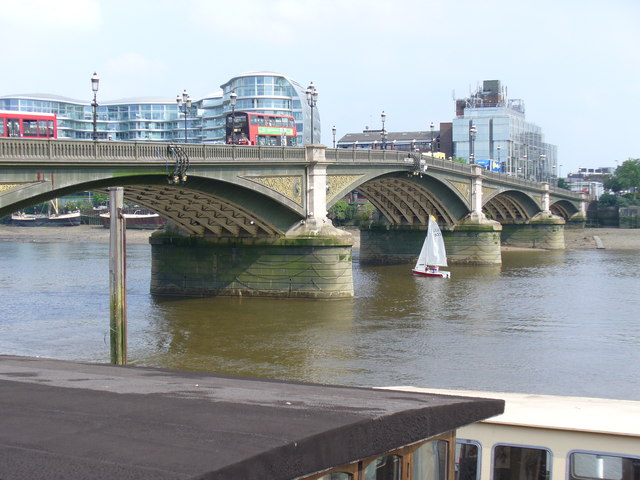
Wandsworth Bridge is a bridge in London, England. The current bridge opened to traffic in 1940. The free Lokali audio guide runs 7 minutes.
✓ Published October 2026 · how we write these guides
Visitor facts
| Lokali audio guide | 7 min · free |
|---|---|
| Type | Bridge |
| Location | London, United Kingdom |
| Coordinates | 51.4650, -0.1881 |
| Languages | 50+, in the Lokali app |
The story
Stand still for a moment and feel the bridge under your feet. There is a faint, steady tremor here. It comes from buses, vans and lorries crossing in a constant stream. Below you, the Thames moves wide and brown, pulling toward the sea or pushing inland with the tide. The wind on this stretch of river often feels stronger than in the streets behind you. And all around, the railings and girders carry a soft, faded shade of blue.
This is Wandsworth Bridge. It links Wandsworth on the south bank with Fulham, and the area called Sands End, on the north. It is not the bridge on postcards. It has no towers, no gilded lamps, no carved stone. Many Londoners cross it every day without a second thought. Some writers have even called it one of the plainest bridges on the Thames. But plain things often hold good stories, and this one does.
Start with the colour. Look along the steelwork and you will see that blue again, in more than one shade. The story most often told is that the bridge was first painted in blue tones as camouflage during the Second World War. The idea was simple. From the air, a blue-grey bridge would be harder to pick out against the water. Whether or not it helped, the colour stayed. Today it gives this working bridge a quiet character of its own.
The wartime link is not an accident of timing. The bridge you stand on opened in 1940. Britain was already at war, and London was entering the period of heavy bombing that people called the Blitz. So this crossing began its life under threat. Imagine engineers and workers finishing a major river bridge while the city prepared for air raids. There was little room for decoration. The goal was a strong, practical road over the river.
But there was a crossing here before. The first Wandsworth Bridge opened in 1873, in the Victorian age, when private companies built many London bridges and charged a toll to cross. That earlier structure was a lattice girder bridge — a frame of criss-crossed iron, like a long metal net. It was designed by the engineer Julian Tolmé. It was not a great success. It was narrow, and it was too weak for heavy traffic.
The toll did not last long. In the late nineteenth century, the authorities in London bought out many private bridges and made them free to use. Wandsworth's crossing was one of them. Think about what that meant for ordinary people. A worker on one bank could now reach a job on the other bank without paying each time. Small changes like that slowly joined the riverside villages into one large city.
By the early twentieth century, the old iron bridge could not cope with the growth of motor traffic. London decided to replace it. The new bridge was designed under Sir Thomas Peirson Frank, an engineer who worked for London County Council. It is a steel cantilever bridge. In simple terms, that means the main beams reach out from supports and hold their own weight, rather than hanging from cables or resting on arches. Look at the long, low line of the deck. It is a design about function, not show.
Here is something many visitors miss. For a long time, this bridge had no special protection at all. Then, in the early twenty-first century, it was given listed status. In England, a listed structure is one recognised by law as having special historic or architectural interest. So the bridge that people called dull is now officially part of the nation's heritage. Sometimes plain engineering earns respect simply by surviving and doing its job.
Now walk to the railing and look along the river. This part of the Thames feels different from central London. The river is broad here, and the banks are lower. Upstream, toward the west, the water bends toward Putney. Downstream, toward the east, it curves on toward Battersea and Chelsea. On a clear day, the light on the water changes quickly. Grey can turn to silver, then back to brown, within minutes.
The Thames is tidal at this point. That surprises some people, because the sea feels very far away. But twice a day, the water rises and falls here by several metres. At low tide, you may see mud and shingle along the edges. At high tide, the river fills almost to the walls. Watch the water near the bridge supports. You can often see which way it is flowing by the small ripples and eddies around them.
The banks themselves tell the story of a changing London. For generations, both sides of this stretch were industrial. There were wharves, works and warehouses along the water. Boats carried coal, timber and goods up and down the river. Much of that has gone. In its place you will see newer flats with large windows and balconies facing the river. The old working Thames and the new residential Thames sit side by side here.
And there is a second river nearby. Not far from this bridge, on the Wandsworth side, a smaller river called the Wandle flows into the Thames. In earlier centuries, the Wandle powered mills and supported many local trades. In fact, the name Wandsworth comes from it. So when you stand here, you are close to the reason this whole district has its name. Two rivers, one small and one great, meet just a short walk away.
If you cross on foot, take your time. The pavement is a good place to watch daily London life. Cyclists lean into the wind. Runners pass on the river paths below. Buses rumble by, full of people heading home or to work. Overhead, you may hear planes on their way to or from Heathrow. This is not a quiet place, but it is an honest one. It shows how the city actually moves.
Before you leave, look once more at that blue steel. It has carried traffic through war, through decades of change, and through the rebuilding of both riverbanks. Feel the vibration under your feet again. That small tremor is the bridge at work, as it has been since 1940. As you walk away, notice how quickly the river disappears behind buildings. Then remember that it is still there, moving with the tide, just out of sight.
Key facts
What to look for
Practical tips
Common questions
Is there a free audio guide to Wandsworth Bridge?
Yes — the Lokali app narrates Wandsworth Bridge free of charge in 50+ languages. The guide runs about 7 minutes, covers the history, what to look for on site and practical tips, and works offline once downloaded.
Where is Wandsworth Bridge?
Wandsworth Bridge is in London, United Kingdom, at 51.4650, -0.1881. Tap the map link on this page for directions from where you are.
What is Wandsworth Bridge known for?
The current bridge opened to traffic in 1940. The first bridge here opened in 1873.
What should you look for at Wandsworth Bridge?
Several shades of blue paint across the steel girders. The long, low line of the cantilever deck. Eddies and ripples swirling around the bridge supports.
What should you know before visiting Wandsworth Bridge?
Cross on foot for the best views up and down river. Check tide times to see the river at low water.
On the map
Opens directions to Wandsworth Bridge from your location.
More to see in London



Hear Wandsworth Bridge in your language
The full story, narrated, in 50+ languages. Download it before you go and it plays offline, at your own pace, with no ticket and no tour group.