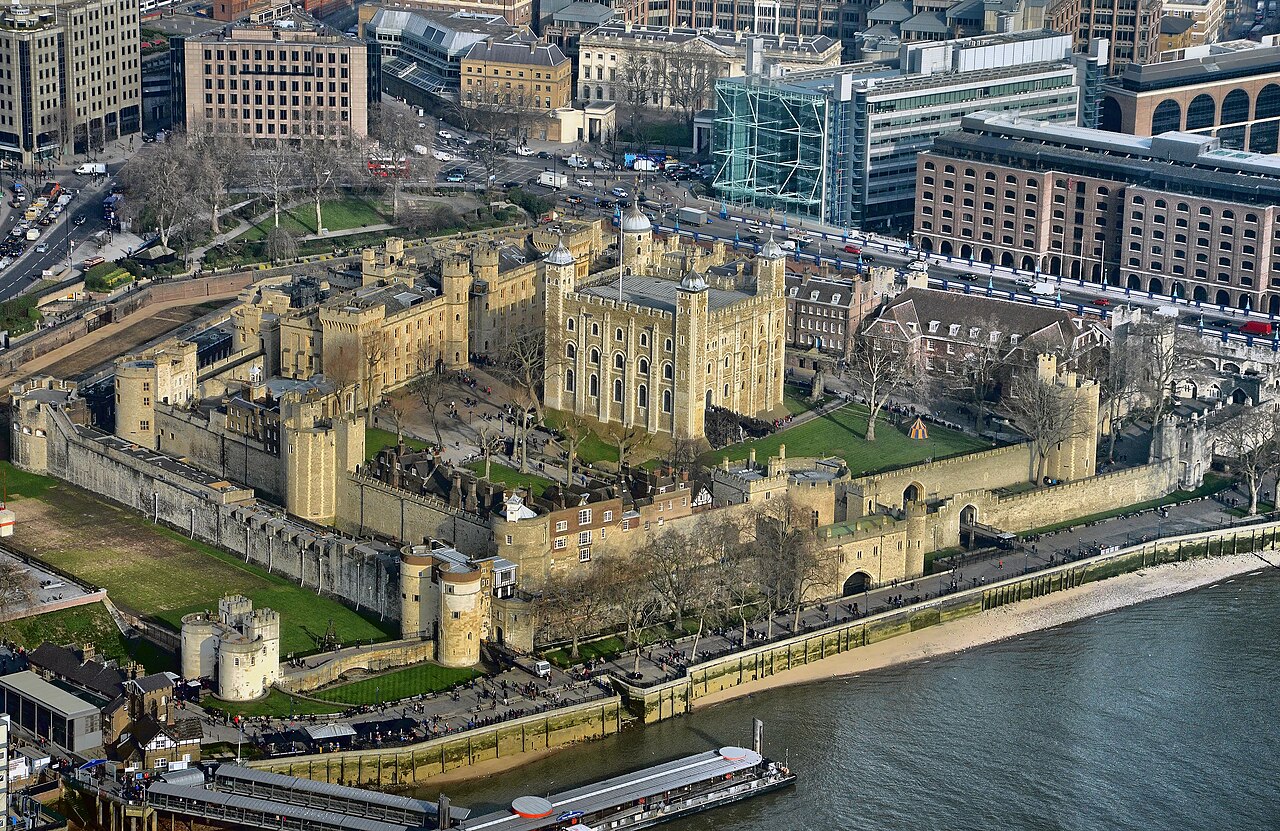
Tower of London is a castle in London, United Kingdom. Medieval fortress on the Thames dating to 1066, home to the Crown Jewels and centuries of royal history. Most visitors spend 2–4 hours here. The free Lokali audio guide runs 9 minutes.
✓ Verified August 2026 · how we write these guides
Visitor facts
| Time needed | 2–4 hours |
|---|---|
| Lokali audio guide | 9 min · free |
| Type | Castle |
| Best for | Editors' pick |
| Location | London, United Kingdom |
| Coordinates | 51.5055, -0.0754 |
| Languages | 45, in the Lokali app |
The story
Stand at the edge of the moat and look up. The White Tower rises in pale Caen limestone, its corners marked by four turrets, each capped in lead that catches the light differently as clouds shift overhead. The stone glows warmest in the hour after sunrise, when the eastern face holds a soft apricot tint. By midday it flattens to grey. Late afternoon, when the sun swings west, the shadows between the crenellations deepen into sharp black lines — that is when the tower reads most dramatically in a photograph.
William the Conqueror ordered this fortress built in the ten-seventies, a statement in stone to a city that had just watched its Saxon king fall at Hastings. The Normans brought the limestone across the Channel from Normandy because London had no quarries that could supply blocks this size. The tower you see today is essentially the same structure William's masons finished by ten-ninety-seven, though the corner turrets were added in the fifteen hundreds and the windows were enlarged by Christopher Wren in the sixteen-nineties. The walls are four and a half metres thick at the base. Walk around the perimeter and notice how the masonry changes texture where medieval repairs meet original Norman work.
The Tower has served as royal palace, prison, armoury, treasury, and menagerie over nine centuries. Anne Boleyn spent her final days here in fifteen-thirty-six. Guy Fawkes was interrogated in the lower chambers after the Gunpowder Plot. During the First World War, eleven German spies were executed by firing squad in the inner courtyard at dawn. The last prisoners held here were the Kray twins in nineteen-fifty-two, charged with failing to report for national service. Each era left its mark on the stonework — graffiti carved by prisoners, scorch marks from fires, patches where cannonballs struck during the Civil War.
The Crown Jewels sit in the Waterloo Barracks on the north side, but the real photographic prize is the interplay of light and shadow across the outer walls. Early morning in winter, when frost clings to the battlements and the Thames runs low, the fortress feels almost monochrome — grey stone, grey water, grey sky. In summer, the moat lawn turns vivid green and the contrast against the pale masonry sharpens. The best vantage for a wide shot is from the south bank of the Thames, near Tower Bridge, where you can frame the entire complex with the river in the foreground. Use a polarising filter to cut the glare off the water.
Inside the grounds, the layout is a maze of courtyards and narrow passages between buildings. The Inner Ward holds the White Tower at its centre, surrounded by a ring of smaller structures — the Chapel of Saint Peter ad Vincula, the Beauchamp Tower, the Bloody Tower. Each courtyard has different light depending on the hour. The space between the White Tower and the Waterloo Barracks fills with hard noon sun, good for stark architectural shots. The passage beside the Bloody Tower stays shaded until late afternoon, giving you soft diffused light even on bright days. The cobblestones are uneven and worn smooth by centuries of foot traffic — watch your footing if you are carrying a tripod.
The Yeoman Warders, dressed in their Tudor-era uniforms of red and gold, patrol the grounds and lead tours. They make striking subjects if you ask permission first, but be mindful that they are working — quick candid shots without interrupting their duties. The ravens are another constant presence. Legend says the kingdom will fall if the ravens ever leave the Tower, so their wings are clipped and they are fed daily by the Ravenmaster. They perch on the battlements and strut across the lawns, bold and unbothered by visitors. A raven silhouetted against the White Tower at dusk is a classic composition, but you will need a fast lens because the light drops quickly.
The outer curtain wall, built in the twelve-seventies under Edward the First, forms a second defensive ring around the inner fortress. Walk along the ramparts and you gain elevated views over the inner courtyards and out across the Thames. The wall walk is narrow and the stone parapet casts deep shadows in the late afternoon — expose for the highlights or you will lose detail in the stonework. From the southwest corner, you can frame Tower Bridge in the background, though the bridge itself is a Victorian addition from eighteen-ninety-four and the contrast between medieval stone and iron latticework can feel jarring in a single frame. Decide whether you want historical purity or the layered story of London across centuries.
The Chapel of Saint Peter ad Vincula, tucked in the northwest corner of the Inner Ward, is one of the quietest spaces inside the Tower. The light inside is dim and cool, filtering through small leaded windows. Anne Boleyn, Catherine Howard, and Lady Jane Grey are buried beneath the chapel floor. The interior is off-limits for photography, but the exterior stonework, especially the small arched doorway on the west side, catches warm light in the late afternoon. The door is oak, blackened with age, and the iron hinges are original Tudor metalwork.
The moat no longer holds water. It was drained in the eighteen-forties and converted to a dry ditch, now planted with wildflowers in summer. The slope of the moat banks creates natural leading lines in a photograph, drawing the eye up toward the fortress walls. In spring, poppies bloom along the moat edge, a deliberate planting that echoes the ceramic poppy installation of twenty-fourteen, when the moat was filled with hundreds of thousands of red flowers to mark the centenary of the First World War. The installation is gone, but the memory lingers and the wildflowers return each year.
The Tower sits at the eastern edge of the City of London, where the medieval street grid gives way to the river. The surrounding area is a mix of old and new — glass office towers to the north, the stone arches of Tower Bridge to the east, the river wall to the south. The best time to shoot is early morning before the crowds arrive, or late afternoon when tour groups thin out and the light softens. The Tower closes at dusk, but the exterior remains visible from the public paths along the Thames, and the floodlights that illuminate the walls after dark create a different kind of drama — cold white light against dark stone, the turrets sharp against the night sky.
As you leave, pause at the edge of the moat and look back. The White Tower stands as it has for nearly a thousand years, its limestone walls holding the light, its turrets marking the skyline. The fortress has outlasted kings, wars, fires, and sieges. It will outlast the photograph you just took. But the image you carry away — the play of shadow on stone, the raven on the battlement, the curve of the Thames beyond the walls — that is yours, a single moment in the long life of this place.
Key facts
What to look for
Practical tips
Common questions
How long do you need at Tower of London?
Plan 2–4 hours. That is the time most visitors spend at Tower of London. The free Lokali audio guide adds about 9 minutes of narration you can listen to as you walk, so it fits inside your visit rather than adding to it.
Is there a free audio guide to Tower of London?
Yes — the Lokali app narrates Tower of London free of charge in 50+ languages. It covers the history, what to look for on site and practical tips, and it works offline once downloaded.
Where is Tower of London?
Tower of London is in London, United Kingdom, at 51.5055, -0.0754. Tap the map link on this page for directions from where you are.
What should you know before visiting Tower of London?
Shoot from south bank of Thames for wide framing with river.
What is Tower of London known for?
White Tower completed ten-ninety-seven, walls four and a half metres thick.
What is the best time to visit Tower of London?
Arrive early to beat crowds at the Jewels.
On the map
Opens directions to Tower of London from your location.
Reference
More to see in London



Hear Tower of London in your language
The full story, narrated, in 50+ languages. Download it before you go and it plays offline, at your own pace, with no ticket and no tour group.