Photo: No machine-readable author provided. A bit iffy assumed (based on copyright claims). · Public domain · Wikimedia Commons
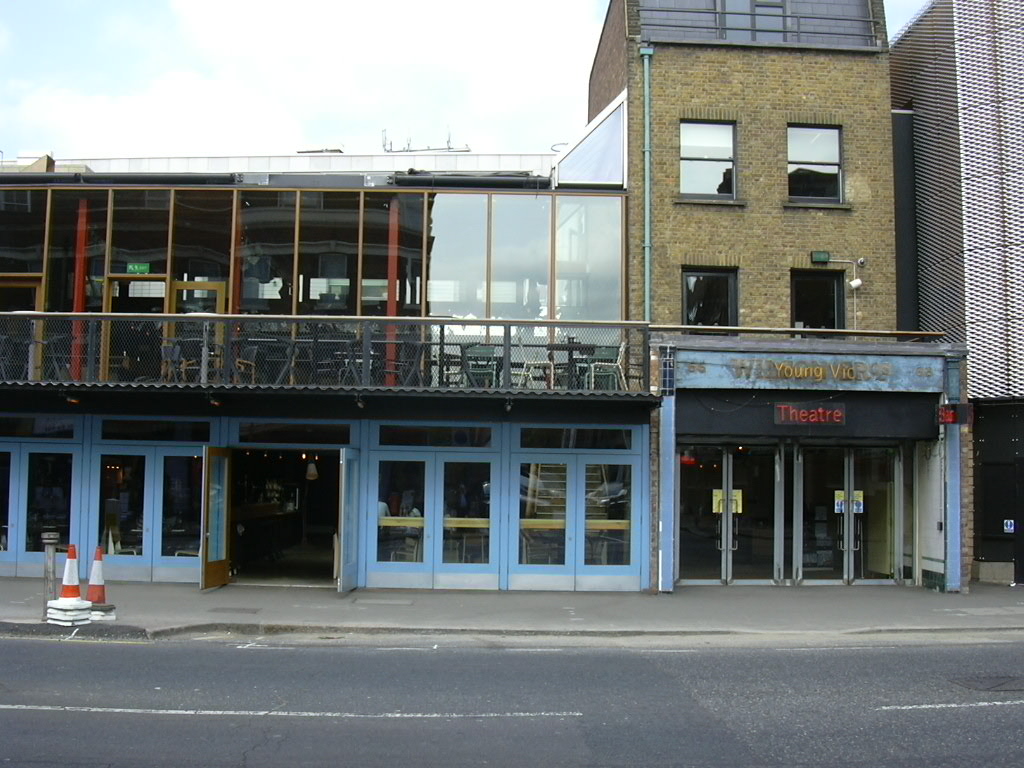
Young Vic is a theatre in Waterloo, London Borough of Lambeth, London, England. The Young Vic opened in 1970 on The Cut. The free Lokali audio guide runs 6 minutes.
✓ Published October 2026 · how we write these guides
Visitor facts
| Lokali audio guide | 6 min · free |
|---|---|
| Type | Theatre |
| Location | London, United Kingdom |
| Coordinates | 51.5032, -0.1075 |
| Official website | youngvic.org |
| Languages | 50+, in the Lokali app |
The story
Listen for a moment. Buses grind past on The Cut, trains rumble somewhere behind the rooftops, and people drift out of the bar with glasses in their hands. In front of you stands a low, modest building. Its surface is part brick, part concrete, and part a grey metal mesh that catches the light. It does not look grand. That is the point. The Young Vic was never meant to impress you from the street. It was meant to pull you inside.
This stretch of South London sits between Waterloo and Southwark. The Cut has been a working street for a very long time. In the nineteenth century it was known for its street market, its noise, and its cheap entertainment. Theatre has lived here for generations. Look across the road and you will see the Old Vic, a much older and more formal playhouse. The Young Vic grew up in its shadow... and then made its own name.
The story begins in 1970. At that time, the National Theatre company was based at the Old Vic, under Laurence Olivier. A director called Frank Dunlop wanted a different kind of space. He imagined a theatre for younger audiences, with low prices and a looser, more democratic feel. The result was the Young Vic, built close to its older sibling. Its name says it plainly — this was the young one, the restless one.
Here is the first surprise. The building was put up quickly and cheaply, and it was expected to last only a few years. Many accounts say around five. Instead, it has stood for more than half a century. Temporary buildings have a way of becoming permanent in London. This one survived because people loved what happened inside it, not because anyone planned for it to last.
The second surprise sits right at the front. Part of this site was damaged by bombing during the Second World War. When the theatre was built, the designers kept a surviving old shop on the corner — a former butcher's shop. Today that small, older structure still forms part of the entrance. So as you walk in, you pass through a piece of the street's earlier life. A place where people once bought meat now welcomes people to watch plays.
The original design came from the architectural practice Howell, Killick, Partridge and Amis. They kept the materials honest and simple. Think of bare concrete blocks, exposed structure, and nothing hidden behind decoration. In the 2000s, the theatre closed for a major rebuild by the architects Haworth Tompkins, and it reopened in 2006. They kept the spirit of the old building. They added new spaces, better facilities, and that distinctive mesh skin on the outside.
Take a closer look at the facade. The mesh panels let light pass through, and they change with the weather. On a bright day, the surface looks almost silver. On a grey London afternoon, it turns soft and dull. At night, light from inside glows through the gaps. The building feels less like a solid wall and more like a screen between the street and the stage. It looks unfinished on purpose, like a workshop.
The heart of the building is the main auditorium. It is not a traditional theatre with a picture-frame stage and rows facing forward. The space is flexible. The seating can be arranged around the action, on several sides, or in other layouts for each production. This means no two visits feel quite the same. You might sit almost close enough to touch an actor. You might look across the stage and see other faces in the audience watching with you.
There are also two smaller studio theatres inside, known as the Maria and the Clare. These rooms are intimate and stripped back. They often host new work, young directors, and experimental pieces. Many theatre makers in Britain took early steps in rooms like these. If the main house is where big ideas reach a wide audience, the studios are where many of those ideas are first tested.
Over the decades, the Young Vic has had several artistic directors, and each one shaped its character. David Lan led the theatre for many years and oversaw the rebuild. Kwame Kwei-Armah took over in 2018. Across these changes, one thread has stayed strong. The theatre has kept a focus on bold productions, international artists, and new ways of telling familiar stories. Classic plays here often arrive looking very different from what you might expect.
The theatre also works closely with the people who live around it. Its community and education work invites local residents, schools, and young people to take part, not only to watch. This matters in a part of London where very expensive offices stand close to older housing estates. The founding idea from 1970 — theatre that feels open to everyone — still runs through the building. You can sense it in the relaxed foyer and the mix of people inside.
If you have time, step inside the bar and restaurant. The space is informal, with simple tables and a lively hum before performances. Upstairs, there is a balcony that looks out over The Cut. From there you can watch the street below — commuters heading to Waterloo, theatregoers crossing towards the Old Vic, and neighbours on their way home. It is one of the easiest ways to feel part of this neighbourhood, even for half an hour.
Before you move on, look again at the building in front of you. See the old shop at the corner, the plain blocks, and the grey mesh catching the light. Nothing here is polished for show. It is a working theatre, built in a hurry, kept alive by audiences and artists. As you walk away down The Cut, listen to the street once more — the buses, the voices, the trains — and notice how easily the theatre sits among them.
Key facts
What to look for
Practical tips
Common questions
Is there a free audio guide to Young Vic?
Yes — the Lokali app narrates Young Vic free of charge in 50+ languages. The guide runs about 6 minutes, covers the history, what to look for on site and practical tips, and works offline once downloaded.
Where is Young Vic?
Young Vic is in London, United Kingdom, at 51.5032, -0.1075. Tap the map link on this page for directions from where you are.
What is Young Vic known for?
The Young Vic opened in 1970 on The Cut. Founded by director Frank Dunlop as an offshoot of the National.
What should you look for at Young Vic?
The old butcher's shop building at the street corner. Grey metal mesh panels that change colour with the weather. Exposed concrete blocks left plain inside the foyer.
What should you know before visiting Young Vic?
Book ahead, since the flexible auditorium often sells out. Arrive early to have a drink in the foyer bar.
When is the best time to visit Young Vic?
Arrive early to have a drink in the foyer bar.
On the map
Opens directions to Young Vic from your location.
More to see in London


Hear Young Vic in your language
The full story, narrated, in 50+ languages. Download it before you go and it plays offline, at your own pace, with no ticket and no tour group.