
Photo: C messier · CC BY-SA 4.0 · Wikimedia Commons
Amnisos is an ancient Minoan settlement. It is near Heraklion, Greece. Minoan harbour town serving the palace of Knossos. The free Lokali audio guide runs 7 minutes.
✓ Published October 2026 · how we write these guides
Visitor facts
| Lokali audio guide | 7 min · free |
|---|---|
| Type | Archaeological Site |
| Location | Heraklion, Greece |
| Coordinates | 35.3308, 25.2061 |
| Languages | 50+, in the Lokali app |
The story
Listen first. Waves fold onto coarse sand, and every few minutes a jet engine roars overhead as a plane drops toward Heraklion's airport. Between those two sounds sits a low, rocky hill above the beach. On the hill there are scattered walls of pale stone. This quiet stretch of shore, a short drive east of the city, was once one of the busiest harbours of the Bronze Age Aegean. Welcome to Amnisos, the old sea gateway to Knossos.
To understand this place, picture Knossos, the great Minoan palace that sits a few kilometres inland. The Minoans were the Bronze Age people of Crete. They built palaces, painted frescoes, and traded across the eastern Mediterranean, centuries before classical Greece. A palace that size needed a port. Ships carrying oil, wine, pottery and metals had to land somewhere close. Most scholars believe that somewhere was here, along this open shore near the mouth of the Karteros river.
The name Amnisos is very old. It appears on clay tablets found at Knossos, written in Linear B. Linear B is the earliest written form of Greek, a script of syllables pressed into wet clay. On those tablets the name is spelled roughly as a-mi-ni-so. Some of the tablets record offerings sent from the palace, including jars of honey, to a goddess linked with this place. So, more than three thousand years ago, palace scribes were already writing down the name you are hearing now.
That goddess was Eileithyia, the protector of women in childbirth. Her sanctuary was not on this hill. It was in a cave in the hills a short distance inland, above the road toward Elounda and Episkopi. Inside the cave there are stalagmites, and people treated some of them as sacred. Archaeologists found pottery there from many different periods. This shows that worship at the cave continued for an extraordinarily long time, from the Neolithic age, long before the Minoans, into Roman times.
Here is the first surprise. Amnisos appears in Homer. In the Odyssey, Odysseus returns home in disguise and tells a false life story to his own wife, Penelope. In that invented tale, he says that a storm drove him to Amnisos, where the cave of Eileithyia is. So the poet knew this harbour and its sacred cave by name. Even as a piece of fiction inside an epic, it is a sign of how well remembered this shore was.
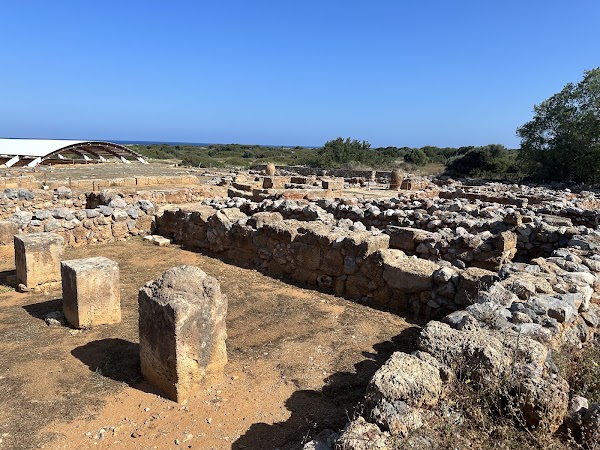
Now look at the hill in front of you. Locals often call it Paliokastro, which simply means old castle. On its slopes and at its foot, excavators uncovered Minoan buildings, including houses and storage rooms. The walls you can see today are low, mostly knee height or less. They are the foundations of rooms, not standing buildings. Try to imagine them with upper floors, plastered walls, wooden beams and flat roofs, looking out over ships pulled up on the sand.
The most famous building here is known as the Villa of the Lilies. When archaeologists cleared it, they found fragments of wall paintings. These showed white lilies and other plants, painted with a light, free hand against coloured backgrounds. The original fragments are now kept in the Heraklion Archaeological Museum, not here on site. If you visit the museum after this, look for them. Seeing those flowers after standing on this windy hill gives them a new meaning.
The main excavations were carried out in the 1930s by the Greek archaeologist Spyridon Marinatos. And this is the second surprise. While digging at Amnisos, Marinatos noticed layers of pumice, a light volcanic stone, in and around the ruins. He suspected it came from the volcano on Thera, the island known today as Santorini, about one hundred kilometres to the north. In 1939 he published a bold idea. A great eruption, he argued, had damaged Minoan Crete.
Scholars still debate the details. The dating of the eruption is argued about, and so is its true effect on the Minoans. Many researchers now think the eruption did not end Minoan civilisation in one blow. But Marinatos's idea changed how people looked at the Bronze Age. It also led him, decades later, to excavate the buried town of Akrotiri on Santorini. In a real sense, that famous excavation began with observations made on this modest Cretan beach.
Amnisos did not disappear with the Minoans. In later Greek times, a sanctuary stood near the hill, dedicated to Zeus. Its remains, including traces of an altar area, lie close to the older Minoan walls. This layering is typical of Crete. People returned to the same sacred spots century after century, and they gave them new gods and new names. The sea and the river mouth stayed the same, and that made the place useful again and again.
Take a moment to look around at the modern setting. The airport runway is right beside you. Hotels and tavernas line the coast road, and swimmers use the beach in summer. It is an unusual mix. Ancient stones sit next to sunbeds, and planes pass so low that you can read their markings. Many travellers pass along this road every day and never realise that a Bronze Age port lies only a few steps from the sand.
The archaeological area is often fenced, and access can vary, so you may view much of it from the edge. That is still worthwhile. From the beach, you can see the shape of the hill and understand why it was chosen. It is a raised point above a sheltered bay, near fresh water from the river. From here, the Minoans could watch the sea for ships and the land for travellers coming down from Knossos.
Before you leave, turn toward the water one more time. Feel the wind coming off the sea, and notice the colour of the shallows over the sand. The same north wind filled Minoan sails here, and it may have carried the volcanic ash that Marinatos found. As the next plane comes in overhead, look back at those low pale walls. For a few thousand years, this shore has been a place of arrivals... and it still is.
Key facts
What to look for
Practical tips
Common questions
Is there a free audio guide to Amnisos?
Yes — the Lokali app narrates Amnisos free of charge in 50+ languages. The guide runs about 7 minutes, covers the history, what to look for on site and practical tips, and works offline once downloaded.
Where is Amnisos?
Amnisos is near Heraklion, Greece, at 35.3308, 25.2061. Tap the map link on this page for directions from where you are.
What is Amnisos known for?
Minoan harbour town serving the palace of Knossos. Name appears on Linear B tablets from Knossos.
What should you look for at Amnisos?
Low pale stone foundations on the slopes of Paliokastro. Planes passing very low over the beach toward the runway. The Karteros river mouth that provided fresh water.
What should you know before visiting Amnisos?
Pair this visit with Heraklion Archaeological Museum's lily frescoes. Bring water and a hat; the hill has little shade.
On the map
Opens directions to Amnisos from your location.
More to see near Amnisos


Hear Amnisos in your language
The full story, narrated, in 50+ languages. Download it before you go and it plays offline, at your own pace, with no ticket and no tour group.