
Knossos Palace
35.2979° N · 25.1631° E · Archaeological Site
Knossos Palace is the largest Bronze Age site on Crete, believed to be the ceremonial centre of Minoan civilisation. It is in Crete, Greece. Most visitors spend 1–2 hours here. The free Lokali audio guide runs 9 minutes.
✓ Verified August 2026 · how we write these guides
Visitor facts
| Time needed | 1–2 hours |
|---|---|
| Lokali audio guide | 9 min · free |
| Type | Archaeological Site |
| Best for | History |
| Location | Crete, Greece |
| Coordinates | 35.2979, 25.1631 |
| Languages | 45, in the Lokali app |
The story
The stone beneath your feet is worn smooth by four thousand years of footsteps. You are standing in the heart of Europe's oldest civilization, where the first great palaces rose on this island long before the Parthenon, long before Rome. The air smells of thyme and dust, and the light here in Crete has a particular brightness — sharp, white, unforgiving — that makes every shadow deep and every colour vivid.
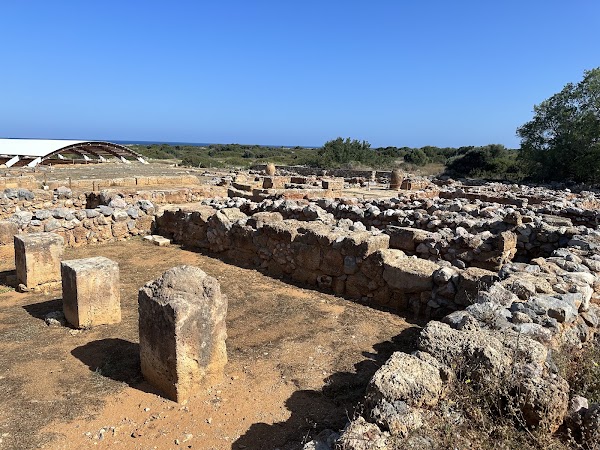
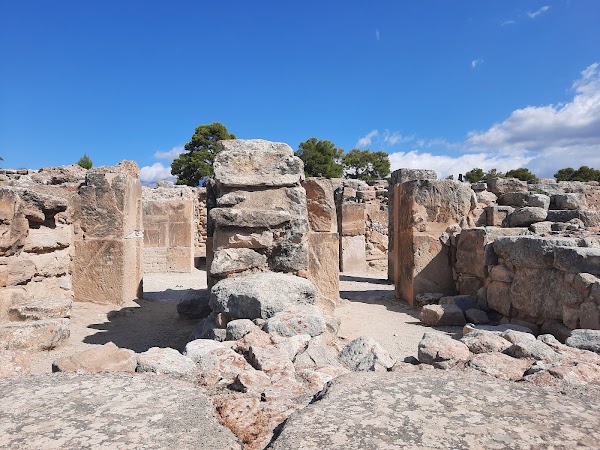
Knossos was the ceremonial and administrative centre of Minoan Crete, a Bronze Age culture that flourished from roughly 2000 to 1400 before Christ. At its peak, this complex covered more than twenty thousand square metres and rose several storeys high. It was not a fortress. There are no defensive walls, no battlements. The Minoans built for ceremony, for storage, for the intricate choreography of palace life. Hundreds of rooms radiate from a central courtyard — workshops, shrines, storage magazines lined with enormous clay jars, living quarters, administrative offices. The layout feels labyrinthine, and that word is no accident. Greek myth remembers this place as the lair of the Minotaur, the beast at the centre of the maze.
The man you see everywhere in the reconstructions is Arthur Evans, the British archaeologist who excavated Knossos starting in 1900. Evans was brilliant, obsessive, and controversial. He unearthed the palace from centuries of earth and gave the Minoans their name — he borrowed it from the legendary King Minos. But he also rebuilt large sections in reinforced concrete, painting columns bright red and black, restoring frescoes with a heavy hand. Some of what you see is ancient. Much of it is early twentieth-century imagination. Scholars argue about where one ends and the other begins.
Look closely at the columns. They taper downward, thick at the top and narrow at the base — the opposite of classical Greek columns. This is a signature of Minoan architecture, and no one is quite sure why they built them this way. The wood is gone, of course. What you see now is Evans's concrete reconstruction, painted in the colours he believed were original. The originals were cypress, and they would have been replaced many times over the centuries the palace stood.
The frescoes are the soul of this place. Fragments survive — leaping dolphins, blue monkeys, young men and women somersaulting over the backs of charging bulls. The bull-leaping frescoes are famous, and they raise more questions than they answer. Was this sport, ritual, sacrifice, all three? The figures are slim, athletic, dressed in bright kilts and jewellery. Some scholars think the acrobats were captives or slaves. Others see them as elite performers in a sacred rite. The frescoes were painted on wet plaster, and the pigments — ochre, lapis, charcoal — have lasted because the lime in the plaster sealed them.
The storage magazines run along the west side of the complex. Walk through them and you will see rows of pithoi, massive clay jars taller than a person, sunk into the floor. These held olive oil, wine, grain, honey — the wealth of the palace. Knossos was not just a ceremonial centre. It was an economic engine, collecting surplus from the countryside, redistributing it, recording transactions on clay tablets in a script we call Linear B. The tablets were baked hard by the fire that destroyed the palace, and they survived when almost everything else burned. They list sheep, chariots, textiles, offerings to gods whose names we still recognize — Poseidon, Dionysus.
The palace burned around 1400 before Christ. We do not know exactly why. Earthquake, invasion, internal collapse — the evidence is murky. The Mycenaeans from mainland Greece moved in afterward and occupied the ruins for a time, but the great Minoan age was over. Knossos was abandoned, and the memory of it faded into legend. By the time the classical Greeks built their temples, Knossos was already ancient, already mythic, already the labyrinth.
Stand in the central courtyard and face north. The hill rises beyond the ruins, covered in olive trees and wild herbs. In summer the heat is fierce and the cicadas are deafening. In spring the poppies bloom red between the stones. This is the landscape the Minoans knew, and it has not changed as much as you might think. The light, the wind, the shape of the hills — these are constants. Close your eyes for a moment and the millennia collapse. You are still standing in the centre of the maze.
As you walk back toward the entrance, notice the smaller details Evans and his team missed or chose not to restore. The drainage channels cut into the stone, sophisticated for their time. The lightwell shafts that brought air and sun into the interior rooms. The slight wear on a threshold where a door once swung. These are the textures of daily life, quieter than frescoes, but just as real. Knossos was not frozen in myth. It was a working palace, full of people, full of noise, full of the ordinary friction of power and ceremony and storage and ritual, all layered together in these stones.
Key facts
What to look for
Practical tips
Common questions
How long do you need at Knossos Palace?
Plan 1–2 hours. That is the time most visitors spend at Knossos Palace. The free Lokali audio guide adds about 9 minutes of narration you can listen to as you walk, so it fits inside your visit rather than adding to it.
Is there a free audio guide to Knossos Palace?
Yes — the Lokali app narrates Knossos Palace free of charge in 50+ languages. It covers the history, what to look for on site and practical tips, and it works offline once downloaded.
Where is Knossos Palace?
Knossos Palace is in Crete, Greece, at 35.2979, 25.1631. Tap the map link on this page for directions from where you are.
What should you know before visiting Knossos Palace?
Visit early morning or late afternoon to avoid midday heat.
What is Knossos Palace known for?
Bronze Age palace active from roughly 2000 to 1400 before Christ.
What is the best time to visit Knossos Palace?
Arthur Evans' concrete reconstructions divide opinion—some archaeologists call them fantasy.
On the map
Opens directions to Knossos Palace from your location.
More to see in Crete




Hear Knossos Palace in your language
The full story, narrated, in 50+ languages. Download it before you go and it plays offline, at your own pace, with no ticket and no tour group.