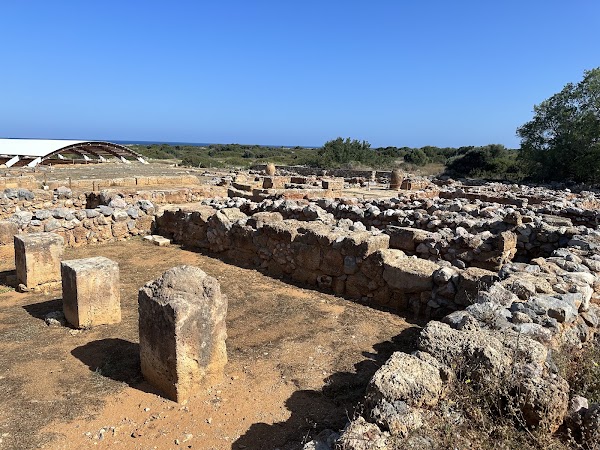
Minoan Palaces Trail
35.2800° N · 25.1000° E · Walking Route
Minoan Palaces Trail is a self-guided circuit connecting Crete's three major Minoan palace sites—Knossos, Phaistos, and Malia—across the central and southern plains. It is in Crete, Greece. Most visitors spend Full day (multi–site) here. The free Lokali audio guide runs 9 minutes.
✓ Verified August 2026 · how we write these guides
Visitor facts
| Time needed | Full day (multi–site) |
|---|---|
| Lokali audio guide | 9 min · free |
| Type | Walking Route |
| Best for | History |
| Location | Crete, Greece |
| Coordinates | 35.2800, 25.1000 |
| Languages | 45, in the Lokali app |
The story
The limestone path beneath your feet is warm even in the shade, polished smooth by thousands of years of footsteps. You are standing on Crete, the largest of the Greek islands, tracing a route that connects the great palace complexes of Europe's first advanced civilization — the Minoans, who flourished here between roughly 2700 and 1450 before Christ.
The trail links four major sites: Knossos near the modern capital Heraklion, Phaistos overlooking the Mesara plain in the south, Malia on the north coast, and Zakros tucked into the island's remote eastern corner. Each palace served as a political, religious, and economic hub for its region. Together they reveal a society that built multi-story structures with plumbing, frescoed walls, and vast storage magazines centuries before classical Athens existed.
Knossos is the largest and most reconstructed. British archaeologist Arthur Evans excavated it starting in 1900 and controversially rebuilt sections in reinforced concrete, painting columns a deep ox-blood red based on frescoes he found. The result is polarizing — some visitors appreciate the vivid sense of scale, others feel it obscures the original stone. Walk the western wing and you will find rows of storage pithoi, enormous clay jars that once held olive oil, wine, and grain. The palace could store enough food to feed thousands.
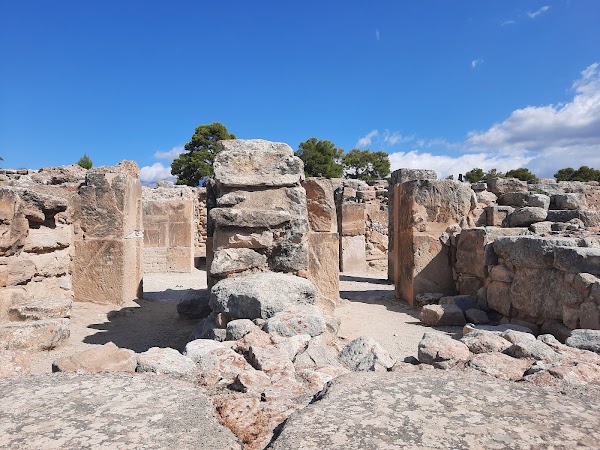
Phaistos sits on a hill with a sweeping view south toward the Libyan Sea. The stonework here is less restored, so you see the Minoan builders' technique more clearly — ashlar blocks fitted without mortar, corridors that turn at right angles, light wells that dropped sunshine into interior rooms. The famous Phaistos Disc was discovered here in 1908, a clay tablet stamped with a spiral of undeciphered symbols. No one has cracked the script, and no other example like it exists.
Malia feels quieter, less visited. The palace complex spreads low and horizontal, and you can walk through the central court where bull-leaping ceremonies may have taken place — young athletes vaulting over charging bulls, a ritual depicted in frescoes across Minoan sites. Look for the kernos stone near the north entrance, a circular altar with shallow cups carved into its surface, likely used for pouring libations of wine or oil.
Zakros lies at the end of a winding road through the Sitia mountains, close to the island's eastern tip. It was the last major palace to be excavated, in the 1960s, and its remoteness meant looters missed it. Archaeologists found workshops with raw materials still in place — elephant ivory, copper ingots, ostrich eggs — evidence of trade networks stretching to Egypt and the Near East. A spring still flows through the site, and Minoans channeled it into a stone basin that supplied the palace with fresh water.
All four palaces share a labyrinthine layout — twisting corridors, multiple stories, storage rooms branching off central courts. This complexity likely inspired the Greek myth of the Labyrinth, the maze King Minos built to imprison the Minotaur. The word "labyrinth" itself may derive from labrys, the double-headed axe that appears as a sacred symbol throughout Minoan art.
The palaces were destroyed around 1450 before Christ, possibly by the massive volcanic eruption on Thera, modern Santorini, or by invasion from Mycenaean Greeks, or both. Ash layers and fire damage mark the end. After the collapse, Mycenaeans occupied Knossos for a few centuries, but the distinctly Minoan culture — its art, its script, its religious iconography — vanished.
What survives are fragments. Frescoes of blue monkeys, dolphins, and saffron gatherers. Linear A tablets no one can read. The ghost of a trade empire that moved goods across the Bronze Age Mediterranean. Walking the trail, you are tracing not a single monument but the skeleton of a world — a network of power and exchange that predates the Greek city-states by a millennium.
The light on Crete is sharp and white, the kind that carves hard shadows across stone. As you move between sites, notice how each palace orients to the landscape — Knossos nestled in a valley, Phaistos commanding a plateau, Zakros opening toward the sea. The Minoans built with the land, not against it. That relationship is still legible in the ruins, waiting for you to walk it.
Stand in one of the central courts and listen. The wind moves through the columns. Somewhere beyond the site fence, a goat bell clinks. The stone under your hand is the same stone a Minoan scribe touched, carrying a tablet of accounts. The distance between you and them collapses for a moment, then opens again. That is what the trail offers — not answers, but proximity to questions we are still asking.
Key facts
What to look for
Practical tips
Common questions
How long do you need at Minoan Palaces Trail?
Plan Full day (multi–site). That is the time most visitors spend at Minoan Palaces Trail. The free Lokali audio guide adds about 9 minutes of narration you can listen to as you walk, so it fits inside your visit rather than adding to it.
Is there a free audio guide to Minoan Palaces Trail?
Yes — the Lokali app narrates Minoan Palaces Trail free of charge in 50+ languages. It covers the history, what to look for on site and practical tips, and it works offline once downloaded.
Where is Minoan Palaces Trail?
Minoan Palaces Trail is in Crete, Greece, at 35.2800, 25.1000. Tap the map link on this page for directions from where you are.
What should you know before visiting Minoan Palaces Trail?
Start early morning to avoid heat and crowds.
What is Minoan Palaces Trail known for?
Minoans flourished between 2700 and 1450 before Christ.
What is the best time to visit Minoan Palaces Trail?
Malia Palace, often overlooked, shows the everyday quarters of royal life—kitchens, workshops, storage.
On the map
Opens directions to Minoan Palaces Trail from your location.
More to see in Crete



Hear Minoan Palaces Trail in your language
The full story, narrated, in 50+ languages. Download it before you go and it plays offline, at your own pace, with no ticket and no tour group.