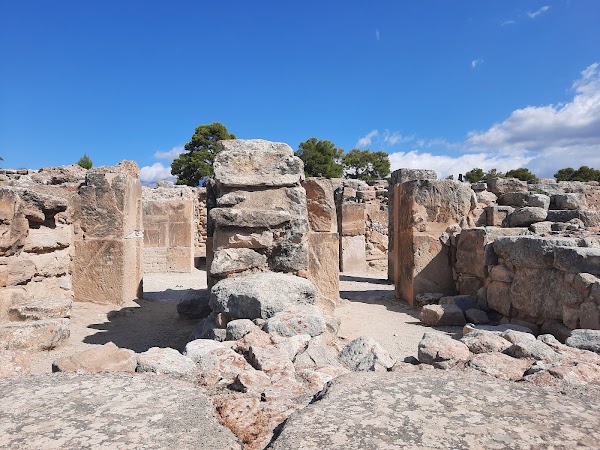
Palace of Phaistos
35.0518° N · 24.8142° E · Archaeological Site
Palace of Phaistos is an archaeological site in Crete, Greece. Second-largest Minoan palace complex on Crete, built around 1900 BCE on a hilltop commanding views of the Messara Plain and Mount Ida. Most visitors spend 1–2 hours here. The free Lokali audio guide runs 9 minutes.
✓ Verified August 2026 · how we write these guides
Visitor facts
| Time needed | 1–2 hours |
|---|---|
| Lokali audio guide | 9 min · free |
| Type | Archaeological Site |
| Best for | History |
| Location | Crete, Greece |
| Coordinates | 35.0518, 24.8142 |
| Languages | 45, in the Lokali app |
The story
The stone beneath your feet is smooth, worn by millennia of footsteps — Bronze Age sandals, Roman boots, modern soles. You are standing in one of the oldest palace complexes in Europe, built and rebuilt across five centuries before collapsing into silence around 1400 BCE. The light here is different from Knossos — sharper, more exposed, with the Messara Plain stretching south and the peaks of Mount Ida rising behind you.
Phaistos was the second great Minoan palace on Crete, rival or partner to Knossos depending on the century. The first palace rose around 1900 BCE, a sprawling complex of storerooms, workshops, and ceremonial halls. Then, around 1700 BCE, an earthquake leveled it. The Minoans cleared the rubble, raised the courtyard, and built again — the palace you see now. The new structure was grander, with wider staircases, deeper storage magazines, and a central court that could hold hundreds.
Walk toward the grand staircase on the western edge. It is one of the finest surviving pieces of Minoan engineering — twelve broad steps cut from local limestone, each worn into a gentle curve by the traffic of priests, traders, perhaps royalty. The staircase once led to a monumental entrance, now lost. Stand at the top and look east across the central court. This open rectangle, roughly fifty metres long, was the heart of the palace — a stage for rituals, bull-leaping, processions, perhaps trade negotiations with merchants from Egypt and the Levant.
The storerooms along the western side still hold their giant pithoi — clay jars taller than a person, sunk into the floor to keep oil and grain cool. Some are intact, their rims chipped but their bellies whole. Phaistos controlled the fertile Messara Plain, and these magazines could hold enough surplus to feed the palace through a failed harvest or fund an expedition across the sea. The Minoans were traders as much as builders, and Phaistos sat at the crossroads of routes linking Crete to North Africa and the eastern Mediterranean.
In 1908, the Italian archaeologist Federico Halbherr began excavating here. His team uncovered the palace layer by layer, and in the summer of that year, they found a small clay disc in a basement room on the northern edge of the site. The Phaistos Disc, as it became known, is one of the most mysterious objects in archaeology — a round tablet stamped with 241 symbols in a spiral, a script no one has convincingly deciphered. It sits now in the Heraklion Museum, but the room where it was found is still here, a modest chamber near the northern entrance.
Phaistos fell silent around the same time as the other Minoan palaces — 1450 to 1400 BCE, during a period of upheaval that saw Knossos burned and the palace culture collapse. Theories range from invasion by Mycenaean Greeks to internal revolt to environmental disaster. What is clear is that the site was never rebuilt. The ruins were picked over, the stones reused, and the palace became a memory. By the time the Romans arrived, Phaistos was already ancient.
The view from the northern terrace is worth the walk. From here, you can see the whole sweep of the Messara Plain, olive groves and vineyards spreading toward the Libyan Sea. On a clear day, the peaks of the White Mountains are visible to the west. The Minoans chose this site not just for its defensibility but for its command of the landscape — a palace that could see everything coming.
Move through the eastern wing, where the residential quarters likely stood. The rooms are smaller here, more intimate, with doorways that once held wooden frames and windows that opened onto courtyards. Fragments of frescoes were found in these rooms — reds, blues, yellows — though most have been removed for preservation. What remains are the walls themselves, the doorways, the sense of domestic life lived at the edge of ceremony.
The site is less restored than Knossos, which means it is also less certain. No concrete reconstructions, no painted columns. What you see is closer to what the archaeologists uncovered — raw stone, collapsed walls, the ghost of a floor plan. It requires more imagination, but it also feels more honest. You are looking at the bones of the palace, not a modern guess at its skin.
Before you leave, walk back to the central court and stand in the middle. Close your eyes for a moment. The wind here is steady, carrying the scent of wild thyme from the hills. When you open them, you are still in the present — but the stones around you have been holding their place for thirty-five centuries, waiting for you to arrive.
Key facts
What to look for
Practical tips
Common questions
How long do you need at Palace of Phaistos?
Plan 1–2 hours. That is the time most visitors spend at Palace of Phaistos. The free Lokali audio guide adds about 9 minutes of narration you can listen to as you walk, so it fits inside your visit rather than adding to it.
Is there a free audio guide to Palace of Phaistos?
Yes — the Lokali app narrates Palace of Phaistos free of charge in 50+ languages. It covers the history, what to look for on site and practical tips, and it works offline once downloaded.
Where is Palace of Phaistos?
Palace of Phaistos is in Crete, Greece, at 35.0518, 24.8142. Tap the map link on this page for directions from where you are.
What should you know before visiting Palace of Phaistos?
Arrive early morning for softer light and fewer crowds.
What is Palace of Phaistos known for?
Built around 1900 BCE, rebuilt after earthquake in 1700 BCE.
What is the best time to visit Palace of Phaistos?
Arrive early morning when light rakes across the stonework and tour groups have not yet filled the courtyards.
On the map
Opens directions to Palace of Phaistos from your location.
More to see in Crete




Hear Palace of Phaistos in your language
The full story, narrated, in 50+ languages. Download it before you go and it plays offline, at your own pace, with no ticket and no tour group.