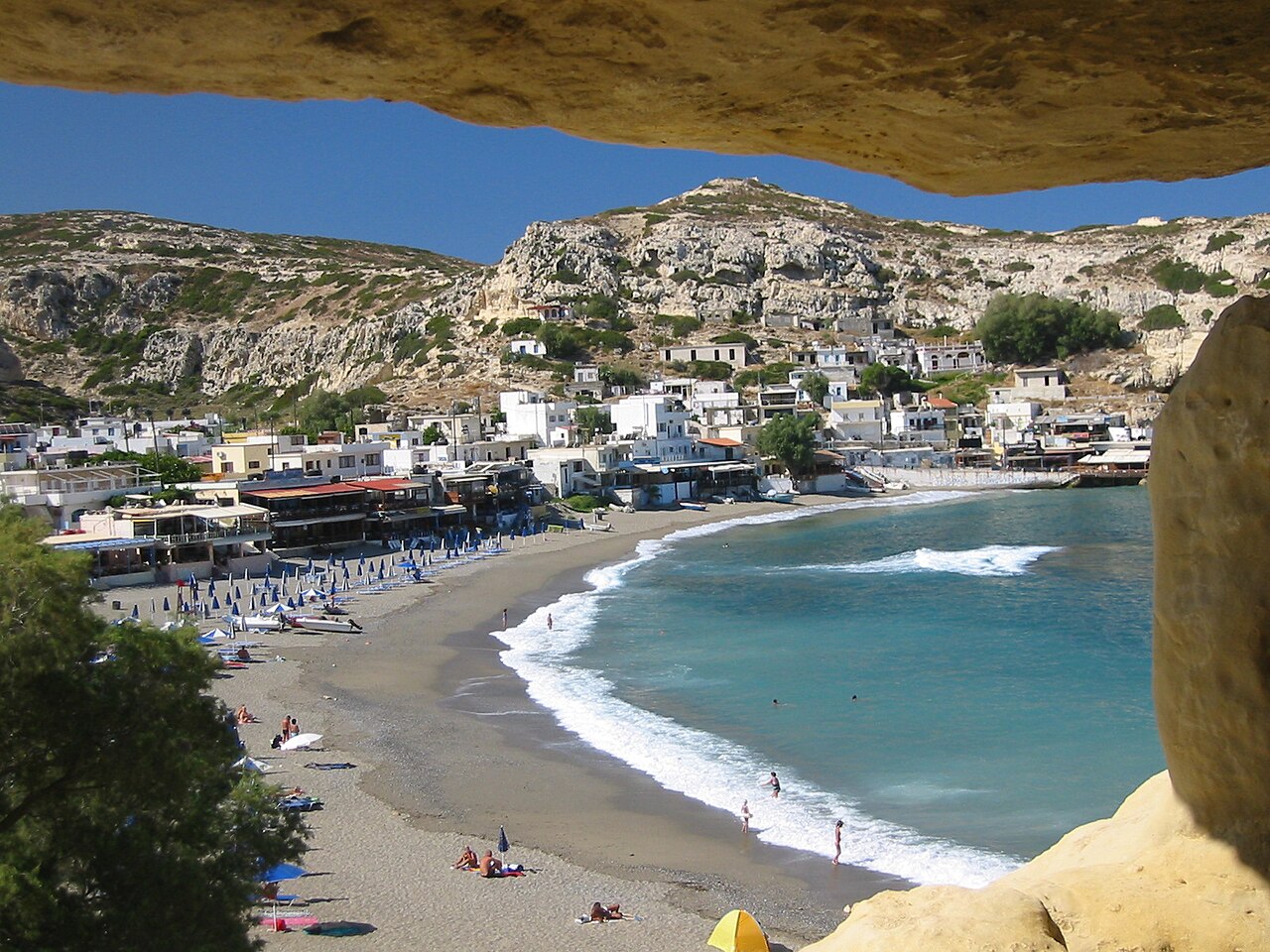
Matala Beach is a sandy bay backed by cliffs honeycombed with Roman-era tombs carved into the sandstone. It is in Crete, Greece. Most visitors spend 1–2 hours here. The free Lokali audio guide runs 9 minutes.
✓ Verified August 2026 · how we write these guides
Visitor facts
| Time needed | 1–2 hours |
|---|---|
| Lokali audio guide | 9 min · free |
| Type | Beach |
| Best for | Photography |
| Location | Crete, Greece |
| Coordinates | 34.9942, 24.7500 |
| Languages | 45, in the Lokali app |
The story
The sand here is coarse and golden, warmed by the afternoon sun, and the cliffs behind you are honeycombed with dark openings — caves carved into the soft limestone thousands of years ago. Matala Beach sits on the southern coast of Crete, where the Libyan Sea meets a crescent bay sheltered by those same cliffs, and the water runs from turquoise shallows to deep sapphire blue just a few metres out.
The caves are what make this place singular. They were cut by hand during Roman times, around the first and second centuries, as tombs — a necropolis facing the sea. The rock here is soft enough to carve with simple tools, and the Romans hollowed out chambers, some with niches for bodies, some with stone benches. You can still see tool marks on the interior walls if you climb up and look closely.
For centuries after the Romans left, the caves sat mostly empty. Fishermen sheltered in them during storms. Shepherds used them for storage. Then, in the late nineteen-sixties, something unexpected happened. Matala became a gathering point for travellers moving through Europe and the Mediterranean — young people looking for cheap places to sleep and a beach where nobody asked questions. The caves filled with backpackers, musicians, artists. Joni Mitchell spent time here in 1970, and later wrote about Matala in her song Carey. Cat Stevens visited. Bob Dylan, according to local stories, though that one is harder to verify.
The hippie era did not last long. By the mid-seventies, the Greek authorities fenced off the caves and declared them an archaeological site. Today you pay a small entrance fee to walk among them, and they are empty again except for tourists with cameras. But the village has kept some of that countercultural memory alive — murals on building walls, a music festival each June, a slightly bohemian tilt to the cafes along the waterfront.
The beach itself runs about three hundred metres end to end, backed by tamarisk trees that give scattered shade. The sand is mixed with small pebbles near the water. Waves here are usually gentle, but when the wind picks up from the south, the bay funnels swells straight onto the shore and swimming becomes rough. Most visitors come between May and September, when the water is warm and the sun reliable.
Stand at the northern end of the beach and look up at the cliffs. The cave entrances are stacked in irregular rows, some low enough to reach by scrambling, others high and accessible only by metal staircases installed for safety. Inside, the chambers are cool and dim, and the stone has a pale ochre colour that glows when sunlight reaches it. A few caves have small windows carved through to the next chamber, framing views of the sea.
The village behind the beach is small — a handful of streets, tavernas serving grilled fish and Greek salads, a few shops selling postcards and beachwear. In the main square, painted onto a whitewashed wall, you will find a large mural of a VW camper van and a peace sign, a nod to the decades when Matala was a symbol of alternative living. The tone today is quieter, more family-friendly, but the mural remains.
Matala sits about seventy-five kilometres southwest of Heraklion, Crete's capital, and the drive takes you through olive groves and small villages in the island's interior. The road drops down to the coast suddenly, and the bay opens in front of you all at once — cliffs, caves, blue water. It is a dramatic arrival.
If you swim out past the rocks at the southern edge of the bay, the seabed drops away sharply and the water turns a darker blue. Fish gather near the rocks — small silver ones that dart in schools, occasionally a larger grouper holding still in the shade. The water is clear enough that you can see the bottom even at three or four metres depth.
When the afternoon light slants in from the west, the cliffs glow amber and the cave openings turn to deep shadow. Visitors begin to leave, the beach empties, and the sound of the waves becomes louder. This is the best time to sit near the tamarisks and watch the colour drain from the rock as the sun drops toward the horizon. The caves have been here for two thousand years, and they will be here long after you walk back up the path to the village.
Key facts
What to look for
Practical tips
Common questions
How long do you need at Matala Beach?
Plan 1–2 hours. That is the time most visitors spend at Matala Beach. The free Lokali audio guide adds about 9 minutes of narration you can listen to as you walk, so it fits inside your visit rather than adding to it.
Is there a free audio guide to Matala Beach?
Yes — the Lokali app narrates Matala Beach free of charge in 50+ languages. It covers the history, what to look for on site and practical tips, and it works offline once downloaded.
Where is Matala Beach?
Matala Beach is in Crete, Greece, at 34.9942, 24.7500. Tap the map link on this page for directions from where you are.
What should you know before visiting Matala Beach?
Arrive late afternoon when cliffs glow amber in western light.
What is Matala Beach known for?
Caves carved as Roman tombs in first and second centuries.
What is the best time to visit Matala Beach?
The caves close at sunset, but the beach stays open.
On the map
Opens directions to Matala Beach from your location.
More to see in Crete




Hear Matala Beach in your language
The full story, narrated, in 50+ languages. Download it before you go and it plays offline, at your own pace, with no ticket and no tour group.