
Gortyn Archaeological Site
35.0619° N · 24.9483° E · Ancient Ruins
Gortyn Archaeological Site is an ancient ruins in Crete, Greece. Sprawling Roman provincial capital across olive groves, preserving the monumental Odeion with Europe's oldest law code inscribed in stone, a 6th-century basilica, and scattered temples. Most visitors spend 1–2 hours here. The free Lokali audio guide runs 9 minutes.
✓ Verified August 2026 · how we write these guides
Visitor facts
| Time needed | 1–2 hours |
|---|---|
| Lokali audio guide | 9 min · free |
| Type | Ancient Ruins |
| Best for | History |
| Location | Crete, Greece |
| Coordinates | 35.0619, 24.9483 |
| Languages | 45, in the Lokali app |
The story
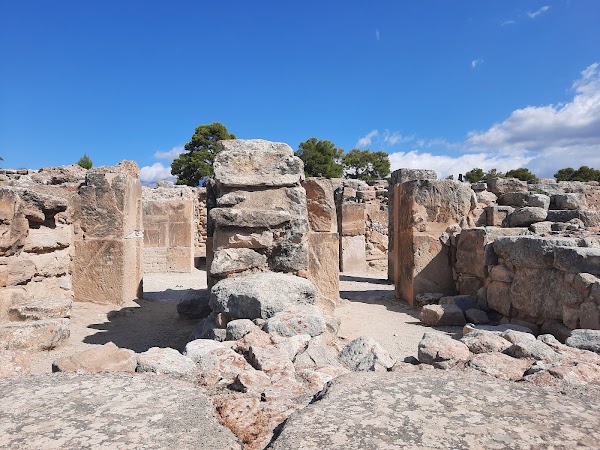
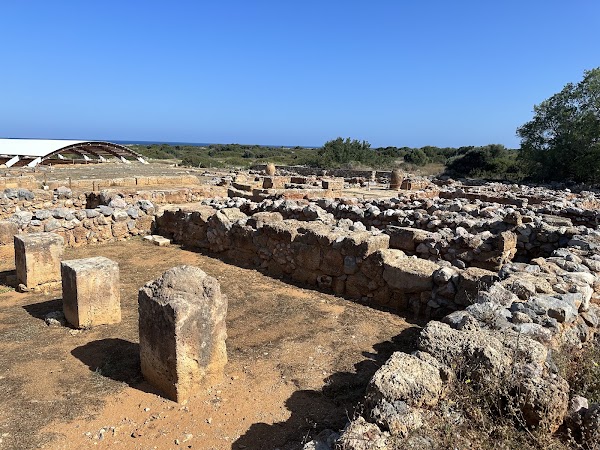
The ground beneath your feet is soft with centuries of dust, and the air smells faintly of wild thyme crushed underfoot. You are standing in what was once the beating heart of Roman Crete — Gortyn, a city that ruled this island for nearly a millennium. Around you, broken columns lean at odd angles, their marble surfaces warm in the afternoon light. The ruins sprawl across olive groves and wheat fields, half-buried, half-exposed, as if the earth itself cannot decide whether to keep or release them.
Gortyn's story begins long before Rome. The city appears in Greek myth as the place where Zeus, disguised as a bull, brought Europa after abducting her from the Phoenician coast. Under the shade of an evergreen plane tree — a tree that, legend says, never lost its leaves — Zeus revealed himself, and Europa bore three sons. One of them, Minos, would become the legendary king of Knossos. Whether or not you believe the myth, the plane tree became sacred, and Gortyn became a place of power.
By the fifth century before Christ, Gortyn was already a major city-state, wealthy from trade and agriculture. But its greatest claim to fame is carved into stone right here — the Law Code of Gortyn, inscribed around four hundred and fifty before Christ. These twelve columns of limestone, arranged in a long wall, contain one of the oldest and most complete legal texts in Europe. The letters are written boustrophedon — meaning the lines alternate direction, left to right, then right to left, like an ox plowing a field. Stand close and you can still read them, though the language is archaic Doric Greek. The laws cover marriage, divorce, property rights, and the treatment of slaves. They are pragmatic, detailed, and surprisingly progressive in some respects — women, for instance, could own property and initiate divorce.
When Rome conquered Crete in sixty-seven before Christ, Gortyn became the capital of the new province of Crete and Cyrenaica. The Romans built lavishly. They raised a massive forum, an odeon for musical performances, a theater, baths, temples, aqueducts. The city grew to cover nearly four hundred hectares, home to perhaps thirty thousand people. You are standing in the ruins of that empire now — fragments of columns, the curve of an apse, a stretch of paving stone worn smooth by Roman sandals.
The most striking structure still standing is the basilica of Saint Titus, built in the sixth century after Christ. Titus was a companion of the apostle Paul, sent to Crete to establish the early Christian church. His basilica here was one of the largest in the eastern Mediterranean, with three aisles and a soaring apse. Today only the apse remains intact, a graceful curve of brick and stone rising above the wheat. The rest is rubble and foundation walls, but the scale is still breathtaking. Walk inside the apse and notice how the acoustics change — your footsteps echo, and the space feels suddenly enclosed, sacred.
Gortyn was destroyed by Arab raiders in the eighth century after Christ. The city burned, its population fled or was enslaved, and the ruins were gradually swallowed by fields and scrub. For over a thousand years, farmers plowed around the broken stones, and shepherds grazed their flocks among the columns. It was not until the late nineteenth century that Italian archaeologists began serious excavation. Much of the site remains unexcavated even now — beneath the olive groves, ground-penetrating radar has revealed entire neighborhoods still buried.
As you walk through the site, notice the layering of history. Roman bricks rest on Greek foundations. Byzantine mosaics lie scattered among pagan altars. A Christian basilica was built directly over a temple to Apollo. This is not a single monument frozen in time — it is a palimpsest, a place where cultures wrote and rewrote themselves over two thousand years. The stones do not speak of one empire, but of many.
Look carefully at the columns near the odeon. Some are fluted in the classical Greek style, others are smooth Roman shafts, and a few show crude medieval repairs — mismatched pieces stacked together after earthquakes. Each column tells a story of survival, adaptation, and eventual collapse. The marble has weathered to a pale honey color, and in the late afternoon light, the whole site glows.
One detail most visitors miss: scattered across the site are dozens of stone sarcophagi, some still sealed, others broken open by treasure hunters centuries ago. The lids are massive slabs of limestone, carved with simple geometric patterns. Stand beside one and run your hand along the edge — the stone is cool and slightly rough, pitted by rain and wind. These are not the tombs of emperors or bishops, but of ordinary citizens, merchants and farmers and craftsmen, buried here when Gortyn was still a living city.
The site is open to the sky, with no ropes or barriers, so you can wander freely among the ruins. In spring, the fields around Gortyn explode with wildflowers — poppies, chamomile, purple vetch. In summer, the heat is fierce, and the cicadas sing so loudly you can barely hear yourself think. In autumn, the light softens, and the shadows of the columns stretch long across the ground. Winter brings rain, and the stones turn dark and slick.
Before you leave, walk to the western edge of the site, where the land drops away toward the Messara Plain. From here, you can see the full sweep of the valley, olive groves stretching to the mountains, the white villages scattered like dice. This is the view Roman governors saw two thousand years ago, standing in the same spot, surveying their domain. The empire is gone, but the land remains, patient and indifferent.
As you turn to go, take one last look at the apse of Saint Titus, rising solitary above the ruins. The bricks are warm in your hand, the stones underfoot are uneven, and somewhere in the olive grove behind you, a dog barks. Gortyn is not a museum. It is a field, a farm, a place where history and the present blur together, where you can touch the past without glass between you.
Key facts
What to look for
Practical tips
Common questions
How long do you need at Gortyn Archaeological Site?
Plan 1–2 hours. That is the time most visitors spend at Gortyn Archaeological Site. The free Lokali audio guide adds about 9 minutes of narration you can listen to as you walk, so it fits inside your visit rather than adding to it.
Is there a free audio guide to Gortyn Archaeological Site?
Yes — the Lokali app narrates Gortyn Archaeological Site free of charge in 50+ languages. It covers the history, what to look for on site and practical tips, and it works offline once downloaded.
Where is Gortyn Archaeological Site?
Gortyn Archaeological Site is in Crete, Greece, at 35.0619, 24.9483. Tap the map link on this page for directions from where you are.
What should you know before visiting Gortyn Archaeological Site?
Visit early morning or late afternoon for softer light.
What is Gortyn Archaeological Site known for?
Capital of Roman Crete from sixty-seven before Christ.
What is the best time to visit Gortyn Archaeological Site?
Walk to the far end past the basilica to find the Roman theatre half-buried in earth — fewer visitors, better light in late afternoon, and you can trace the full curve of seating.
On the map
Opens directions to Gortyn Archaeological Site from your location.
More to see in Crete



Hear Gortyn Archaeological Site in your language
The full story, narrated, in 50+ languages. Download it before you go and it plays offline, at your own pace, with no ticket and no tour group.