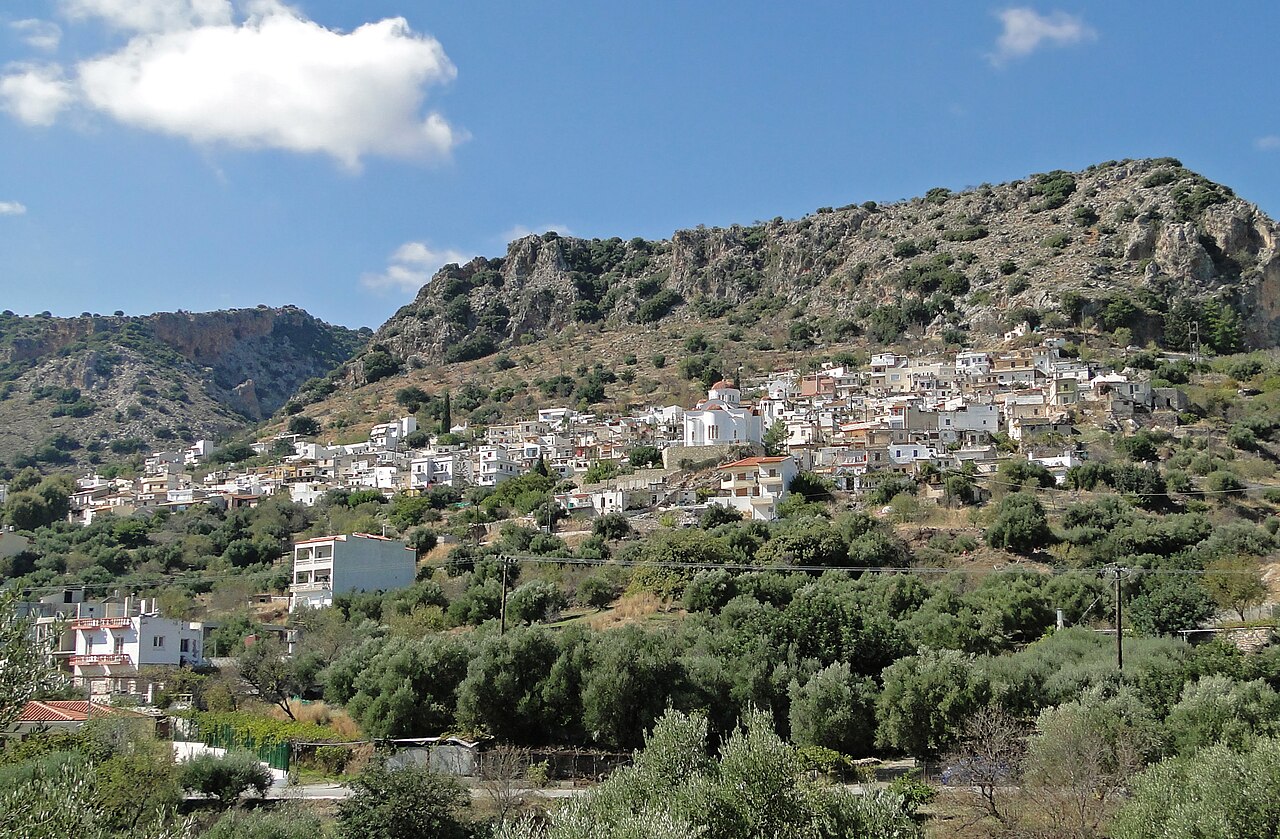
Kritsa Village is a mountain village in Crete, Greece. Traditional Cretan village climbing the slopes above Agios Nikolaos, known for handwoven textiles and narrow stone lanes. Most visitors spend 1–2 hours here. The free Lokali audio guide runs 9 minutes.
✓ Verified August 2026 · how we write these guides
Visitor facts
| Time needed | 1–2 hours |
|---|---|
| Lokali audio guide | 9 min · free |
| Type | Mountain Village |
| Best for | Local life |
| Location | Crete, Greece |
| Coordinates | 35.1583, 25.6419 |
| Languages | 45, in the Lokali app |
The story
The road narrows as you climb, twisting through olive groves that silver in the breeze. Then the houses appear — stone and ochre, stacked against the hillside like a tumble of worn dice. This is Kritsa, a mountain village clinging to the slopes above the Cretan coast, where the air smells of wild thyme and the streets are too steep for anything but footsteps.
Kritsa sits about ten kilometres inland from Agios Nikolaos, high enough that the sea becomes a distant blue stripe. The village has been here for centuries — some say since Venetian times, others trace threads back to Byzantine refugees fleeing coastal raids. What matters now is the texture: narrow lanes paved in stone, whitewashed walls hung with bougainvillea, doorways framed in blue paint to ward off the evil eye. The houses press close, their upper floors nearly touching across the alley, creating cool tunnels of shade even at midday.
This is not a museum village. People live here year-round. You will see old women in black dresses sitting in doorways, crocheting lace with hands that have worked the same patterns for sixty years. Kritsa became famous for its textiles — woven rugs, embroidered linens, lace tablecloths — and many of the shops lining the main street still sell handmade goods, though tourism has shifted the balance. Some pieces are local work, others trucked in from factories elsewhere. The genuine articles cost more and take longer to examine, but you can tell by the irregularity of the stitches, the weight of the fabric.
The village church, dedicated to the Virgin Mary, stands near the centre, its bell tower visible from most approaches. Inside, the iconostasis is carved wood darkened by centuries of candle smoke. Icons lean against the walls, some recent, others so worn the faces have nearly vanished into shadow. On feast days the church fills, incense thick enough to taste, voices rising in Byzantine chant that has not changed its melody in a thousand years.
Just outside the village — a ten-minute walk down a signposted path — sits the church of Panagia Kera, one of the finest examples of Byzantine fresco work on Crete. Built in the thirteenth or fourteenth century, the interior walls are covered floor to ceiling in painted scenes: the life of Christ, the Virgin enthroned, saints and martyrs rendered in ochre, blue, and red. The colours have faded but the compositions remain vivid, figures floating in a golden otherworld. Art historians travel here specifically for these frescoes. If you visit, go slowly. Let your eyes adjust to the dim light, then start at the entrance and work your way around. The details emerge gradually — a hand gesture, a fold of drapery, a demon's grimace.
Back in the village, the main street climbs steeply, splitting into smaller lanes that dead-end at garden walls or open suddenly onto views of the valley below. Kritsa is built for walking, but not casually. The stone underfoot is polished smooth by generations of footsteps, slippery when wet. Wear shoes with grip. Pause often, not just for breath but to notice the small things: a lemon tree heavy with fruit in a courtyard, a cat asleep on a windowsill, the way the light slants through a vine-covered pergola in the late afternoon.
The village has a handful of tavernas, most clustered near the lower end of the main street where tour buses can park. The food is traditional Cretan — dakos, lamb with stamnagathi greens, fresh cheese drizzled with honey. Some places are better than others. Look for the taverna where locals eat, usually one street back from the main drag, where the menu is handwritten and the waiter is someone's uncle. Order what the kitchen recommends that day.
Kritsa empties in the evenings once the day-trippers leave. If you are staying nearby, come back after sunset. The streets grow quiet, the shops close their shutters, and the village returns to itself. You might hear a radio playing somewhere, or the clatter of dishes being washed, or nothing at all except the wind moving through the olive trees below. The lights of Agios Nikolaos glitter on the coast, but up here the darkness is almost complete.
As you leave, glance back at the village from the road. It looks timeless from a distance, a cluster of stone and tile against the mountain. But timeless is the wrong word. Kritsa is not frozen — it is continuous, adapting without erasing itself. The old women still crochet, the church bells still ring, the stones underfoot still carry the weight of everyone who has climbed this hill before you. That is what you take with you: not a postcard image, but the sense of a place still living its own life, indifferent to whether you noticed or not.
Key facts
What to look for
Practical tips
Common questions
How long do you need at Kritsa Village?
Plan 1–2 hours. That is the time most visitors spend at Kritsa Village. The free Lokali audio guide adds about 9 minutes of narration you can listen to as you walk, so it fits inside your visit rather than adding to it.
Is there a free audio guide to Kritsa Village?
Yes — the Lokali app narrates Kritsa Village free of charge in 50+ languages. It covers the history, what to look for on site and practical tips, and it works offline once downloaded.
Where is Kritsa Village?
Kritsa Village is in Crete, Greece, at 35.1583, 25.6419. Tap the map link on this page for directions from where you are.
What should you know before visiting Kritsa Village?
Wear shoes with good grip for steep slippery streets.
What is Kritsa Village known for?
Located ten kilometres inland from Agios Nikolaos.
What is the best time to visit Kritsa Village?
Walk the upper alleys early before the heat—elderly women sit weaving in doorways, and the smell of baking bread drifts from stone ovens.
On the map
Opens directions to Kritsa Village from your location.
More to see in Crete



Hear Kritsa Village in your language
The full story, narrated, in 50+ languages. Download it before you go and it plays offline, at your own pace, with no ticket and no tour group.