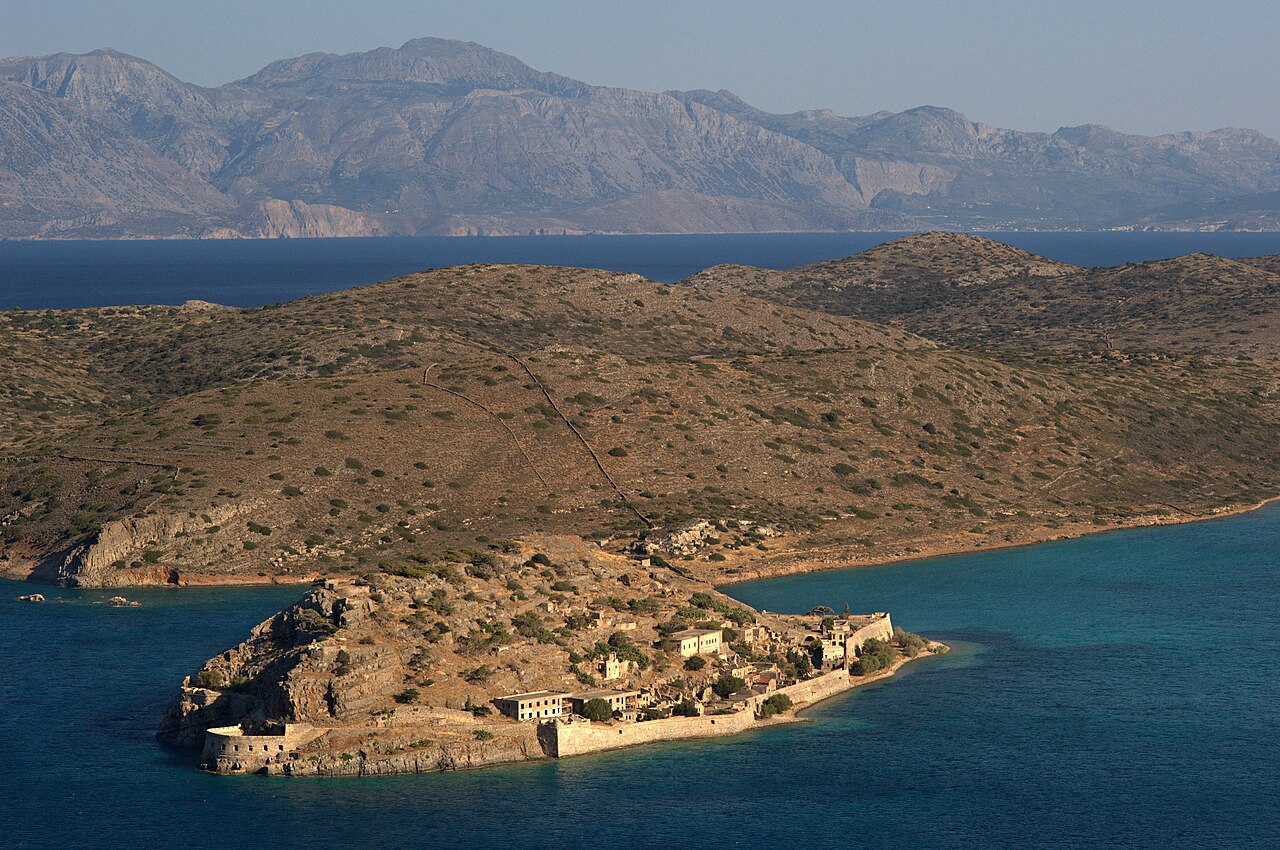
Spinalonga Fortress
35.2981° N · 25.7406° E · Historic Fort
Spinalonga Fortress is a Venetian fortress island in the Gulf of Elounda, Crete, built in 1579 to defend against Ottoman raids. It is in Crete, Greece. Most visitors spend 2–3 hours here. The free Lokali audio guide runs 9 minutes.
✓ Verified August 2026 · how we write these guides
Visitor facts
| Time needed | 2–3 hours |
|---|---|
| Lokali audio guide | 9 min · free |
| Type | Historic Fort |
| Best for | History |
| Location | Crete, Greece |
| Coordinates | 35.2981, 25.7406 |
| Languages | 45, in the Lokali app |
The story
The first thing you notice as you step onto the island is the silence. The wind off the Cretan sea carries salt and the faint scent of wild herbs, but there are no voices now, no clatter of daily life against these stone walls. Spinalonga sits in the Gulf of Elounda, a small rocky outcrop that has worn many identities over the centuries, each one leaving its mark in the layered architecture around you.
The Venetians built this fortress in the fifteen-fifties, carving defensive walls directly into the island's natural rock. They needed a stronghold to protect the salt pans of Elounda and control the shipping lanes into the bay. The walls you see climbing the slopes are Venetian work, thick and angled to deflect cannon fire, with bastions positioned to cover every approach from the sea. Walk along the main path and you will pass through the original gate, its stone lintel still bearing the lion of Saint Mark, though centuries of weather have softened the carving.
After the Venetians lost Crete to the Ottomans in the sixteen-sixties, Spinalonga held out for another half-century. It became a refuge for Venetian families and Greek Christians who refused Ottoman rule, a tiny republic of resistance supplied by ships from the Ionian islands. The Ottomans finally took the fortress in seventeen-fifteen, not by siege but by negotiation, and they turned it into a thriving trading post. The narrow streets you climb today, the small houses pressed shoulder to shoulder, most of those date from the Ottoman period when merchants and their families lived here year-round.
By the early twentieth century, the fortress had lost its strategic value. In nineteen-oh-three, the newly autonomous Cretan government repurposed Spinalonga as a leper colony, a place to isolate people with Hansen's disease. For the next fifty years, hundreds of patients lived here, building a community in the shadow of the Venetian walls. They opened shops, a school, a church, even a small cinema. The colony had its own elected council and a surprising degree of self-governance, though the patients could never leave.
Walk up toward the hospital ruins and you will see the remains of that twentieth-century village layered over the Ottoman houses. Doorways lead into roofless rooms where plaster still clings to the walls in patches. The church of Saint Panteleimon, built by the patients themselves, stands near the centre of the settlement, its blue-painted interior surprisingly intact. The leper colony closed in nineteen-fifty-seven, one of the last in Europe, after new drug treatments made isolation unnecessary.
The fortress sits empty now, but the layering of history is everywhere. Venetian gun emplacements overlook Ottoman cisterns. A Turkish mosque, its minaret long collapsed, shares a courtyard with a Greek Orthodox chapel. The paths wind past fragments of all three eras, stone speaking to stone across centuries. The island is small enough to walk end to end in thirty minutes, but the density of story packed into this rock takes longer to absorb.
Climb to the highest bastion on the northern side for a view across the strait to the Cretan mainland. From here you can see why the Venetians chose this spot, how the fortress commands the narrow channel and the salt flats beyond. The wind is stronger up here, steady and cool even in summer. Below, the sea shifts between turquoise and deep blue depending on the depth, and you can trace the submerged causeway that once connected Spinalonga to the shore before Venetian engineers cut through it to make the island defensible.
As you walk back down toward the landing, look for the graffiti scratched into the plaster of the old houses. Some of it is recent, tourists leaving their marks, but some dates from the colony years, names and dates and small prayers in Greek. One doorway near the main path has a carved wooden lintel, painted green, that somehow survived the decades of abandonment. It is these small domestic details, not the grand military architecture, that bring the island's human scale back into focus.
The boat that brought you here will return in an hour or so, enough time to sit on the stone steps near the landing and let the place settle. The silence is not quite complete—there are gulls, and the slap of water against the breakwater, and the occasional voice of another visitor drifting up from the lower paths. But the quiet is what stays with you, the sense of a place that has outlasted its purposes and now simply exists, stone and sea and the long memory of those who lived here when they could live nowhere else.
Key facts
What to look for
Practical tips
Common questions
How long do you need at Spinalonga Fortress?
Plan 2–3 hours. That is the time most visitors spend at Spinalonga Fortress. The free Lokali audio guide adds about 9 minutes of narration you can listen to as you walk, so it fits inside your visit rather than adding to it.
Is there a free audio guide to Spinalonga Fortress?
Yes — the Lokali app narrates Spinalonga Fortress free of charge in 50+ languages. It covers the history, what to look for on site and practical tips, and it works offline once downloaded.
Where is Spinalonga Fortress?
Spinalonga Fortress is in Crete, Greece, at 35.2981, 25.7406. Tap the map link on this page for directions from where you are.
What should you know before visiting Spinalonga Fortress?
Boats run regularly from Elounda and Plaka in summer.
What is Spinalonga Fortress known for?
Venetians built the fortress in the fifteen-fifties.
What is the best time to visit Spinalonga Fortress?
Walk the main street at dawn before tour boats arrive — the silence among the abandoned shops and homes feels suspended in time.
On the map
Opens directions to Spinalonga Fortress from your location.
More to see in Crete



Hear Spinalonga Fortress in your language
The full story, narrated, in 50+ languages. Download it before you go and it plays offline, at your own pace, with no ticket and no tour group.