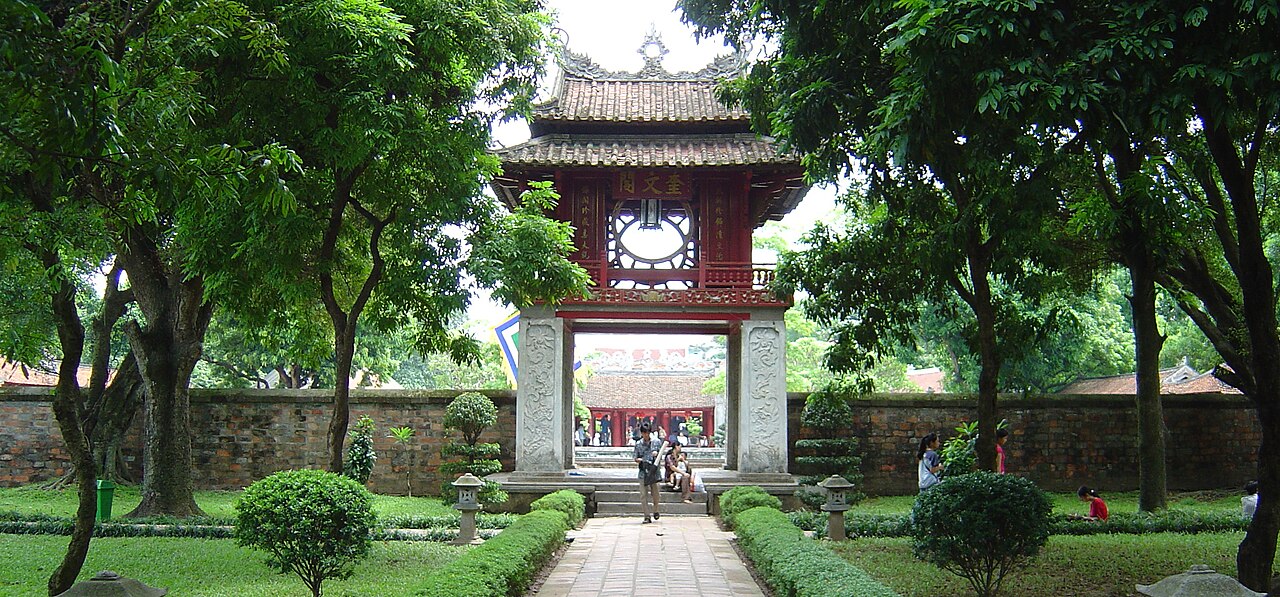
Temple of Literature is a temple in Hà Nội, Vietnam. Vietnam's first national university, founded in 1070. Most visitors spend 60–90 min here. The free Lokali audio guide runs 5 minutes.
✓ Verified August 2026 · how we write these guides
Visitor facts
| Time needed | 60–90 min |
|---|---|
| Lokali audio guide | 5 min · free |
| Type | Temple |
| Best for | History |
| Location | Hà Nội, Vietnam |
| Coordinates | 21.0276, 105.8345 |
| Languages | 45, in the Lokali app |
The story
Step through the gate and the noise of the city falls away. The traffic fades behind old brick walls. Ahead, a long path runs between tall trees and still ponds. The air smells of incense and damp stone. This is the Temple of Literature, a place built for learning almost a thousand years ago.
The temple was founded in 1070, under Emperor Ly Thanh Tong. At first it honored Confucius, the Chinese teacher whose ideas shaped how Vietnam viewed study and order. Six years later, in 1076, the country opened its first national university here. It was called the Imperial Academy. For a long time, only the sons of nobles could enter. Later, gifted students from common families were allowed in too. The exams tested poetry, history, and the teachings of Confucius.
The grounds are divided into five courtyards, one after another. You walk through them in a straight line, from the entrance toward the back. Each courtyard is quieter and more sacred than the last. The design is meant to slow you down. As you move forward, you leave the ordinary world behind and approach the world of knowledge.
In the third courtyard you reach a large square pond, calm and green. It is called the Well of Heavenly Clarity. On both sides stand rows of stone tablets. Each tablet rests on the back of a carved stone turtle. The turtle is a sign of wisdom and long life. Look closely at the faces of these turtles. Each one is a little different. Some turtles look up, while others pull their heads in.
These stone tablets are the heart of the temple. They are called the doctoral stelae. They record the names and home villages of students who passed the highest royal exams. The first tablets were carved in 1484, under Emperor Le Thanh Tong. Once there were many more. Today 82 remain. Together they list 1307 graduates from 82 separate examinations. Reading them, you can find the home village of a scholar who lived five hundred years ago.
Passing these exams was very hard. They were held only once every three years. A scholar might study for decades and still fail. Those who succeeded brought great honor to their families and villages. Their names were cut into stone so they would not be forgotten. In 2010, these tablets were added to a UNESCO register of important world documents.
Walk on, and you come to the temple buildings themselves. Here Confucius is honored, along with four of his closest students. Red lacquer and gold paint cover the wooden beams. The roofs curve upward at the corners. Bronze cranes stand on the backs of tortoises. The smell of incense grows stronger here. People still come to pray before exams of their own. Long wooden halls run along the sides of the courtyard.
For centuries, this was the center of learning for the whole country. Students lived and studied on these grounds. They read the classic texts, practiced calligraphy, and prepared for the exams that could change their lives. The academy stayed open until 1779, more than seven hundred years after it began.
Notice the gates and walls as you pass through them. They were built to mark stages of a journey. One gate is named for a group of stars linked to scholars and writing. The whole temple is a kind of map. It shows the path a student must walk, from beginner to master, with patience at every step.
The trees here are old. Some have stood for many generations. Their shade has fallen on countless students over the years. Frangipani flowers drop onto the stone paths. In the early morning, before the crowds arrive, the courtyards are very still. You can almost hear the quiet that scholars once needed to think. Birds call from the high branches overhead.
Today the Temple of Literature appears on the back of a Vietnamese banknote. It is one of the most loved places in Hanoi. Graduates come here in their gowns to take photographs. Children come to learn about the past. The place that once trained a chosen few has become a place for everyone. At the lunar new year, calligraphers gather near the walls to write good wishes in ink.
Before you leave, stop once more by the turtles and their stone tablets. Each name carved there belonged to a real person, with hopes and fears like your own. They studied by candlelight and waited years for a single result. Standing here, in the cool shade, you join a long line of people who came to this quiet place to learn.
Key facts
What to look for
Practical tips
Common questions
How long do you need at Temple of Literature?
Plan 60–90 min. That is the time most visitors spend at Temple of Literature. The free Lokali audio guide adds about 5 minutes of narration you can listen to as you walk, so it fits inside your visit rather than adding to it.
Is there a free audio guide to Temple of Literature?
Yes — the Lokali app narrates Temple of Literature free of charge in 50+ languages. It covers the history, what to look for on site and practical tips, and it works offline once downloaded.
Where is Temple of Literature?
Temple of Literature is in Hà Nội, Vietnam, at 21.0276, 105.8345. Tap the map link on this page for directions from where you are.
What should you know before visiting Temple of Literature?
Arrive early in the morning to avoid the crowds.
What is Temple of Literature known for?
Founded in 1070 under Emperor Ly Thanh Tong.
What is the best time to visit Temple of Literature?
The second courtyard holds 82 stone tortoises inscribed with names of successful exam candidates — touch them for scholarly luck.
On the map
Opens directions to Temple of Literature from your location.
More to see in Hà Nội


Hear Temple of Literature in your language
The full story, narrated, in 50+ languages. Download it before you go and it plays offline, at your own pace, with no ticket and no tour group.