
Photo: A. Fabbretti · CC BY-SA 3.0 · Wikimedia Commons
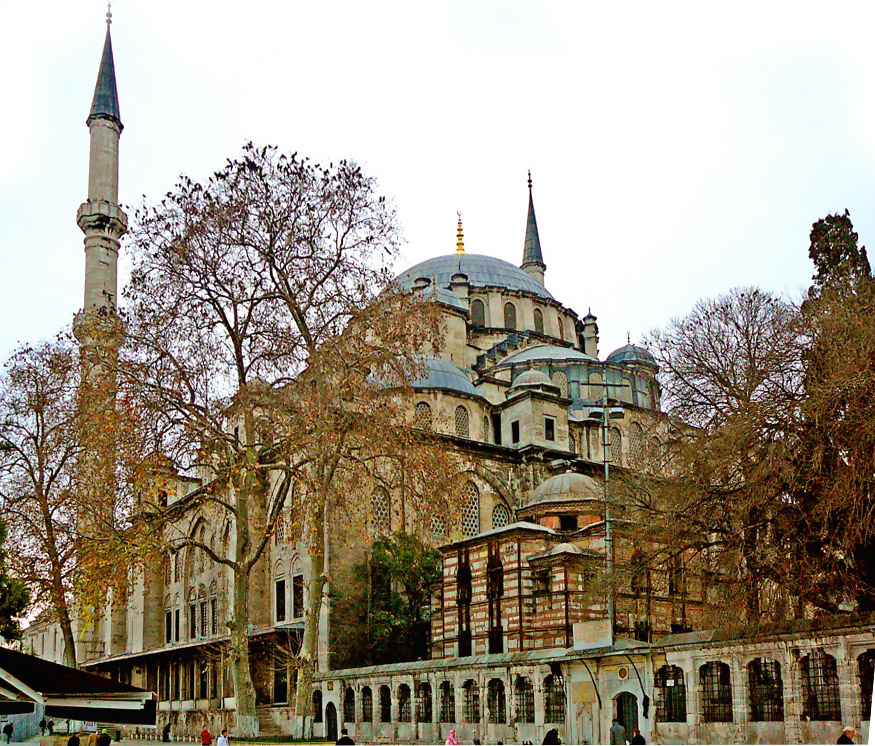
Eski Imaret Mosque is a mosque in İstanbul, Turkey. Generally identified as the Byzantine church of Christ Pantepoptes. The free Lokali audio guide runs 7 minutes.
✓ Published October 2026 · how we write these guides
Visitor facts
| Lokali audio guide | 7 min · free |
|---|---|
| Type | Mosque |
| Location | Istanbul, Türkiye |
| Coordinates | 41.0217, 28.9550 |
| Languages | 50+, in the Lokali app |
The story
Start with the walls. Run your eyes along the brick and you will see something odd. Thin red layers of brick alternate with thick pale bands of mortar, almost as wide as the bricks themselves. The surface looks striped, like a layered cake left out in the sun. Above you, a dome sits on a many-sided drum, its tall windows letting in a soft, even light. The street around you is quiet. Laundry hangs from balconies. Somewhere a cat is watching you.
This is Eski Imaret Mosque, in the old Fatih district of Istanbul, on the slopes above the Golden Horn. It does not look like the mosques most visitors come to see. There are no cascading domes here, no grand courtyard, no crowd of tour groups. Instead, you are standing in front of a building that began its life as a Byzantine church, nearly a thousand years ago. Most people walk past it without knowing.
Scholars generally identify this building as the church of a monastery called Christ Pantepoptes. That Greek name means Christ the All-Seeing. It is a fitting name for a church on a hill. From this height, the monastery once looked out over the harbour and the city below. Historians link its founding to the late eleventh century, and to a powerful woman of the Byzantine court, Anna Dalassene.
Anna Dalassene was the mother of Emperor Alexios the First Komnenos, who rose to power in 1081. She was no quiet figure in the background. According to the Byzantine sources, her son gave her extraordinary authority over the running of the empire while he was away at war. She was known for her strict piety, and founding a monastery was one way a person of her rank showed both faith and status. This church is part of that story.
Now look again at those striped walls. This is a building method that architectural historians call the recessed brick technique. Builders set every second course of brick slightly back from the wall face. Then they covered those recessed bricks with a thick layer of mortar. From a distance, you see only half the bricks. It was a common method in Constantinople during this period, and this church is one of the clearest surviving examples in the city.
The overall shape follows a plan typical of middle Byzantine churches, known as the cross-in-square. Imagine a square room, with a cross drawn inside it, and a dome placed at the centre where the arms meet. Four supports hold up the dome. Smaller spaces fill the corners. At the west end, there is an entrance hall called a narthex, and the church also had an outer porch. It is a compact, carefully balanced design.
Walk slowly around the exterior if the street allows. On the east end, you will see the curved apses, which held the altar in the church's Christian days. Look closely at the brickwork here. Byzantine builders liked to add decorative touches using brick alone. You may notice patterns, small arches and bands set into the walls. These details are easy to miss, but they show how much care went into a surface that most people pass in seconds.
The church also appears in one of the darkest moments in the city's history. In 1204, the armies of the Fourth Crusade attacked Constantinople. According to the Byzantine historian Niketas Choniates, the emperor of that moment, Alexios the Fifth, set up his command post near this monastery during the siege. From this hill, he could watch the enemy fleet in the Golden Horn. The city fell, and the crusaders sacked it. The monastery was plundered along with much of the city.
After the Ottoman conquest of the city in 1453, the building found a new role. Sultan Mehmed the Second, the conqueror of Constantinople, was building his great mosque complex nearby, the Fatih Mosque. While that work went on, this old church was put to use as an imaret. An imaret was a public kitchen that served meals to students, scholars and the poor. That is where the name comes from. Eski Imaret simply means the Old Imaret.
Later, the building was converted into a mosque, and it has served the neighbourhood as a place of prayer ever since. A minaret was added, and the interior was adapted for Islamic worship. So the walls in front of you carry traces of two faiths and two empires. A Byzantine church, a soup kitchen for an Ottoman sultan's scholars, and then a neighbourhood mosque. Few buildings in Istanbul have changed roles so quietly.
Here is something many visitors do not realise. Istanbul still has a surprising number of Byzantine churches that became mosques, scattered through these back streets. The nearby Zeyrek Mosque, once the great Pantokrator monastery, is one of them. Eski Imaret is smaller and less visited. That makes it one of the best places to see Byzantine brickwork up close, without crowds, and in the ordinary daily life of a living neighbourhood.
If you go inside, remember that this is an active mosque. Remove your shoes at the entrance, dress modestly, and avoid visiting during prayer times. Inside, look up at the dome and notice how the light falls through the windows of the drum. The space feels intimate, almost private. Take a moment to sit quietly. The proportions you see were planned by Byzantine builders, and they still shape how the room feels today.
Before you leave, step back across the street and look at the building as a whole. Notice the pale mortar bands catching the light, and the curve of the dome against the sky. Listen to the neighbourhood around you, the voices from windows, the footsteps on the hill. Nine centuries of people have walked past these same walls. As you head down toward the Golden Horn, look out for other old brick walls along the way. Some of them may be older than you think.
Key facts
What to look for
Practical tips
Common questions
Is there a free audio guide to Eski Imaret Mosque?
Yes — the Lokali app narrates Eski Imaret Mosque free of charge in 50+ languages. The guide runs about 7 minutes, covers the history, what to look for on site and practical tips, and works offline once downloaded.
Where is Eski Imaret Mosque?
Eski Imaret Mosque is in Istanbul, Türkiye, at 41.0217, 28.9550. Tap the map link on this page for directions from where you are.
What is Eski Imaret Mosque known for?
Generally identified as the Byzantine church of Christ Pantepoptes. Pantepoptes is Greek for Christ the All-Seeing.
What should you look for at Eski Imaret Mosque?
Thick pale mortar bands between thin layers of red brick. The dome set on a tall many-sided drum. Curved apses on the eastern end of the building.
What should you know before visiting Eski Imaret Mosque?
Remove your shoes and dress modestly before entering the mosque. Avoid visiting during the five daily prayer times.
On the map
Opens directions to Eski Imaret Mosque from your location.
More to see in Istanbul



Hear Eski Imaret Mosque in your language
The full story, narrated, in 50+ languages. Download it before you go and it plays offline, at your own pace, with no ticket and no tour group.