
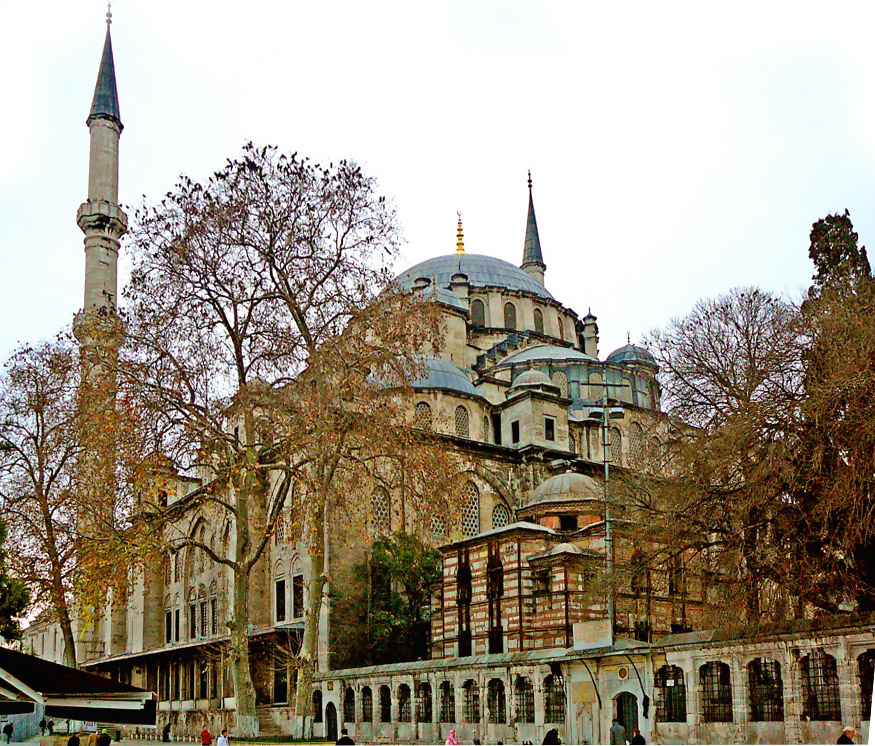
Photo: Sharon Nathan · CC BY-SA 4.0 · Wikimedia Commons
Zeyrek Mosque is a religious building from the Byzantine Empire period. It is in Istanbul, Türkiye. Originally the Byzantine Monastery of Christ Pantokrator. The free Lokali audio guide runs 8 minutes.
✓ Published October 2026 · how we write these guides
Visitor facts
| Lokali audio guide | 8 min · free |
|---|---|
| Type | Mosque |
| Location | Istanbul, Türkiye |
| Coordinates | 41.0197, 28.9572 |
| Languages | 50+, in the Lokali app |
The story
Listen first. The traffic of Atatürk Boulevard fades behind you as you climb. Up here the lanes narrow, and the stone underfoot turns uneven. You may hear a cat scolding from a doorway, a radio through an open window, gulls drifting up from the Golden Horn. Then the building appears. It is long and low, made of bands of brick and stone, crowned by several grey domes. Nothing about it looks like the slender Ottoman mosques elsewhere in the city. That is your first clue. You are standing in front of something much older.
This is Zeyrek Mosque. Before it was a mosque, it was the heart of the Monastery of Christ Pantokrator, one of the great religious foundations of Byzantine Constantinople. Pantokrator is a Greek title that means ruler of all. It describes Christ as the lord of creation, the stern bearded figure you see in so many Orthodox domes. The monastery rose in the early twelfth century, under the Komnenos dynasty, a family of emperors who ruled the Byzantine Empire for about a century and brought it a period of recovery.
The story begins with a woman. Empress Irene was born a Hungarian princess named Piroska. She married the future emperor John the Second Komnenos and came to Constantinople. Irene founded the first church here, the southern one, dedicated to Christ Pantokrator. After her death, her husband continued the work. He added a second church to the north, and then a chapel between the two. So what you see is not one church, but three, joined side by side into a single long body.
Look at the walls as you walk along them. The builders used a technique common in middle Byzantine architecture. They set courses of brick into thick beds of mortar and recessed some of the bricks behind the surface. The result is a striped, layered texture. It shows the many hands that worked here over nine centuries. Some patches are clearly newer. Others carry the soft, worn edges of very old brick. The building has been repaired again and again, and you can read those repairs if you look closely.
Now for the first surprise. The Pantokrator was not only a place of prayer. In 1136, the emperor issued a founding charter for the monastery, a document called a typikon. It survives, and it describes a hospital attached to the complex. The charter sets out wards, doctors, nurses, and even rules for feeding the patients. Historians often cite it as one of the most detailed records of a medieval hospital anywhere. Imagine the sick of the city climbing these same slopes, hoping for care.
The middle chapel had a darker purpose. It was dedicated to the Archangel Michael and served as a funerary chapel for the Komnenos family. Emperor John the Second was buried here, and so was Empress Irene. Later, their son, Emperor Manuel the First, was laid to rest in this place as well. For a time, this hilltop was the resting place of a dynasty. The tombs themselves are gone today. But the chapel still sits between the two churches, like a quiet hinge holding the whole complex together.
There is a story attached to Manuel's grave. According to Byzantine tradition, the emperor brought a stone slab from Ephesus to Constantinople. People believed it was the stone on which the body of Christ had been laid after the crucifixion. The account says Manuel himself helped carry it, and that it was later placed near his tomb. Whether the slab was what people believed is a matter of faith rather than history. But it tells you how sacred this place felt to the people who built it.
The centuries that followed were hard. In 1204, soldiers of the Fourth Crusade captured and plundered Constantinople. During the Latin occupation that followed, the monastery passed into Western hands, and the Venetians used it for their own purposes. Many of its treasures disappeared in this period. When the Byzantines retook the city later in the thirteenth century, the Pantokrator returned to Orthodox use. Yet the empire was smaller and poorer now. The great foundations of the Komnenos age never regained their old splendour.
Then came 1453 and the Ottoman conquest. Soon afterwards, the complex became a mosque. Its name comes from a scholar known as Molla Zeyrek Mehmed Efendi, who taught in a religious school here in the early Ottoman years. His name passed to the mosque, and then to the whole neighbourhood around you. That is the second surprise. Every time someone in Istanbul says Zeyrek, they are speaking the name of a fifteenth century teacher, without most of them knowing it.
If the mosque is open, step inside quietly. The space feels different from a classic Ottoman mosque. Instead of one great dome over one open hall, you move through linked rooms, each with its own dome and its own light. The building went through a long and much-debated restoration, completed in the late 2010s. In the southern church, parts of a medieval marble floor survive. It is made of cut coloured stone set in geometric patterns, a technique called opus sectile. Carpets usually cover much of it, so look for any exposed edges.
Archaeologists working here also found fragments of coloured glass. They are believed to come from the Byzantine windows of the churches. This matters because medieval stained glass is usually linked with Western Europe, with cathedrals in France or England. Finds like these suggest Constantinople knew the craft as well. You will not see the fragments in the windows today. But it is worth picturing the interior in its first years, with gold mosaics above and coloured light falling across that marble floor.
When you come back outside, turn around and look at the neighbourhood. Zeyrek is part of the historic areas of Istanbul listed by UNESCO as World Heritage. Around the mosque you will find old timber houses, some leaning, some carefully restored, some close to collapse. Laundry hangs between windows. Children play football on sloping lanes. This is a living residential quarter, not a museum. The mosque is still a place of daily prayer, and the people around it have their own routines.
Find a spot near the edge of the hill, where the view opens to the north. Below you lies the Golden Horn, the long inlet of water that divides old Istanbul from the districts across it. To the south, not far away, the arches of the Roman aqueduct of Valens cross the valley. From this hill, the Byzantine builders could see their city spread out in every direction. That is part of why they chose it. A royal foundation needed to be seen, and to see.
Before you leave, stand still for a moment and look once more at the long brick wall in front of you. Three churches, one mosque, a hospital, a royal tomb, nine centuries of repair. The prayer call may sound from the minaret while you stand here. The same walls once heard Greek hymns. As you walk back down the steep lanes, notice how the domes slip out of sight behind the wooden houses... and how quickly the old city hides one of its oldest stories.
Key facts
What to look for
Practical tips
Common questions
Is there a free audio guide to Zeyrek Mosque?
Yes — the Lokali app narrates Zeyrek Mosque free of charge in 50+ languages. The guide runs about 8 minutes, covers the history, what to look for on site and practical tips, and works offline once downloaded.
Where is Zeyrek Mosque?
Zeyrek Mosque is in Istanbul, Türkiye, at 41.0197, 28.9572. Tap the map link on this page for directions from where you are.
What is Zeyrek Mosque known for?
Originally the Byzantine Monastery of Christ Pantokrator. Founded by Empress Irene, born Hungarian princess Piroska.
What should you look for at Zeyrek Mosque?
Striped walls of recessed brick and thick mortar beds. Several grey domes of different sizes along the roofline. Exposed edges of the marble opus sectile floor.
What should you know before visiting Zeyrek Mosque?
Dress modestly; women should bring a headscarf for inside. Avoid visiting during the Friday midday prayer.
On the map
Opens directions to Zeyrek Mosque from your location.
More to see in Istanbul



Hear Zeyrek Mosque in your language
The full story, narrated, in 50+ languages. Download it before you go and it plays offline, at your own pace, with no ticket and no tour group.