
Photo: fusion-of-horizons · CC BY 2.0 · Wikimedia Commons
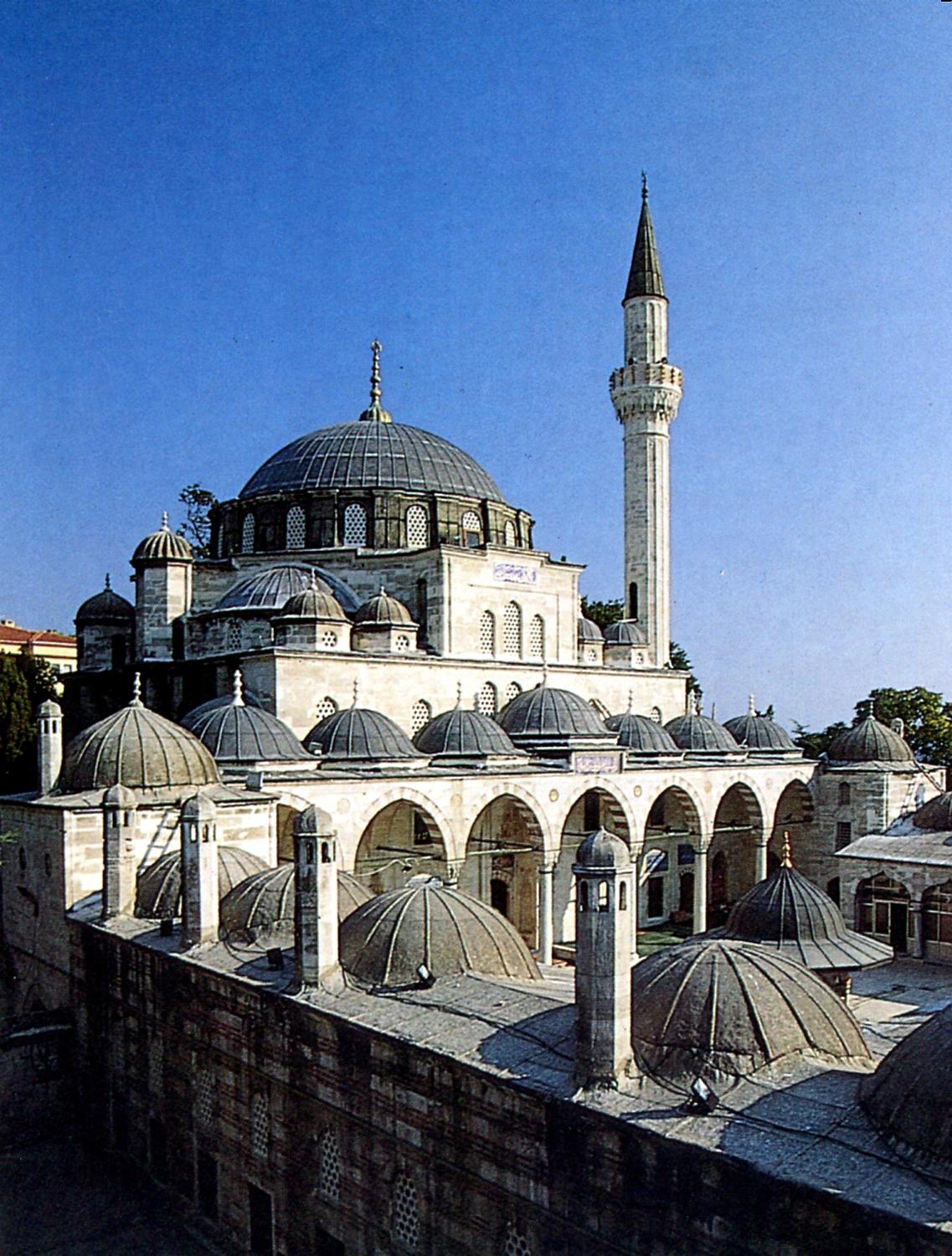
Little Hagia Sophia is a former Greek Eastern Orthodox church in Istanbul converted to a mosque. Built under Justinian and Theodora in the early sixth century. The free Lokali audio guide runs 7 minutes.
✓ Published October 2026 · how we write these guides
Visitor facts
| Lokali audio guide | 7 min · free |
|---|---|
| Type | Mosque |
| Location | Istanbul, Türkiye |
| Coordinates | 41.0028, 28.9719 |
| Languages | 50+, in the Lokali app |
The story
Leave your shoes at the door and feel the carpet, soft and slightly cool under your feet. The air inside is still. Traffic and gulls fade behind the thick walls. Look up, and the space opens above you into a pale dome, ribbed like the inside of a shell. Light falls in through small windows around its base. For a moment it is hard to tell whether you are in a mosque or a church. The honest answer is that you are in both.
This is Little Hagia Sophia, known in Turkish as Küçük Ayasofya. It began life as the Church of Saints Sergius and Bacchus, built in the early sixth century under the Emperor Justinian and his wife, the Empress Theodora. At that time this city was Constantinople, capital of the Eastern Roman Empire, which historians often call the Byzantine Empire. The church went up in the 520s and 530s, so it is one of the oldest Byzantine buildings still standing in Istanbul.
Here is the first surprise. Many visitors assume this building is a small copy of the great Hagia Sophia up the hill. The name certainly suggests that. But most scholars believe construction here began before work started on its famous neighbour. So this is not a little sister built afterwards. It may be closer to an older sibling — a place where Justinian's builders tested ideas about domes and open central spaces before attempting something far larger.
Why dedicate a church to Sergius and Bacchus? These two saints were Roman soldiers, remembered as Christian martyrs in Syria, and they became popular patrons of soldiers. A well-known tradition connects them directly to Justinian. Legend has it that, as a young man, he was accused of plotting against his uncle, the Emperor Justin, and faced execution. According to the tale, the two saints appeared to Justin in a dream and spoke for the young man. He was spared, and this church was his thanks.
Whether or not that story is true, the location carries real meaning. The church stood beside the Palace of Hormisdas, where Justinian lived before he became emperor. Theodora is also linked to this palace. Historical sources describe her sheltering monks here who held religious views the official church rejected. So this quiet corner near the sea was once close to the centre of imperial power, faith, and argument.
Now look at the shape of the room around you. The heart of the building is an octagon, an eight-sided space, set inside an outer rectangle. Between the central columns and the outer walls runs an aisle, with a gallery above it. Notice that the outer walls are not perfectly regular. The angles shift slightly, and the plan is a little lopsided. Scholars still discuss why — perhaps the builders had to fit the church between existing structures on a crowded site.
Lift your eyes to the dome again. It is divided into sixteen segments. Look closely and you will see that they alternate. Some sections are flat, and others curve outward like the hollow of a scallop shell. This pattern gives the dome a gentle, rippling rhythm. It is a clever solution to a hard problem: how to place a round dome over an eight-sided base. Stand in the centre and turn slowly to follow the pattern.
The second surprise sits just above the columns on the ground floor. Run your eyes along the carved band of stone, the frieze, that circles the space. It carries a long inscription in Greek. It names Justinian and Theodora and honours Saint Sergius. After roughly fifteen centuries, the letters are still there, cut deep into the marble. Few visitors notice it. Yet it is a direct message from the people who built this church.
Also look at the column capitals, the carved tops of the columns. Their stonework is deeply cut, almost like lace, with leaves and patterns that catch light and shadow. On some of them you may find monograms, letters woven together into a single design. These were a Byzantine way of signing a building with the names of its patrons. The church once had rich mosaics and marble on its walls. Those surfaces are now plain, which lets the carving stand out.
Nearly a thousand years after it was built, the church became a mosque. This happened around the turn of the sixteenth century, during the reign of the Ottoman Sultan Bayezid the Second. The conversion was led by Hüseyin Agha, a senior official in the palace. He added the features you see today: the mihrab, the niche that shows the direction of Mecca, the minbar, or pulpit, and the minaret outside. His tomb stands in the courtyard.
The building has not had an easy life. Earthquakes struck it over the centuries. Damp, heavy traffic, and the nearby railway line also took their toll. In the early twenty-first century, the structure was considered seriously at risk. A major restoration followed in the 2000s, which strengthened the building and returned it to active use. Today it is a working mosque once again, with prayers held here every day.
When you step outside, take time with the courtyard. It is lined with the small domed rooms of an Ottoman medrese, a religious school, where students once lived and studied. Some of these rooms now hold small shops, and there is often a tea garden here. Sit with a glass of tea and you can hear the call to prayer, the clatter of cups, and trains passing on the line between the mosque and the sea.
Before you go, stand back and look at the building from the outside. The walls are made of alternating bands of brick and stone, warm red against pale grey. Above them sits the low, broad dome, and beside it the slim Ottoman minaret. Byzantine and Ottoman, church and mosque, sit together in one small outline. As you walk away toward the sea or back up the hill, remember the room you just left — a space that has held prayer for nearly fifteen hundred years.
Key facts
What to look for
Practical tips
Common questions
Is there a free audio guide to Little Hagia Sophia?
Yes — the Lokali app narrates Little Hagia Sophia free of charge in 50+ languages. The guide runs about 7 minutes, covers the history, what to look for on site and practical tips, and works offline once downloaded.
Where is Little Hagia Sophia?
Little Hagia Sophia is in Istanbul, Türkiye, at 41.0028, 28.9719. Tap the map link on this page for directions from where you are.
What is Little Hagia Sophia known for?
Built under Justinian and Theodora in the early sixth century. Originally the Church of Saints Sergius and Bacchus.
What should you look for at Little Hagia Sophia?
Greek inscription carved along the frieze above the columns. Dome segments alternating between flat and shell-like curves. Lace-like carving and monograms on the column capitals.
What should you know before visiting Little Hagia Sophia?
Remove your shoes and dress modestly before entering. Women should bring a scarf to cover their hair.
On the map
Opens directions to Little Hagia Sophia from your location.
More to see in Istanbul


Hear Little Hagia Sophia in your language
The full story, narrated, in 50+ languages. Download it before you go and it plays offline, at your own pace, with no ticket and no tour group.