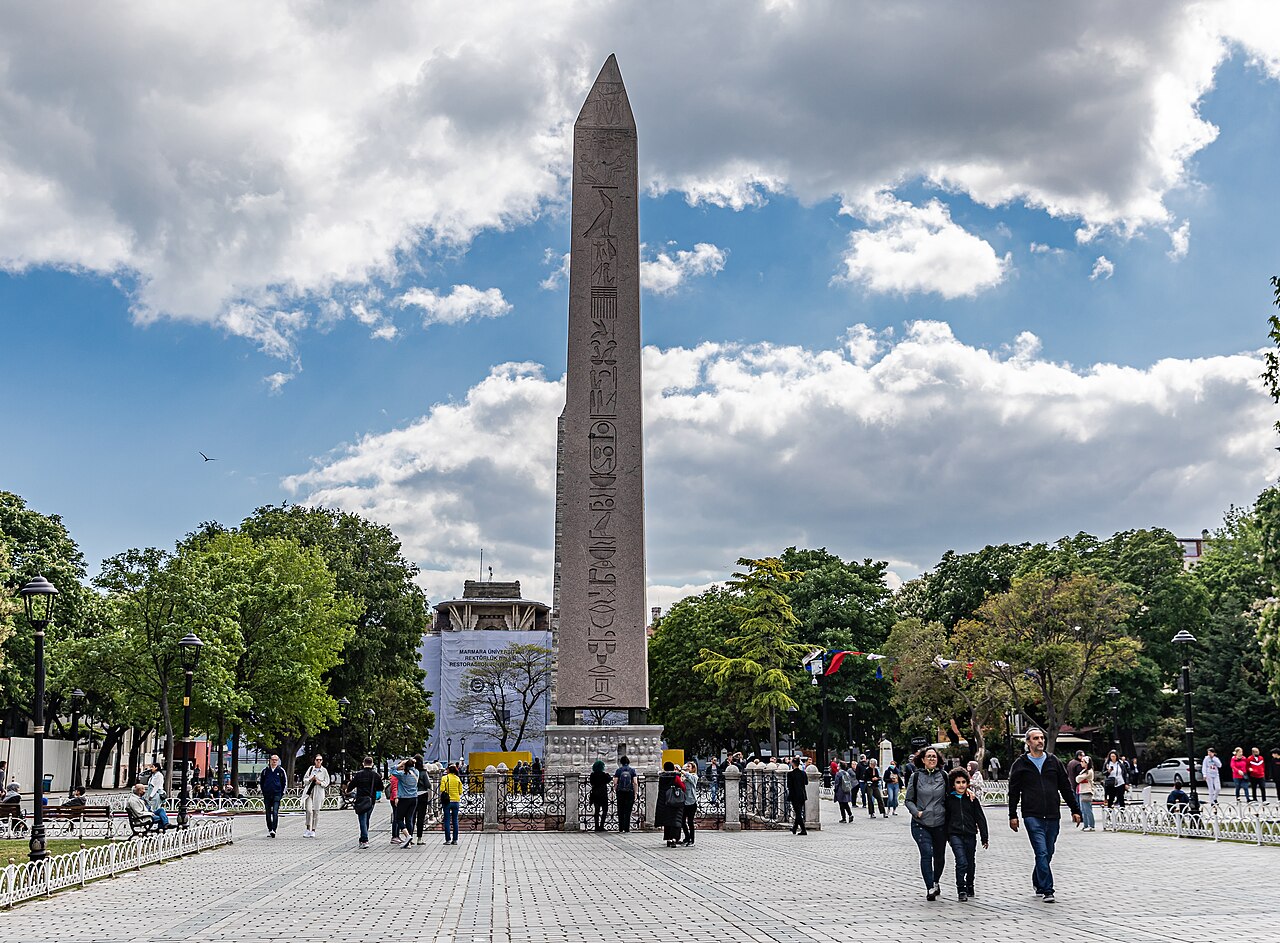
Sultanahmet Square is a square in Istanbul, Türkiye. This UNESCO World Heritage plaza is bounded by the Blue Mosque, Hagia Sophia, and the Basilica Cistern. Most visitors spend 30–60 min here. The free Lokali audio guide runs 9 minutes.
✓ Verified August 2026 · how we write these guides
Visitor facts
| Time needed | 30–60 min |
|---|---|
| Lokali audio guide | 9 min · free |
| Type | Square |
| Best for | Photography |
| Location | Istanbul, Türkiye |
| Coordinates | 41.0058, 28.9765 |
| Languages | 45, in the Lokali app |
The story
The light here is different — softer, filtered through centuries of dust and prayer. Stand in the centre of Sultanahmet Square and you are standing at the crossroads of empires. Beneath your feet lie the buried foundations of the Hippodrome, the vast chariot-racing arena that once held a hundred thousand spectators screaming for their teams. The cobblestones remember.
This square has worn many names. The Byzantines called it the Hippodrome. The Ottomans knew it as At Meydanı, the Horse Square. Today it carries the name of Sultan Ahmet, whose Blue Mosque rises at the southern edge, its six minarets needling the sky. But the bones of the place are far older — Roman, built in the early third century when Constantinople was still a dream in an emperor's mind.
Look to your left and you will see three monuments standing in a line down the square's spine. The first is a granite obelisk, rose-coloured and carved with hieroglyphs. It was already ancient when Emperor Theodosius brought it from Egypt in the late fourth century. The bronze crabs that once held it steady at its base are long gone, melted down in some forgotten war. What remains is stone that saw pharaohs.
Beside it stands the Serpent Column, a twisted bronze pillar cast in Greece to celebrate victory over the Persians. It arrived here in the fourth century, three serpent heads coiled at the top. Time and vandals have taken the heads — one fragment rests in a museum nearby — but the column still spirals upward, green with age, a survivor of twenty-four centuries.
The third monument is the Obelisk of Constantine, a tower of rough stone blocks that locals call the Walled Obelisk. No one knows its exact age. Byzantine chronicles mention it, Ottoman travellers sketched it, and still it stands, mute and massive, its original bronze cladding stripped away long ago. Some say it once gleamed. Now it is just stone, patient and plain.
The square hums with tourists and vendors, the smell of roasted chestnuts and simit bread drifting from the carts. But step to the western edge, near the low stone wall, and you can still trace the curve of the old Hippodrome's outer wall. The chariots ran counterclockwise, teams in blue and green crashing around the turning posts, the crowd's roar shaking the arcades. Emperors watched from the kathisma, the imperial box, which connected directly to the Great Palace. One door, and they were home.
Between the Hippodrome's glory and the square's present calm lies a thousand years of riot and ruin. The Fourth Crusade sacked the city in the early thirteenth century, and the bronze horses that crowned the starting gates were torn down and shipped to Venice, where they still stand above Saint Mark's Basilica. The Ottomans, when they took the city in the mid-fifteenth century, let the Hippodrome fall into disrepair. They used it for festivals and processions, but the great arcades crumbled, and eventually the stones were carted away to build other things.
What you see now is a nineteenth-century reimagining, a public garden laid over the ancient track. The monuments were excavated and re-erected, the flowerbeds planted, the pathways paved. It is a palimpsest — Roman stone, Byzantine memory, Ottoman architecture, and modern tourism all pressed into one square. You can feel the weight of it if you stand still long enough.
The Blue Mosque to the south and Hagia Sophia to the north frame the square like bookends. Both are vast, both are sacred, both pull the eye upward. But the square itself is the hinge, the open space where the city exhales. In the early morning, before the tour groups arrive, you can hear the call to prayer echo off the domes, and for a moment the centuries collapse.
As you leave, glance back at the obelisk. The hieroglyphs are worn smooth in places, unreadable. But they are still there, still speaking a language older than this city, older than the empires that rose and fell around them. The square will outlast us all.
Key facts
What to look for
Practical tips
Common questions
How long do you need at Sultanahmet Square?
Plan 30–60 min. That is the time most visitors spend at Sultanahmet Square. The free Lokali audio guide adds about 9 minutes of narration you can listen to as you walk, so it fits inside your visit rather than adding to it.
Is there a free audio guide to Sultanahmet Square?
Yes — the Lokali app narrates Sultanahmet Square free of charge in 50+ languages. It covers the history, what to look for on site and practical tips, and it works offline once downloaded.
Where is Sultanahmet Square?
Sultanahmet Square is in Istanbul, Türkiye, at 41.0058, 28.9765. Tap the map link on this page for directions from where you are.
What should you know before visiting Sultanahmet Square?
Visit early morning before tour groups for quiet.
What is Sultanahmet Square known for?
Built as the Hippodrome in the early third century.
What is the best time to visit Sultanahmet Square?
Sit on a bench facing the Blue Mosque at sunset when the tiles shift from blue to gold.
On the map
Opens directions to Sultanahmet Square from your location.
Reference
More to see in Istanbul


Hear Sultanahmet Square in your language
The full story, narrated, in 50+ languages. Download it before you go and it plays offline, at your own pace, with no ticket and no tour group.