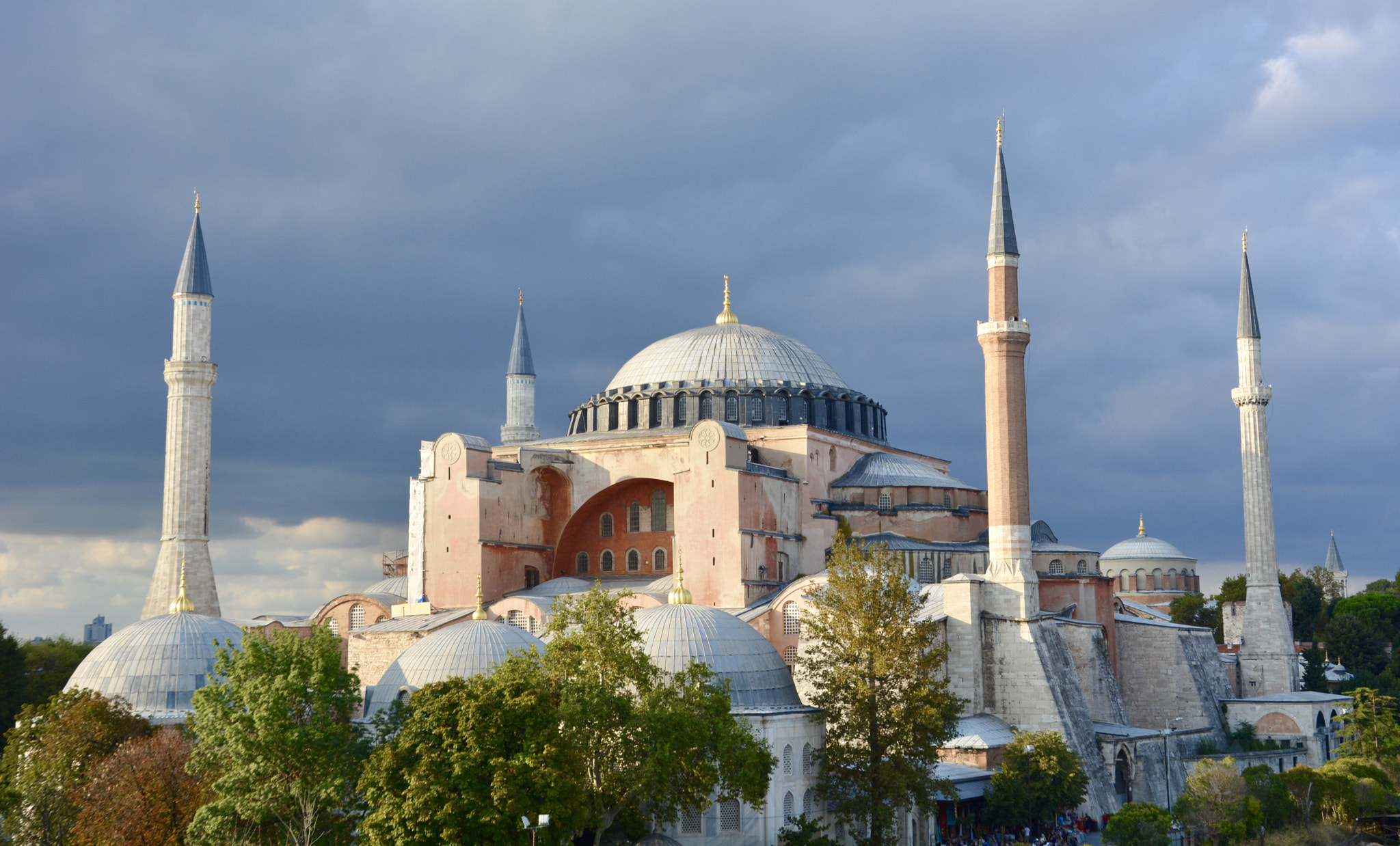
Ayasofya is a museum in Istanbul, Türkiye. Completed in 537 CE, this Byzantine cathedral was the largest domed structure in the world for over a thousand years. Most visitors spend 1–2 hours here. The free Lokali audio guide runs 9 minutes.
✓ Verified August 2026 · how we write these guides
Visitor facts
| Time needed | 1–2 hours |
|---|---|
| Lokali audio guide | 9 min · free |
| Type | Museum |
| Best for | History |
| Location | Istanbul, Türkiye |
| Coordinates | 41.0086, 28.9802 |
| Languages | 45, in the Lokali app |
The story
Stand in the courtyard and look up. The dome seems to float — a shallow hemisphere of brick and stone that appears weightless against the Istanbul sky, ringed by forty arched windows that pour light into the interior below. This is Ayasofya, a building that has defined the skyline of this city for nearly fifteen centuries.
The emperor Justinian commissioned it in the year 532, determined to build the greatest church in Christendom. He hired two mathematicians — Anthemius of Tralles and Isidore of Miletus — not traditional architects, but geometers who understood forces and curves. They raised the dome on four massive piers, using pendentives — curved triangular sections that transition the square base into the circular crown above. When Justinian first entered the completed building in 537, he is said to have whispered, "Solomon, I have surpassed you."
Step inside. The central nave opens into a vast volume of air and light, the dome rising forty-five metres overhead. For nine hundred years this was the cathedral of the Byzantine Empire, the seat of the Ecumenical Patriarch, the stage for imperial coronations. Gold mosaics once covered nearly every surface — Christ Pantocrator gazing down from the apse, the Virgin and Child flanked by emperors, archangels with jeweled wings. Many survive, hidden under plaster for centuries and now revealed again in patches of radiant color.
In 1453 the Ottoman sultan Mehmed II entered Constantinople and converted Ayasofya into a mosque. Minarets rose at the corners. A mihrab was installed to mark the direction of Mecca, angled slightly off the building's axis because the church had faced east toward Jerusalem. Enormous wooden medallions bearing the names of Allah, Muhammad, and the early caliphs were hung in the nave. For nearly five centuries it served as the principal mosque of the Ottoman capital, a symbol of Islamic power anchored in a Christian shell.
Look for the marble panels on the walls — slabs of green Thessalian stone, purple porphyry from Egypt, white Proconnesian marble veined with gray. The Byzantines chose each piece for its color and grain, then sliced and mirrored the slabs so the natural patterns formed symmetrical designs. Some panels look like faces, others like landscapes or abstract flames. Medieval visitors called these stones "the living marbles" because the patterns seemed to shift in candlelight.
In the upper galleries, accessible by a long sloping ramp, you will find the Deesis mosaic — Christ flanked by the Virgin Mary and John the Baptist, their faces rendered in thousands of tiny tesserae that catch and reflect light at different angles. The mosaic dates to the thirteenth century, created after the Fourth Crusade when Latin rulers briefly controlled the city. Christ's expression changes as you move — serene from one angle, sorrowful from another. Much of the mosaic has been lost, but what remains is among the finest Byzantine work anywhere.
The building has survived earthquakes, fires, and the rise and fall of empires. The dome cracked and partially collapsed in 558, just twenty years after completion, and was rebuilt higher and lighter. Buttresses were added over the centuries, massive external supports that brace the walls and keep the whole structure from spreading outward under the dome's weight. You can see them from the street — thick sloping walls of brick and stone that look almost organic, like the roots of an ancient tree.
In 1935 the Turkish Republic converted Ayasofya into a museum, a neutral space where both Christian mosaics and Islamic calligraphy could coexist. In 2020 it became a mosque again, though visitors of all backgrounds are still welcome outside prayer times. The building carries both identities now — the mihrab and the mosaics, the minarets and the marble, the call to prayer echoing under a dome built to glorify a different faith.
Walk slowly through the side aisles. Notice the columns — some are ancient spolia, taken from earlier Roman temples and brought here to support Justinian's vision. The capitals are carved with acanthus leaves and monograms, each one slightly different. The floor is worn smooth by centuries of footsteps, the stone polished to a soft sheen. Light moves across the walls as the day progresses, and the building feels different at every hour — cool and shadowed in the morning, golden in the late afternoon.
Pause near the Imperial Door, the central entrance once reserved for emperors. Above it is a mosaic of Christ enthroned, with a prostrate emperor at his feet — possibly Leo VI, seeking forgiveness for a scandalous marriage. The emperor's face is worn away, erased by time or intention, but the gesture of submission remains. It is a small reminder that even the most powerful came here as supplicants.
Before you leave, step outside and circle the building. From the street you can see how the dome is supported — not by a single massive shell, but by a cascade of half-domes and arches that step down from the central crown. It is a structure built on the edge of what was possible, a gamble in stone and geometry that has stood for fourteen and a half centuries. The light is changing now, and the windows around the dome are beginning to glow.
Key facts
What to look for
Practical tips
Common questions
How long do you need at Ayasofya?
Plan 1–2 hours. That is the time most visitors spend at Ayasofya. The free Lokali audio guide adds about 9 minutes of narration you can listen to as you walk, so it fits inside your visit rather than adding to it.
Is there a free audio guide to Ayasofya?
Yes — the Lokali app narrates Ayasofya free of charge in 50+ languages. It covers the history, what to look for on site and practical tips, and it works offline once downloaded.
Where is Ayasofya?
Ayasofya is in Istanbul, Türkiye, at 41.0086, 28.9802. Tap the map link on this page for directions from where you are.
What should you know before visiting Ayasofya?
Visit outside prayer times for interior access.
What is Ayasofya known for?
Built in 537 by mathematicians, not traditional architects.
What is the best time to visit Ayasofya?
Stand directly beneath the dome's centre and look up; the scale becomes overwhelming.
On the map
Opens directions to Ayasofya from your location.
More to see in Istanbul


Hear Ayasofya in your language
The full story, narrated, in 50+ languages. Download it before you go and it plays offline, at your own pace, with no ticket and no tour group.