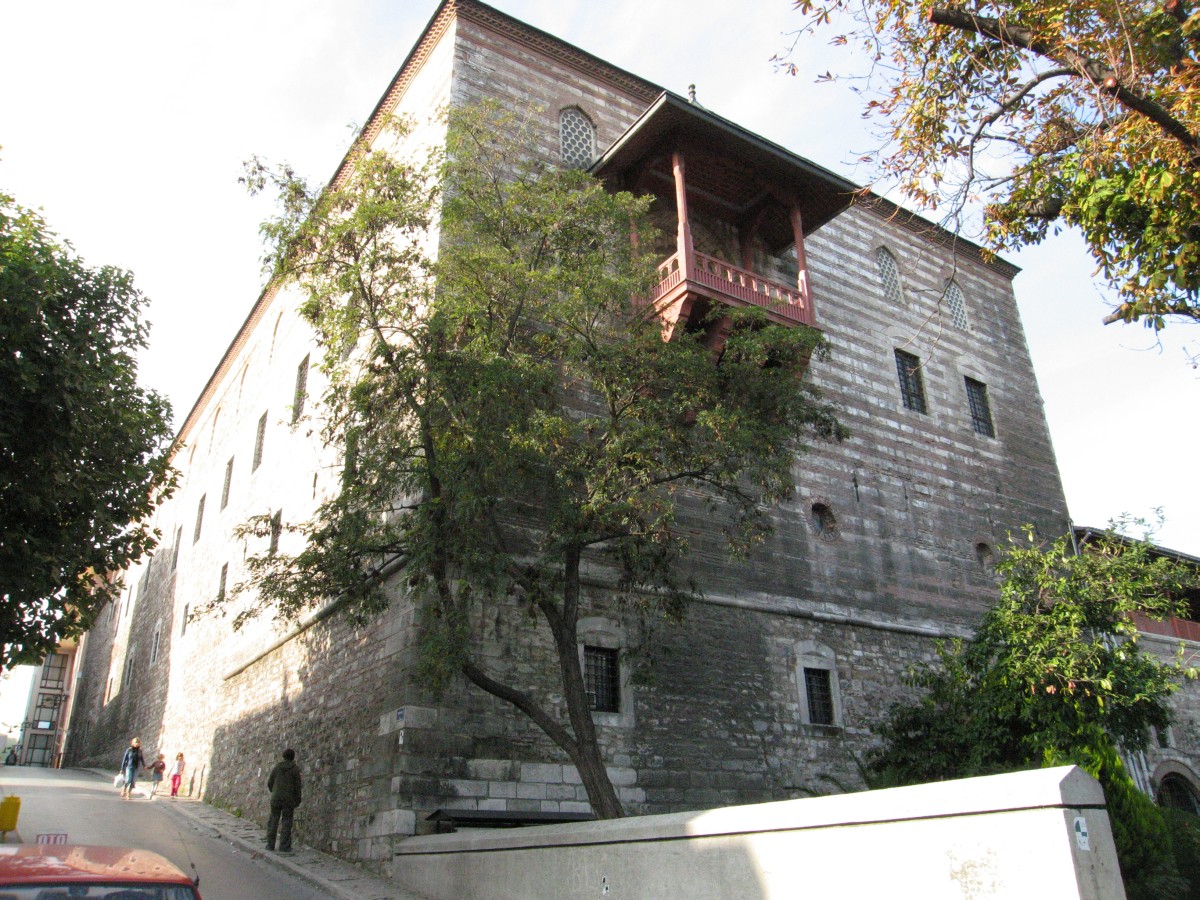
Turkish and Islamic Arts Museum
41.0063° N · 28.9746° E · Museum
Photo: Chapultepec · Public domain · Wikimedia Commons
Turkish and Islamic Arts Museum is a museum of Islamic arts in Istanbul. Housed in the sixteenth-century palace of Ibrahim Pasha. The free Lokali audio guide runs 6 minutes.
✓ Published October 2026 · how we write these guides
Visitor facts
| Lokali audio guide | 6 min · free |
|---|---|
| Type | Museum |
| Location | Istanbul, Türkiye |
| Coordinates | 41.0063, 28.9746 |
| Languages | 50+, in the Lokali app |
The story
Stand for a moment at the foot of the stone steps. Behind you, the open ground of the old Hippodrome stretches toward the Blue Mosque, with tour groups, simit sellers and pigeons moving across it. In front of you rises a long wall of rough grey stone, cut by small arched windows. It looks more like a fortress than a home. Yet this building was once a private house, and a very grand one.
This is the Turkish and Islamic Arts Museum, and its building is the Palace of Ibrahim Pasha. Ibrahim was the grand vizier, the chief minister, of Sultan Suleiman the Magnificent in the early sixteenth century. He grew up as a Christian boy on the Greek coast, entered Ottoman service, and became the young prince Suleiman's close friend. When Suleiman took the throne, Ibrahim rose with him, faster and higher than almost anyone in the empire.
Think about where this palace stands. The Hippodrome was the ceremonial heart of the city, both under Byzantium and under the Ottomans. Festivals, parades and public celebrations filled this square. Ibrahim built his residence right on its edge. From these windows, he and his guests could watch the life of the capital unfold below them. A house in this spot was a public statement. It told everyone who passed exactly how close its owner stood to the sultan.
That closeness did not last. In 1536, Ibrahim was executed on Suleiman's orders. Historians still debate the reasons. Some point to his growing power and his bold use of titles, others to rivalries inside the palace. After his death, the building passed to the state. Over the following centuries, it served many purposes, and parts of it fell into poor condition. Here is the first surprise... this is one of the very few private palaces of its age to survive in Istanbul at all.
Wooden mansions burned. Stone ones were rebuilt or torn down. This palace endured, though not unchanged. What you see today is the result of major restoration work in the twentieth century. As you climb inside, notice the thickness of the walls and the coolness of the air. The rooms open around a large central courtyard, a layout that keeps the city's noise outside and lets light fall gently into the halls.
The museum itself is older than its current home. It opened in 1914, in the final years of the Ottoman Empire, inside the Süleymaniye mosque complex across the old city. Its founders wanted to protect religious and artistic objects that were at risk of being sold, lost or carried abroad. In 1983, the collection moved here, into Ibrahim's restored palace. So the objects of an empire now rest inside the house of one of its most powerful men.
Now to the heart of the collection — the carpets. This museum holds one of the most important groups of historic carpets anywhere in the world. Some of the oldest pieces date to the Seljuk period, the Turkic dynasty that ruled much of Anatolia before the Ottomans. Several came from the great mosque of Alaeddin in Konya. Look closely at their thick borders and their bold, angular patterns. Many centuries have passed, and the colours still hold.
Here is the second surprise. Some Anatolian carpet types are known today by the names of European painters. You may hear the terms Holbein carpets and Lotto carpets. These names come from Renaissance artists, Hans Holbein and Lorenzo Lotto, who painted such rugs in their portraits and church scenes. In Europe, a Turkish carpet was a sign of wealth and taste. Here, you can see the real thing that those painters copied onto their canvases.
Move through the halls and the materials change. You will find carved wooden doors and Qur'an stands, inlaid with mother-of-pearl. There is metalwork, with brass and bronze shaped into lamps, bowls and candlesticks. There are glazed ceramics, and pages of calligraphy, the art of beautiful writing. In the Islamic tradition, calligraphy is often seen as one of the highest arts. A single line of script can take years of training to write well.
The manuscripts deserve slow attention. Many Qur'ans here have gilded pages, with gold leaf framing the text, and margins painted with fine floral ornament. The scripts vary from region to region and century to century. Some letters are tall and angular, others round and flowing. You do not need to read Arabic to see the care in them. Notice the balance between ink and empty space. The blank areas matter as much as the writing.
On the lower level, the mood shifts. The ethnographic section shows how people in Anatolia actually lived. You can see the inside of a nomad's tent, woven from dark goat hair, with rugs and storage bags laid out as a family would use them. There are recreated rooms from traditional town houses too. After the grandeur upstairs, these spaces feel intimate. They show that carpets were not only art. They were floors, walls, beds and doors.
Before you leave, find a window that faces the Hippodrome. Look across to the obelisk, the tall carved column brought from Egypt during the Byzantine era. Beyond it, the domes and minarets of the Blue Mosque rise above the trees. That mosque was built about a century after Ibrahim's death. So the view he knew was different. But the square below, and the sense of standing at the centre of a city, remain the same.
When you step back out onto those stone steps, pause one more time. Listen to the voices from the square, the call of a street vendor, perhaps the call to prayer drifting across from the mosque. Behind you, the walls stay cool and quiet. They have held a vizier's household, a state's records, and now the woven memory of an empire. Take that quiet with you as you walk into the light.
Key facts
What to look for
Practical tips
Common questions
Is there a free audio guide to Turkish and Islamic Arts Museum?
Yes — the Lokali app narrates Turkish and Islamic Arts Museum free of charge in 50+ languages. The guide runs about 6 minutes, covers the history, what to look for on site and practical tips, and works offline once downloaded.
Where is Turkish and Islamic Arts Museum?
Turkish and Islamic Arts Museum is in Istanbul, Türkiye, at 41.0063, 28.9746. Tap the map link on this page for directions from where you are.
What is Turkish and Islamic Arts Museum known for?
Housed in the sixteenth-century palace of Ibrahim Pasha. Ibrahim Pasha was grand vizier to Suleiman the Magnificent.
What should you look for at Turkish and Islamic Arts Museum?
Rough grey stone facade with small arched windows. Angular patterns on the early Seljuk carpets from Konya. Mother-of-pearl inlay on carved wooden Qur'an stands.
What should you know before visiting Turkish and Islamic Arts Museum?
Start with the carpet halls before tour groups arrive. Save the lower ethnographic floor for the end of your visit.
On the map
Opens directions to Turkish and Islamic Arts Museum from your location.
More to see in Istanbul


Hear Turkish and Islamic Arts Museum in your language
The full story, narrated, in 50+ languages. Download it before you go and it plays offline, at your own pace, with no ticket and no tour group.