
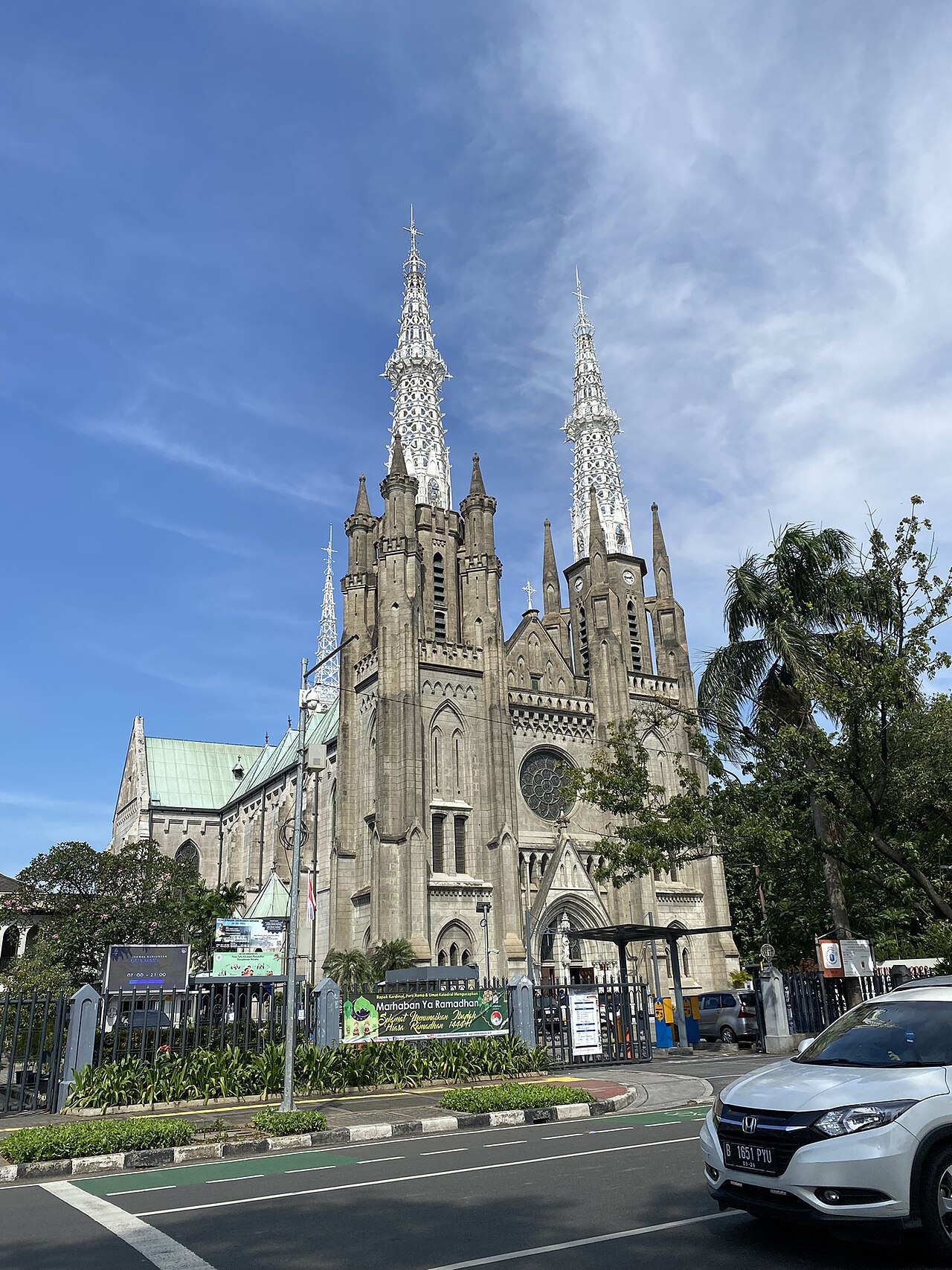
Photo: Chainwit. · CC BY 4.0 · Wikimedia Commons
Jakarta Cathedral is a catholic church in Jakarta, Indonesia. Official name means Church of Our Lady of the Assumption. The free Lokali audio guide runs 7 minutes.
✓ Published October 2026 · how we write these guides
Visitor facts
| Lokali audio guide | 7 min · free |
|---|---|
| Type | Cathedral |
| Location | Jakarta, Indonesia |
| Coordinates | -6.1692, 106.8331 |
| Official website | katedraljakarta.or.id |
| Languages | 50+, in the Lokali app |
The story
Step out of the traffic and listen. The roar of motorbikes softens here, behind the iron fence. Underfoot, the paving is warm, even in the shade. Look up and three dark grey spires rise above the palm trees. They are sharp and thin, almost like needles. In a city of glass towers and concrete overpasses, this church looks as if it came from a northern European market town. And in a way, it did.
You are standing in front of Jakarta Cathedral. Its formal name in Indonesian is Gereja Santa Perawan Maria Diangkat Ke Surga. That means the Church of Our Lady of the Assumption. The Assumption is the Catholic belief that Mary, the mother of Jesus, was taken up into heaven at the end of her life. Locals usually just call it Gereja Katedral, the Cathedral Church. It is the seat of the Catholic Archdiocese of Jakarta.
The building in front of you is not the first church on this ground. In the nineteenth century, Jakarta was Batavia, the capital of the Dutch East Indies. Catholics in the colony worshipped in an earlier church on this site. In 1890, that older church collapsed. For a city still growing its Catholic community, it was a serious loss. The parish had to start again, almost from the foundations.
The new design came from the Dutch tradition of the time. That tradition is called neo-Gothic. It copied the medieval cathedrals of Europe, with pointed arches, tall windows, and spires that lead the eye upward. Construction began under the Jesuit architect Antonius Dijkmans. Later, the work was completed by Marius Hulswit. The finished cathedral was consecrated in 1901. So these walls have now stood for well over a century of Jakarta's changes.
Now look closely at the materials. The main body is brick, covered with plaster and painted pale grey. But the spires are different. They are not stone at all. Their frames are made of iron. This was a practical choice. Heavy masonry towers would be a risk in a tropical city with soft ground and occasional earthquakes. A lighter metal frame kept the Gothic look without the weight. Many visitors never notice this.
Each of the three spires has a name. The two tall towers on the front are called the Tower of David and the Ivory Tower. Both names come from old Catholic prayers to Mary, known as the Litany of Loreto. The smaller spire in the centre, above the crossing of the roof, is called Angelus Dei, the Angel of God. Once you know the names, the facade feels less like decoration. It reads more like a prayer built in iron and brick.
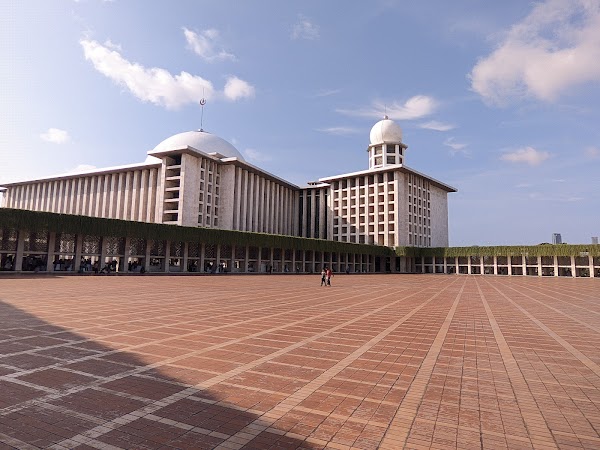
Before you go inside, turn around. Across the road, you can see the great white dome and minaret of Istiqlal Mosque. It is the national mosque of Indonesia, and one of the largest mosques in Southeast Asia. The placement is deliberate in spirit, if not by original design. The two buildings face each other across a few lanes of traffic. For many Indonesians, this view is a daily picture of religious tolerance in a Muslim-majority country.
Here is a detail most visitors miss. In recent years, an underground passage was built to connect the cathedral grounds with the mosque. It is often called the Tunnel of Friendship. The idea is simple and practical. On big holidays, the cathedral and the mosque sometimes share parking and space for crowds. People walking between the two can pass beneath the road together. Ask the staff at the gate if the passage is open during your visit.
Now step inside, quietly. The temperature drops a little, and the light changes. Rows of wooden pews lead toward the altar. Above them, the ceiling rises in pointed arches. Look at the stained glass. The colours fall onto the floor and the pillars as the sun moves. If a Mass is in progress, you will hear Indonesian prayers and hymns. The sound carries well under the high roof.
Walk slowly along the side aisles. Look for the carved wooden pulpit, the raised platform where a priest once preached to the congregation. Look also for the confessionals, the small enclosed booths where Catholics confess their sins to a priest. Small details here show the mix of European design and local craft. Notice the Stations of the Cross on the walls. These are fourteen scenes that tell the story of the last day of Jesus's life.
There is a second surprise upstairs. On an upper level, the cathedral keeps a small museum. It holds liturgical objects, old vestments, which are the robes priests wear, and documents from the history of the Catholic Church in Indonesia. It is modest in size. But it shows how the faith arrived here, and how it changed after Indonesian independence. Ask at the parish office whether the museum is open, because access can depend on the church schedule.
The cathedral has also welcomed popes. Several popes have come to Jakarta over the decades, and the cathedral has been part of those visits. Most recently, Pope Francis came to the cathedral in 2024 during his visit to Indonesia. For the local Catholic community, which is a minority in this country, these moments carry great weight. They are remembered in photographs and in family stories across the city.
Outside again, look for the grotto of Mary in the grounds. This is a small shrine built to look like a rocky cave, with a statue of Mary inside. You may see people lighting candles or standing quietly with folded hands. Some are tourists. Many are office workers on a lunch break. The grotto is a reminder that this is a working church, not a museum. Please keep your voice low and give people space.
Before you leave, stand at the gate for a moment. Look at the iron spires against the hazy Jakarta sky. Then look across at the white dome of Istiqlal. Listen to the traffic, and perhaps, at the right hour, the call to prayer from across the road. Two faiths, two buildings, one view. As you walk away, notice how quickly the city returns... and how this quiet corner stays with you.
Key facts
What to look for
Practical tips
Common questions
Is there a free audio guide to Jakarta Cathedral?
Yes — the Lokali app narrates Jakarta Cathedral free of charge in 50+ languages. The guide runs about 7 minutes, covers the history, what to look for on site and practical tips, and works offline once downloaded.
Where is Jakarta Cathedral?
Jakarta Cathedral is in Jakarta, Indonesia, at -6.1692, 106.8331. Tap the map link on this page for directions from where you are.
What is Jakarta Cathedral known for?
Official name means Church of Our Lady of the Assumption. An earlier church on this site collapsed in 1890.
What should you look for at Jakarta Cathedral?
Two front spires named Tower of David and Ivory Tower. The smaller central spire called Angelus Dei above the roof. The white dome of Istiqlal Mosque facing the cathedral.
What should you know before visiting Jakarta Cathedral?
Dress modestly, covering shoulders and knees, before entering. Check the Mass schedule and avoid touring during services.
When is the best time to visit Jakarta Cathedral?
Arrive in the morning to avoid the strongest midday heat.
On the map
Opens directions to Jakarta Cathedral from your location.
More to see in Jakarta


Hear Jakarta Cathedral in your language
The full story, narrated, in 50+ languages. Download it before you go and it plays offline, at your own pace, with no ticket and no tour group.