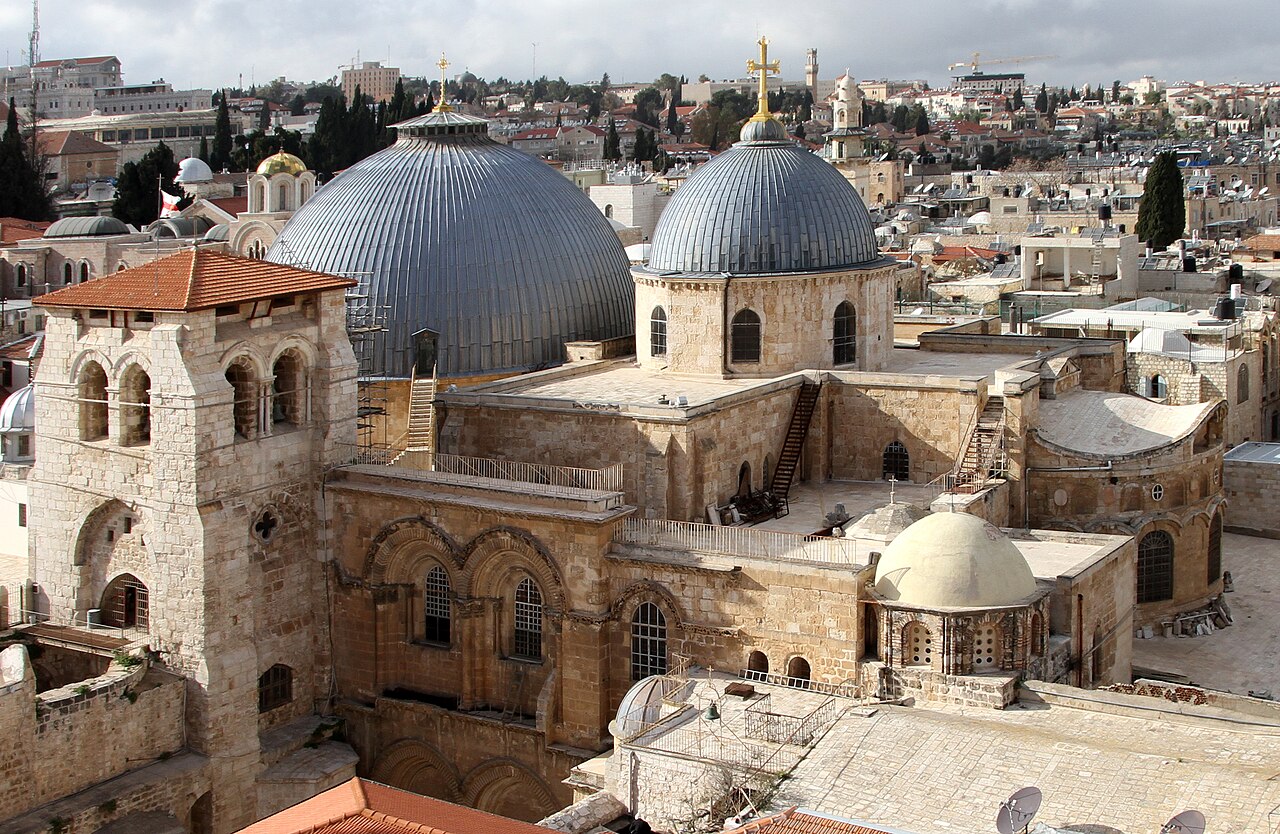
Church of the Holy Sepulchre
31.7784° N · 35.2292° E · Cathedral
Church of the Holy Sepulchre is a cathedral in Jerusalem, Israel. Christianity's holiest church, believed to mark the site of Jesus's crucifixion and resurrection. Most visitors spend 1–2 hours here. The free Lokali audio guide runs 6 minutes.
✓ Verified August 2026 · how we write these guides
Visitor facts
| Time needed | 1–2 hours |
|---|---|
| Lokali audio guide | 6 min · free |
| Type | Cathedral |
| Best for | History |
| Location | Jerusalem, Israel |
| Coordinates | 31.7784, 35.2292 |
| Languages | 45, in the Lokali app |
The story
Step through the low doorway, and the light changes. The air turns cool and heavy with incense and candle smoke. Somewhere ahead, a chant rises and falls in a language you may not know. Pilgrims move slowly across worn stone, their hands trailing the walls. You are standing inside one of the oldest places of Christian worship in the world.
This is the Church of the Holy Sepulchre, in the Christian Quarter of the Old City of Jerusalem. For many Christians, this single building holds the two most important moments of their faith. Here, by tradition, Jesus was crucified. And here, by tradition, he was buried and rose again. Both places sit under one roof, only a short walk apart.
The first great church on this spot was built in the fourth century, under the Roman emperor Constantine. His builders cleared away an earlier temple and shaped the rock below into a shrine. In the year 1009, a Fatimid ruler ordered the church torn down, and it had to be raised again. The building you see now is mostly the work of Crusader hands in the twelfth century.
Just inside the entrance, you may see people kneeling at a flat slab of pink stone. They press their hands to it. Some lay scarves or beads on the surface to carry the blessing home. This is the Stone of Anointing. It marks, by tradition, where the body of Jesus was prepared for burial. The stone itself is not ancient. It was placed here in the nineteenth century. But the act of kneeling here is very old.
To your right, a steep staircase climbs to a raised chapel. This is Golgotha, also called Calvary, the rock of the crucifixion. The space is low and golden, crowded with hanging lamps. The Greek and the Latin churches each keep an altar here, side by side. Under one of them, a silver disc marks the spot, and people kneel to reach beneath it and touch the stone.
Now walk into the great round hall, the rotunda. Tall stone piers rise around you to a ring of windows, and light falls from an opening high in the dome. In the center stands a small stone chamber, like a little house within the church. This is the Aedicule. Inside it is the tomb itself. The line to enter can be long, and only a few people fit inside at a time.
The Aedicule was restored between 2016 and 2017 by a team of experts from Athens. They opened the tomb, strengthened the leaning structure, and cleaned away centuries of soot from candle smoke. For a few days, the burial shelf was uncovered for study. Then it was sealed again, as it had been for hundreds of years.
Look for a long flight of worn steps leading down to the Chapel of Saint Helena. The walls beside the stairs are covered with small crosses, scratched into the stone by pilgrims over many hundreds of years. By tradition, this lower level is near where the true cross was found, buried in the ground. The deeper you go, the older and rougher the stone becomes.
Six Christian communities share this church. Greek Orthodox, Roman Catholic, Armenian, Coptic, Syriac, and Ethiopian. Each has its own chapels, its own hours, its own prayers. The arrangement that divides the space is known as the Status Quo. It has stayed largely unchanged since the eighteenth century. Even a small repair must be agreed by all of them first.
Look up at the windows above the main entrance. On a ledge rests a simple wooden ladder. No one moves it. It has stood in roughly the same place for centuries, because shifting it would break the Status Quo. People call it the Immovable Ladder. It is a small object, but it tells you how carefully balanced this place is.
Every day, the great wooden doors are opened and closed by hand. For generations, two Muslim families have shared this duty. One family keeps the ancient key. The other works the door, climbing a short ladder to reach the lock. The custom is said to go back many centuries, a quiet agreement that has helped keep peace among the Christian groups inside.
Take a moment to simply listen. You may hear several services at once, in different corners, in different tongues. Bells, chant, the shuffle of feet on stone. The smell of beeswax and incense hangs in the air. Hundreds of candles flicker against the dark. Few buildings in the world hold this much devotion in so small a space.
Whatever you believe, you are standing where millions have come to weep, to pray, and to hope. The stones here have been touched by countless hands. When you step back out into the daylight, the noise of the city returns at once. But the quiet weight of this place tends to stay with you for a long while.
Key facts
What to look for
Practical tips
Common questions
How long do you need at Church of the Holy Sepulchre?
Plan 1–2 hours. That is the time most visitors spend at Church of the Holy Sepulchre. The free Lokali audio guide adds about 6 minutes of narration you can listen to as you walk, so it fits inside your visit rather than adding to it.
Is there a free audio guide to Church of the Holy Sepulchre?
Yes — the Lokali app narrates Church of the Holy Sepulchre free of charge in 50+ languages. It covers the history, what to look for on site and practical tips, and it works offline once downloaded.
Where is Church of the Holy Sepulchre?
Church of the Holy Sepulchre is in Jerusalem, Israel, at 31.7784, 35.2292. Tap the map link on this page for directions from where you are.
What should you know before visiting Church of the Holy Sepulchre?
Arrive early morning to avoid the longest tomb queues.
What is Church of the Holy Sepulchre known for?
First church built in the fourth century under Constantine.
What is the best time to visit Church of the Holy Sepulchre?
The church is dark, incense-filled, and crowded — arrive very early or in late afternoon.
On the map
Opens directions to Church of the Holy Sepulchre from your location.
More to see in Jerusalem


Hear Church of the Holy Sepulchre in your language
The full story, narrated, in 50+ languages. Download it before you go and it plays offline, at your own pace, with no ticket and no tour group.