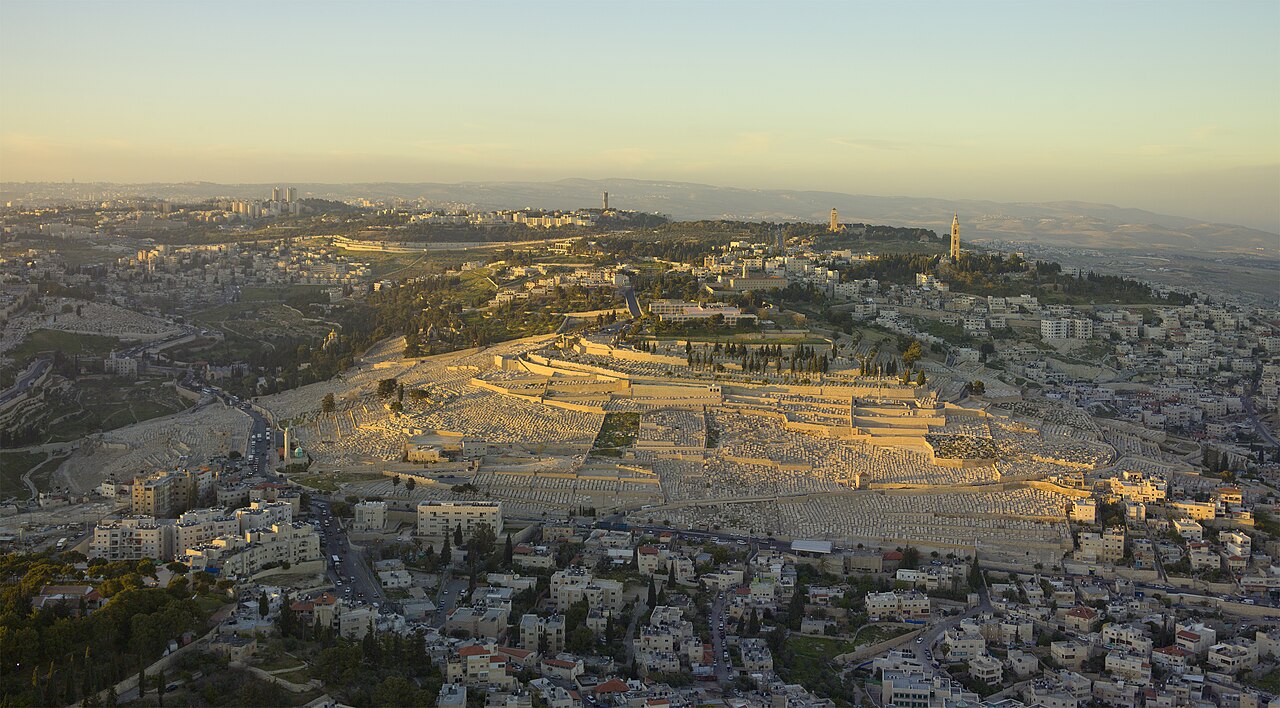
Mount of Olives is a ridge east of the Old City offering panoramic views of Jerusalem, the Temple Mount, and the Judean Desert. It is in Jerusalem, Israel. Most visitors spend 1–2 hours here. The free Lokali audio guide runs 5 minutes.
✓ Verified August 2026 · how we write these guides
Visitor facts
| Time needed | 1–2 hours |
|---|---|
| Lokali audio guide | 5 min · free |
| Type | Viewpoint |
| Best for | Photography |
| Location | Jerusalem, Israel |
| Coordinates | 31.7742, 35.2547 |
| Languages | 45, in the Lokali app |
The story
Cross the valley to the east of the Old City and climb. Near the top, turn around. The whole of old Jerusalem lies before you, gold and grey in the morning sun. The Dome of the Rock shines at the center, ringed by walls and rooftops. This view, from the slope of the Mount of Olives, is one of the most photographed in the world. And it costs nothing.
The Mount of Olives is a long ridge that rises across a narrow valley from the Old City. Its name comes from the olive trees that once covered its slopes. For thousands of years, people have prayed here, buried their dead here, and looked out over the holy city from this height. Three faiths hold the hill dear.
Much of the western slope is covered with graves. Pale stone tombs run down the hillside in their thousands. This is among the oldest and most important Jewish cemeteries in the world, used for burials over many centuries. People wished to lie here because of a long-held belief that this is the very place where redemption would one day begin.
From the lookout near the top, study the city wall across the valley. You may notice a sealed gate, blocked with stone, facing the mount. This is the Eastern Gate, also called the Golden Gate. By tradition it is tied to the hope of a coming messiah. For now it stays closed, a quiet, blind shape in the ancient wall.
A steep road winds down the slope toward the valley. Pilgrims walk it slowly, often pausing to pray or to catch their breath. The path passes several churches, each marking a moment from the life of Jesus. Near the bottom lies a walled garden that draws visitors from all over the world.
This is the Garden of Gethsemane. In Christian tradition, it is where Jesus prayed on the night before his death. A handful of very old olive trees grow here, their trunks thick, split, and twisted with age. Researchers who studied them found that some go back many centuries. Whether or not they stood on that night, they are remarkably old living things.
Beside the garden stands the Church of All Nations, also called the Basilica of the Agony. Its front carries a bright golden mosaic that glows in the afternoon light. Inside, the windows are made of deep violet glass, so the whole space feels dim, cool, and still. At the front lies a piece of bare rock, where, by tradition, Jesus knelt to pray.
Partway up the slope sits a small church shaped like a teardrop. It is called Dominus Flevit, which means the Lord wept, marking by tradition the place where Jesus looked at the city and cried for it. Behind its altar, a low arched window frames the Old City and the Dome of the Rock. Many visitors call it the finest window in Jerusalem.
Higher up the slope, watch for a cluster of golden onion domes among the trees. This is the Church of Mary Magdalene, built by a Russian ruler in memory of his mother in the late nineteenth century. Its shape is unlike anything else on the mount, a touch of old Moscow set above the valley of Jerusalem.
Near the summit, one small domed chapel marks, by tradition, the place of the ascension; inside, a worn stone is said to hold a footprint. Close by, the walls of the Pater Noster church carry tiled panels of one famous prayer, written out in dozens of languages, side by side. You may find your own among them.
The climb can be hot and steep, so go early if you can. The light is best in the morning, when the sun is behind you and the city glows across the valley. Olive leaves rustle in the breeze. The dry air carries dust and a faint smell of warm stone and pine. Below, the traffic of the modern city hums on.
Find a quiet spot away from the tour groups, and simply sit for a while. Watch the shadows shift across the domes and rooftops. Pilgrims of three faiths move along the same paths you are walking. Few places on Earth let you take in so much history and belief in a single, slow look.
People have stood on this slope and gazed at Jerusalem for longer than almost any city has existed. Empires came and went in the valley below; the view remained. When you finally turn to go, you carry the picture with you, the gold dome, the grey walls, the old graves on the hill, all held in one long, quiet glance.
Key facts
What to look for
Practical tips
Common questions
How long do you need at Mount of Olives?
Plan 1–2 hours. That is the time most visitors spend at Mount of Olives. The free Lokali audio guide adds about 5 minutes of narration you can listen to as you walk, so it fits inside your visit rather than adding to it.
Is there a free audio guide to Mount of Olives?
Yes — the Lokali app narrates Mount of Olives free of charge in 50+ languages. It covers the history, what to look for on site and practical tips, and it works offline once downloaded.
Where is Mount of Olives?
Mount of Olives is in Jerusalem, Israel, at 31.7742, 35.2547. Tap the map link on this page for directions from where you are.
What should you know before visiting Mount of Olives?
Go early morning with the sun behind you.
What is Mount of Olives known for?
A ridge facing the Old City across the Kidron valley.
What is the best time to visit Mount of Olives?
Sunrise from the summit is the best light for photography.
On the map
Opens directions to Mount of Olives from your location.
More to see in Jerusalem


Hear Mount of Olives in your language
The full story, narrated, in 50+ languages. Download it before you go and it plays offline, at your own pace, with no ticket and no tour group.