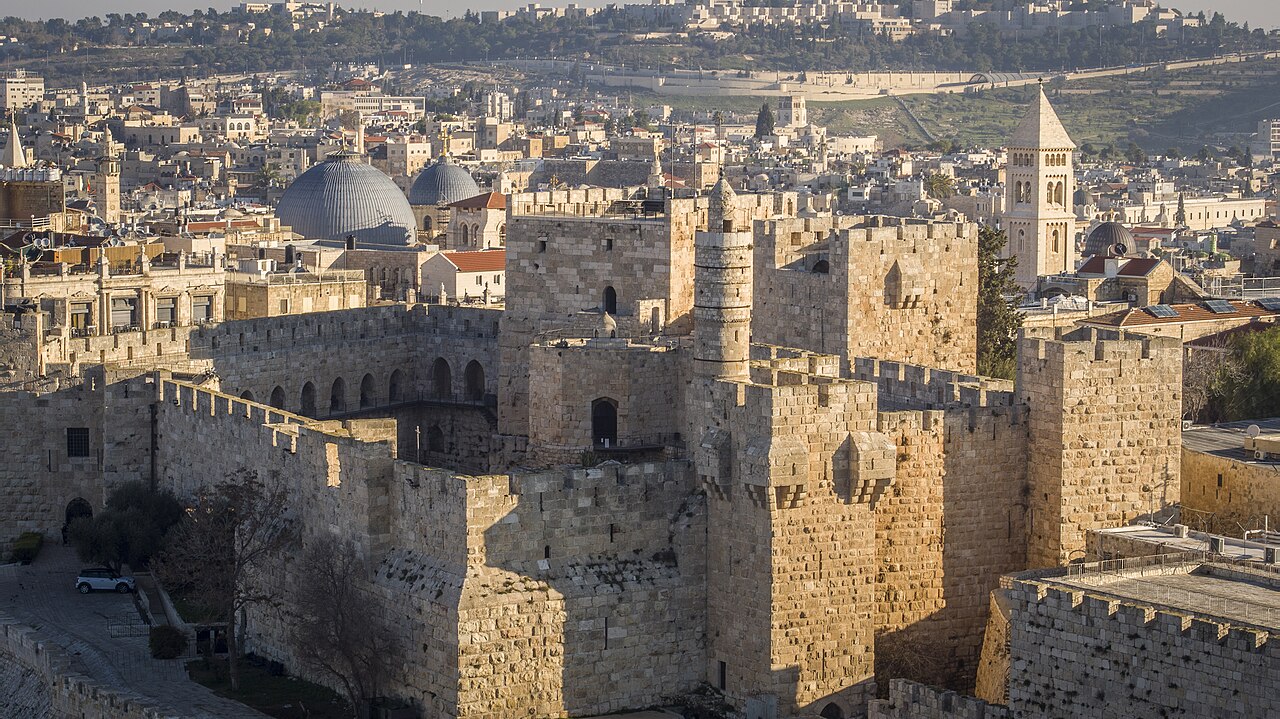
Tower of David Museum
31.7359° N · 35.2255° E · Museum
Tower of David Museum is a museum in Jerusalem, Israel. Housed in the 16th-century Ottoman citadel, this museum traces Jerusalem's 4,000-year history through artifacts, models, and displays. Most visitors spend 1.5–2 hours here. The free Lokali audio guide runs 5 minutes.
✓ Verified August 2026 · how we write these guides
Visitor facts
| Time needed | 1.5–2 hours |
|---|---|
| Lokali audio guide | 5 min · free |
| Type | Museum |
| Best for | History |
| Location | Jerusalem, Israel |
| Coordinates | 31.7359, 35.2255 |
| Languages | 45, in the Lokali app |
The story
Just inside the Jaffa Gate, the lane opens, and a great stone fortress rises on your left. Its walls are pale and massive, topped by a tall, pointed tower. Banners may hang from the battlements above. Step toward it, and the noise of the gate fades behind thick stone. This is the citadel of Jerusalem, long known as the Tower of David.
You enter the fortress across a narrow bridge. Below it lies a deep dry moat, cut long ago to keep attackers back from the walls. Once through the gate, the lane opens into a wide courtyard ringed by towers and ramparts. The change is sudden, from the press of the gate to this open, sunlit ground within the walls.
The name is a puzzle. King David is not, in fact, the builder. The story comes from Byzantine Christians, centuries after David, who looked at the strong walls and gave them his name. The mistake stuck. So the Tower of David has very little to do with David himself. What it does hold is layer upon layer of the city's past.
Dig down here, and you pass through many ages at once. The lowest stones reach back more than two thousand years. King Herod, the great builder of the first century before the common era, raised three mighty towers on this corner to guard his palace. He named them for his brother, his friend, and his wife. The base of one may still survive within the walls you see.
Above Herod's stones lie the works of those who came after. Romans, Muslims, Crusaders, Mamluks, and Ottomans each held this fortress, and each rebuilt it to their need. What stands today is mostly the shape given by Muslim and Ottoman builders in the medieval and later centuries. The fortress is a kind of stone diary, written by many different hands.
That tall, slender tower, the one most people photograph, is a minaret. It was added in the Ottoman period, in the seventeenth century, around the year 1635. For a long time it was the highest marker on the western skyline of the Old City. Curiously, this Muslim minaret is the very thing that most visitors now call the Tower of David.
Since 1989, the citadel has held a museum that tells the long story of Jerusalem itself. The tale it lays out reaches back some four thousand years, from the first small settlement to the city of today. Its rooms and towers lead you through age after age, people after people. The building is both the container and a part of the story it tells.
The museum closed for a major renewal and reopened in 2023. New galleries, gentler ramps, and fresh lighting were added, while the ancient walls were cleaned and braced. The result joins old and new with care. You can now reach parts of the ramparts and towers that had been closed to visitors for years.
In the center of the fortress lies an open courtyard, sunk below the walls. This is the archaeological garden. Here, excavated stones from many periods sit in the open air. You can walk among foundations, cisterns, and walls laid bare by the diggers. Grass and old stone share the same quiet space under the sky.
Climb to the top of the ramparts, and the reward is the view. The whole Old City spreads before you, a sea of domes, crosses, and minarets. To the east, the golden Dome of the Rock catches the light, and beyond it the Mount of Olives rises. From up here, the shape of Jerusalem finally makes sense.
After dark, the courtyard sometimes hosts a show of light and sound. Images are thrown across the ancient walls, and the story of the city plays out in color and music. The old stones become a moving screen. If your visit allows it, seeing the fortress lit at night is a wholly different experience from the day.
Run your hand along the walls as you climb. The stone is warm where the sun has reached it, cool in the shadows. Pigeons wheel around the minaret. From the heights, you hear the city all at once, the church bells, the call to prayer, the hum of the streets below, layered like the stones beneath your feet.
This fortress has guarded the gate of Jerusalem through war and peace for two thousand years. Kings misnamed it, armies fought over it, and now it simply tells its story to anyone who climbs its stairs. When you leave through the Jaffa Gate, glance back at the tower. It has watched far older travelers than you pass beneath it.
Key facts
What to look for
Practical tips
Common questions
How long do you need at Tower of David Museum?
Plan 1.5–2 hours. That is the time most visitors spend at Tower of David Museum. The free Lokali audio guide adds about 5 minutes of narration you can listen to as you walk, so it fits inside your visit rather than adding to it.
Is there a free audio guide to Tower of David Museum?
Yes — the Lokali app narrates Tower of David Museum free of charge in 50+ languages. It covers the history, what to look for on site and practical tips, and it works offline once downloaded.
Where is Tower of David Museum?
Tower of David Museum is in Jerusalem, Israel, at 31.7359, 35.2255. Tap the map link on this page for directions from where you are.
What should you know before visiting Tower of David Museum?
Climb the ramparts for the best city views.
What is Tower of David Museum known for?
Named by Byzantine Christians, not by King David himself.
What is the best time to visit Tower of David Museum?
Climb the tower's internal ramps for views most tourists miss.
On the map
Opens directions to Tower of David Museum from your location.
More to see in Jerusalem


Hear Tower of David Museum in your language
The full story, narrated, in 50+ languages. Download it before you go and it plays offline, at your own pace, with no ticket and no tour group.