
Alexandria Arachosia
31.6022° N · 65.6589° E · Archaeological Site
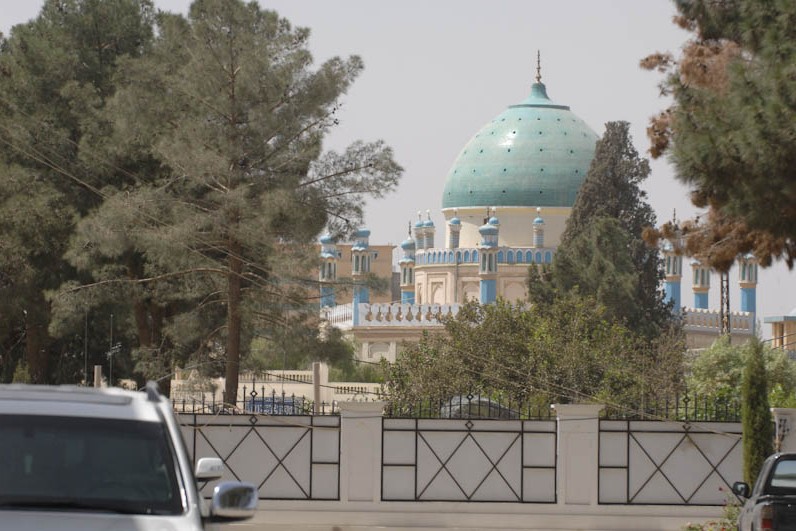
Photo: Karla Marshall · Public domain · Wikimedia Commons
Alexandria Arachosia is an ancient Greek city, site of modern-day Kandahar, Afghanistan. Alexander the Great founded a city here around 330 BCE. The free Lokali audio guide runs 7 minutes.
✓ Published October 2026 · how we write these guides
Visitor facts
| Lokali audio guide | 7 min · free |
|---|---|
| Type | Archaeological Site |
| Location | Kandahar, Afghanistan |
| Coordinates | 31.6022, 65.6589 |
| Languages | 50+, in the Lokali app |
The story
Feel the ground under your shoes first. It is not paving. It is packed earth, broken pottery and crumbled mud brick, the colour of dry bread. Wind comes off the open plain and carries fine dust that settles on your sleeves. Above you, a long ridge of bare rock rises from the flat land. Below it, low mounds run in uneven lines. Those mounds are walls. You are standing in the old city of Kandahar.
Historians usually identify this place with Alexandria in Arachosia. Arachosia was the ancient name for this region of southern Afghanistan. It was a province of the Persian Achaemenid Empire, the great dynasty that ruled from Egypt to the Indus. Alexander the Great passed through around 330 BCE, during his long campaign eastward. He founded, or refounded, a settlement here and gave it his own name, as he did with many cities across Asia.
Now look at the setting. The city sits on rising ground where several old routes met. Roads ran west toward Persia, north toward the mountains and Central Asia, and southeast toward the Indus valley. The Arghandab River, a short way off, waters a belt of orchards and fields. A garrison here could watch traffic, collect tolls and feed itself. Alexander did not pick this spot for its beauty. He picked it because everyone had to pass by.
And something surprising happened after his death. Within a generation, Alexander's successor in the east, Seleucus, handed this region to Chandragupta Maurya, founder of a powerful Indian empire. The deal is usually dated to around 305 BCE. So a city with a Greek name, built inside a former Persian province, became part of an Indian state. Few places on earth sat so directly on the line between these three worlds.
The best evidence for this mixing came out of the ground right here. In 1958, a carved rock was found near the ridge. It carried an edict of Ashoka, the Mauryan emperor of the third century BCE. Ashoka had turned toward Buddhism after a bloody war. He ordered messages about compassion and self-control to be cut into stone across his lands. This one is written in two languages... Greek and Aramaic.
Think about what that means. Ashoka's officials expected people in this city to read Greek. They also expected readers of Aramaic, the old administrative language of the Persian empire. The text asks people to avoid killing living creatures and to respect their parents and elders. A few years later, another Ashokan inscription in Greek was found in the old city as well. The Greek is fluent and well composed — not a clumsy translation, but the work of educated local writers.
Those stones are not here now. They were taken to the national museum in Kabul, and their fate during the years of conflict has been a worry for scholars. So what you see on site is the context, not the objects. That is still worth a great deal. You are looking at the same skyline, the same ridge and the same plain that those scribes knew more than two thousand years ago.
Now turn your eyes to the rock face itself. Cut high into the ridge is a set of steps leading up to a small chamber. Locals call it Chilzina, meaning forty steps. Inside the niche is a long Persian inscription from the Mughal period. It is connected with Babur, founder of the Mughal dynasty, who captured Kandahar in the early sixteenth century. The text records conquests and lists territories, a royal boast carved into the hill.
So one ridge holds a Greek and Aramaic message of peace near its foot, and a Persian victory notice near its top. Nearly two thousand years separate them. The city kept changing hands between empires from the east and the west. Each new ruler wanted to leave a mark, and the hard rock here made a natural noticeboard. Read the place as a layered document, not a single monument.
The old city did not fade away slowly. It was destroyed. In 1738, the Persian ruler Nader Shah besieged Kandahar and took it after a long siege. Afterwards the old town was largely abandoned. Less than a decade later, in 1747, Ahmad Shah Durrani founded the modern city a short distance to the east. He is regarded as the founder of the Afghan state, and his mausoleum still stands in today's Kandahar.
You may hear a popular story that the very name Kandahar comes from Iskandar, the Persian form of Alexander. It is a lovely idea, and many locals repeat it. Scholars, however, debate it. Some link the name instead to Gandhara, an ancient region further east, or to older local words. Treat the Alexander connection to the name as an attractive theory, not a settled fact.
Archaeologists have worked here in limited seasons, including British-led excavations in the 1970s. They traced the line of the defensive walls and found layers of occupation reaching back before Alexander. That is a quiet but important point. Alexander did not build on empty land. A town already stood here under the Persians, and probably earlier. The Greek name was one chapter, laid over a settlement that was already old.
The site today is rough and unrestored. There are no tidy pathways and few signs. Mud brick returns to earth with every rain, so the outlines soften a little each year. Walk slowly and watch your footing on loose ground. Look closely at the soil and you will often see small pieces of glazed and plain pottery. They belong to the site, so leave them exactly where they lie.
Before you leave, stand still for a moment and face east. Somewhere beyond the haze is the modern city, with its traffic and markets, built because this one fell. Behind you, the ridge holds its carved steps against the sky. Listen to the wind moving across the mounds. People argued, traded and prayed here in Greek, Aramaic, Persian and Pashto. Now there is mostly quiet, and the long view across the plain.
Key facts
What to look for
Practical tips
Common questions
Is there a free audio guide to Alexandria Arachosia?
Yes — the Lokali app narrates Alexandria Arachosia free of charge in 50+ languages. The guide runs about 7 minutes, covers the history, what to look for on site and practical tips, and works offline once downloaded.
Where is Alexandria Arachosia?
Alexandria Arachosia is in Kandahar, Afghanistan, at 31.6022, 65.6589. Tap the map link on this page for directions from where you are.
What is Alexandria Arachosia known for?
Alexander the Great founded a city here around 330 BCE. Seleucus ceded this region to the Mauryan Empire around 305 BCE.
What should you look for at Alexandria Arachosia?
The forty carved steps climbing the rocky ridge. Persian inscription inside the niche at the top. Low earthen mounds tracing the line of old walls.
What should you know before visiting Alexandria Arachosia?
Check current security advice before visiting the old city site. Go with a trusted local guide who knows the ground.
When is the best time to visit Alexandria Arachosia?
Visit in early morning to avoid the strongest heat.
On the map
Opens directions to Alexandria Arachosia from your location.
More to see in Kandahar
Hear Alexandria Arachosia in your language
The full story, narrated, in 50+ languages. Download it before you go and it plays offline, at your own pace, with no ticket and no tour group.