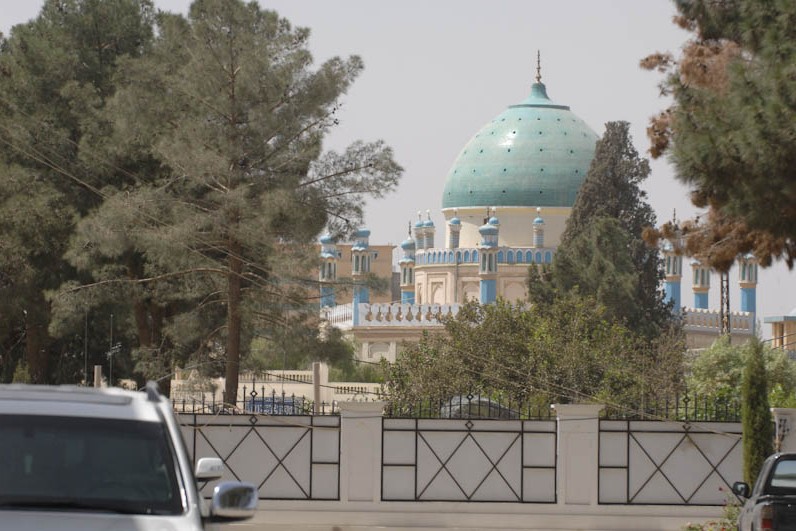
Photo: Brian H. Neely (U.S. Department of State) · Public domain · Wikimedia Commons
Cloak of Muhammad is a Cloak believed to have been worn by the founder of Islam. Kherqa Sharif means the Noble Cloak in Persian. The free Lokali audio guide runs 6 minutes.
✓ Published October 2026 · how we write these guides
Visitor facts
| Lokali audio guide | 6 min · free |
|---|---|
| Type | Mosque |
| Location | Kandahar, Afghanistan |
| Coordinates | 31.6196, 65.7080 |
| Languages | 50+, in the Lokali app |
The story
Listen for a moment. Footsteps on stone, a murmur of prayer, birds in the trees of the old city. Here, in the heart of Kandahar, people slow down without being asked. They lower their voices. Some press a hand to their chest as they pass. The reason is something almost nobody standing here will ever see: a single garment, folded away and locked inside the shrine in front of you.
This is the shrine of the Kherqa Sharif, which means the Noble Cloak. Many Muslims believe the garment inside was worn by the Prophet Muhammad himself. For believers, that makes it one of the most sacred objects in Afghanistan. It is not a museum piece. It is not on display behind glass. It is a relic of faith, guarded and kept from view, and its power comes partly from that hiddenness.
To understand why the cloak is here, in Kandahar, you need one name: Ahmad Shah Durrani. In 1747 he was chosen as leader by Pashtun tribal chiefs. He went on to build a large empire across the region. Today many Afghans call him the father of the nation. Kandahar was his capital, and he shaped this part of the city around his rule.
According to the most common account, Ahmad Shah obtained the cloak in the late eighteenth century from the ruler of Bukhara, a city in present-day Uzbekistan. The year usually given is 1768. The details of the exchange are told in different ways. Some versions describe a diplomatic agreement. Others describe something closer to a bargain made under pressure. Historians cannot agree on every detail, so it is best to hold the story lightly.
Then there are the legends, and Kandahar has several. Locals tell a tale that the cloak was meant to be returned, but the relic itself seemed unwilling to leave. In one popular telling, a stone where the cloak rested became sacred too. These stories are folklore, not documented history. But they show something real — how deeply people here feel that the cloak belongs to this city.
Now, look beside the shrine. The large tomb nearby is the mausoleum of Ahmad Shah Durrani. He died in the early 1770s, only a few years after the cloak arrived. The relic and the ruler rest side by side. That closeness is not an accident. A king who brought the Prophet's cloak to his capital also tied his own legacy to it. Power and piety stand here in the same courtyard.
Here is the first surprise for most visitors. The cloak is almost never shown. It is kept wrapped and locked away, and access is controlled by a small group of trusted guardians. Over more than two centuries, it has been brought out only on very rare occasions. Most people who live in Kandahar have never seen it. Their devotion is to the presence of the relic, not to the sight of it.
Those rare moments have usually come in times of crisis. One widely reported occasion was in the 1930s, when the cloak was reportedly brought out as people prayed for protection from a deadly epidemic. The belief behind such moments is simple and old. In a time of fear, a community turns to the most sacred thing it holds, and asks for mercy.
The second surprise is more recent, and it changed how the world knows this relic. In 1996, the Taliban leader Mullah Omar took the cloak from the shrine. He displayed it from a rooftop in Kandahar before a large crowd. Soon after, his supporters gave him the title Commander of the Faithful. It was a deliberate act. By holding the Prophet's cloak, he claimed a religious authority that went far beyond politics.
That moment still divides opinion. For some, it was a powerful symbol. For many others, inside Afghanistan and beyond, it was a misuse of a sacred object for political ends. Either way, it shows a pattern that runs through this shrine's history. Whoever is linked to the cloak gains a special kind of legitimacy. That is why the relic has always been guarded so carefully.
It helps to know that this is not the only cloak linked to the Prophet. A famous one is kept in Topkapı Palace in Istanbul, the former home of the Ottoman sultans. Other relics of this kind exist in different parts of the Muslim world. Each has its own history and its own community of believers. The Kandahar cloak is special to this city because of its bond with Ahmad Shah and the founding of the Afghan state.
As you stand here, notice the people more than the buildings. Pilgrims come to pray, to ask for blessings, and to sit in quiet for a while. Families bring children. Older men move slowly, with prayer beads in their hands. This is a working place of worship. If you are a visitor, the most important thing you can bring is respect — modest clothing, a soft voice, and patience with local customs and any guardians at the gate.
The shrine is also part of a living old city. Beyond these walls are narrow lanes, small shops, and the steady sound of traffic and daily life. Kandahar has seen empires rise and fall, many wars, and long periods of hardship. Through all of it, this relic has stayed in the same place. For many people here, that continuity is itself a kind of comfort.
Before you walk on, take one last look at the shrine. You will not see the cloak, and almost no one does. But you can see what it means — in the lowered voices, the careful steps, the hands raised in prayer. Something folded away in a locked chest still shapes how people move through this courtyard. As you leave, listen again to the quiet. It is the sound of a city keeping a promise to something it cannot see.
Key facts
What to look for
Practical tips
Common questions
Is there a free audio guide to Cloak of Muhammad?
Yes — the Lokali app narrates Cloak of Muhammad free of charge in 50+ languages. The guide runs about 6 minutes, covers the history, what to look for on site and practical tips, and works offline once downloaded.
Where is Cloak of Muhammad?
Cloak of Muhammad is near Kandahar, Afghanistan, at 31.6196, 65.7080. Tap the map link on this page for directions from where you are.
What is Cloak of Muhammad known for?
Kherqa Sharif means the Noble Cloak in Persian. Believed by many Muslims to be the Prophet's own cloak.
What should you look for at Cloak of Muhammad?
The mausoleum of Ahmad Shah Durrani beside the shrine. Pilgrims raising hands in quiet prayer near the entrance. Guardians watching over the shrine's main doorway.
What should you know before visiting Cloak of Muhammad?
Dress modestly, with arms and legs fully covered. Ask permission before photographing pilgrims or guardians.
When is the best time to visit Cloak of Muhammad?
Visit outside Friday prayer times to avoid crowds.
On the map
Opens directions to Cloak of Muhammad from your location.
More to see in Kandahar

Hear Cloak of Muhammad in your language
The full story, narrated, in 50+ languages. Download it before you go and it plays offline, at your own pace, with no ticket and no tour group.