
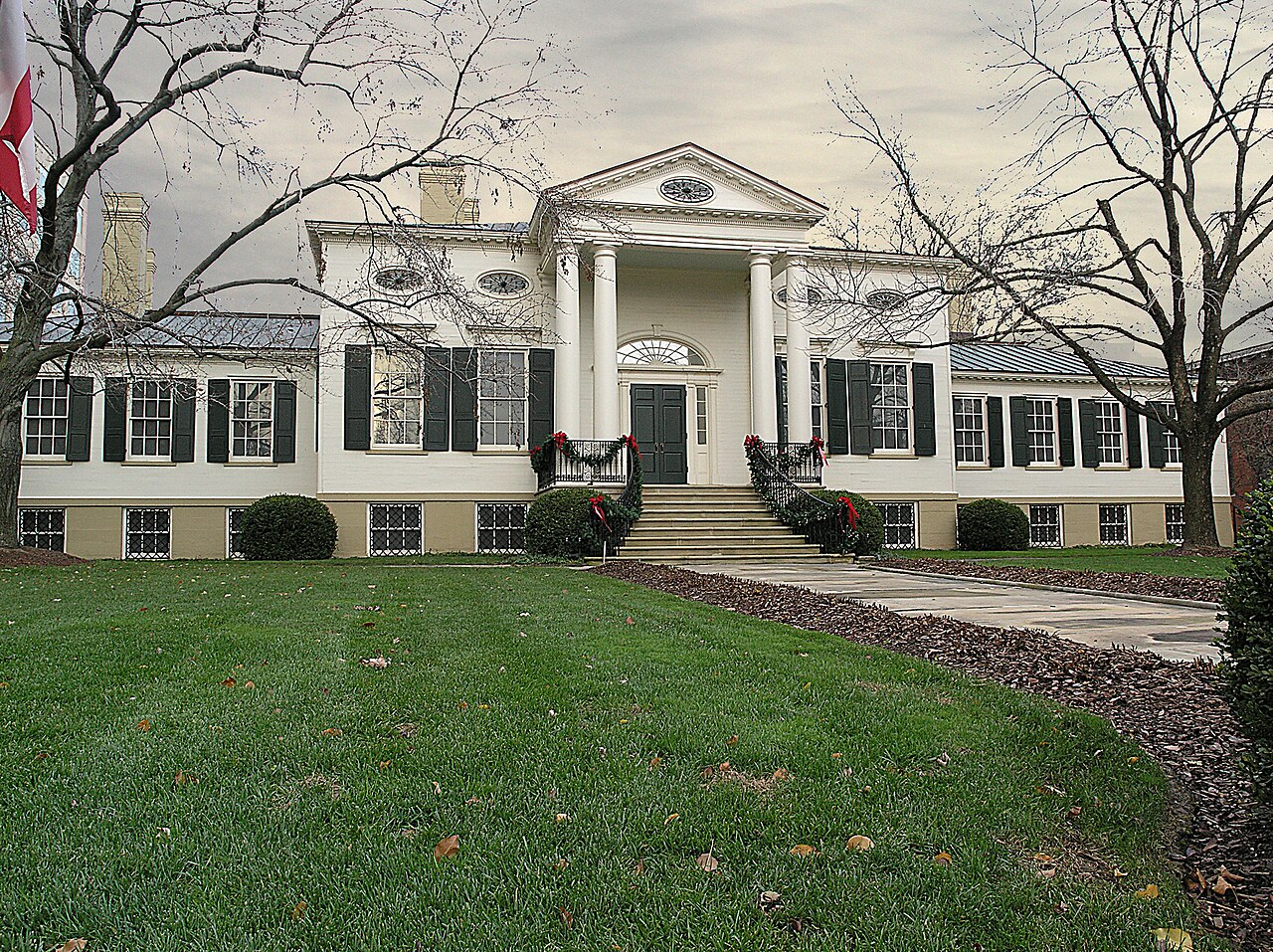
Photo: Creashin at English Wikipedia · Public domain · Wikimedia Commons
Creation Museum is a museum. It is near Kentucky, United States. Opened in 2007 in Petersburg, northern Kentucky. The free Lokali audio guide runs 7 minutes.
✓ Published October 2026 · how we write these guides
Visitor facts
| Lokali audio guide | 7 min · free |
|---|---|
| Type | Museum |
| Location | Kentucky, United States |
| Coordinates | 39.0862, -84.7835 |
| Official website | creationmuseum.org |
| Languages | 50+, in the Lokali app |
The story
Listen for a moment. Somewhere ahead, a mechanical dinosaur shifts its head with a soft hum of motors. Nearby, water trickles over artificial rock, and a child laughs at the sight of a scaly neck turning toward her. The air inside is cool and dim, lit in pools of amber and green. This is the Creation Museum, in the rolling hills of Petersburg, northern Kentucky. Before we walk on, it helps to know exactly what kind of place you have entered.
This is not a natural history museum in the usual sense. It was built to tell the story of the world as described in the Book of Genesis, read in a literal way. The museum is run by Answers in Genesis, a Christian ministry. It presents the view that the Earth is only a few thousand years old. That view differs sharply from mainstream science, which dates the planet to around four and a half billion years. Whatever you believe, it is worth seeing how that argument is staged.
The museum opened its doors in 2007. Its driving figure is Ken Ham, an Australian-born former schoolteacher who founded Answers in Genesis in the United States. The location was a careful choice. The site sits a short drive from Cincinnati, just across the Ohio River, and close to a major airport. A large share of the American population lives within a day's drive. From the start, the plan was to reach families on road trips, church groups, and curious travellers alike.
Notice the craft around you. Whatever the message, the production values are high. Many of the exhibit designers came from a background in theme parks and professional museum design. The lighting is theatrical. The figures are detailed down to wrinkles and fingernails. Rooms are built as scenes rather than display cases. You do not simply read labels here. You walk through a sequence of spaces that work much like the chapters of a book.
The journey begins with a question about starting points. Early galleries set out the museum's central idea. Two people can look at the same fossil, it argues, and reach different conclusions because they start from different assumptions. One gallery shows paleontologists at a dig site, working the same bones. From there, the route moves through what the museum calls the Seven C's — a summary of the Bible's story, from Creation and the Fall to the Flood and beyond.
Now comes the part that surprises most first-time visitors. In the Garden of Eden scenes, life-sized human figures stand beside dinosaurs. Children play near young reptiles. Animals that most scientists place tens of millions of years before humans appear here in the same moment. This is the museum's most debated image. It is also the one people photograph most. Take a slow look at the faces of the figures and the plants around them. The scene was built to feel peaceful, almost like a garden painting.
The mood changes as you continue. The galleries darken as the story moves to the Fall, when Genesis says sin entered the world. Then the narrative turns to the Flood. Here you will find exhibits about Noah and the building of the Ark, with figures of workers hauling timber. The museum argues that a worldwide flood explains canyons, rock layers, and fossil beds. Geologists overwhelmingly disagree, and see those layers as the work of immense spans of time.
One exhibit draws serious fossil enthusiasts. The museum displays a real Allosaurus skeleton, a large meat-eating dinosaur from the Jurassic period, as mainstream science names it. The bones were donated to the museum. Allosaurus was a relative of the more famous Tyrannosaurus, though it lived much earlier on the standard timeline. Stand near the skull and look at the curved, serrated teeth. Whatever story the label tells, the fossil itself is genuine, and remarkably complete.
Here is a second detail many visitors never hear about. In 2014, this building hosted a televised debate between Ken Ham and Bill Nye, the American science educator once known on television as the Science Guy. The question was whether creation is a viable model of origins. The event was streamed online and watched by a very large audience. For one evening, a museum in a quiet Kentucky town sat at the centre of a national argument about science and faith.
Step outside, and the pace slows. The museum grounds include landscaped gardens with paths, ponds, and small bridges. In warmer months, flowers and shade trees fill the space, and the sound of moving water replaces the hum of the galleries. There is also a small animal area, which is often the favourite stop for younger children. Many families end up spending as much time outdoors as inside. It is a good place to sit and talk over what you have seen.
Back indoors, the museum also has a planetarium. Its shows take visitors on a tour of stars, galaxies, and the vastness of space. As with the rest of the building, the presentation frames astronomy through the museum's own beliefs. Still, the dome itself is a calm, enveloping space. Lean back, let your eyes adjust to the dark, and watch the projected sky turn slowly overhead.
It also helps to know where this museum fits. It has a larger sister attraction, the Ark Encounter, farther south in Williamstown, Kentucky. That site holds a full-scale wooden reconstruction of Noah's Ark, built to the dimensions described in Genesis. Many visitors plan both in the same trip. If you go, notice how the two sites share a design style and a message, but at very different scales.
How should you take all this in? Many visitors come as believers, seeking encouragement. Others come as sceptics, curious to understand a worldview that shapes how millions of Americans see the past. Some come mainly for the dinosaurs. The museum is a useful window into a real and lasting debate in American culture. You can disagree with its science and still learn a great deal about the people who built it, and the people who visit.
Before you leave, pause once more. Listen to the motors, the water, the voices of families comparing notes. Look at the figures frozen mid-gesture around you, built with obvious care. Whatever you take away today, you have walked through a carefully told story about where we come from. As you step back into the Kentucky air, notice the real hills, the real trees, and the long question this building tries to answer.
Key facts
What to look for
Practical tips
Common questions
Is there a free audio guide to Creation Museum?
Yes — the Lokali app narrates Creation Museum free of charge in 50+ languages. The guide runs about 7 minutes, covers the history, what to look for on site and practical tips, and works offline once downloaded.
Where is Creation Museum?
Creation Museum is near Kentucky, United States, at 39.0862, -84.7835. Tap the map link on this page for directions from where you are.
What is Creation Museum known for?
Opened in 2007 in Petersburg, northern Kentucky. Run by the Christian ministry Answers in Genesis.
What should you look for at Creation Museum?
Life-sized humans and dinosaurs together in the Eden scene. Serrated teeth on the real Allosaurus skeleton's skull. Two paleontologists studying the same bones at the dig scene.
What should you know before visiting Creation Museum?
Allow several hours to see galleries, gardens, and planetarium. Visit the outdoor gardens in warmer months for shade and flowers.
When is the best time to visit Creation Museum?
Arrive early to walk the indoor galleries before crowds build.
On the map
Opens directions to Creation Museum from your location.
More to see near Creation Museum


Hear Creation Museum in your language
The full story, narrated, in 50+ languages. Download it before you go and it plays offline, at your own pace, with no ticket and no tour group.