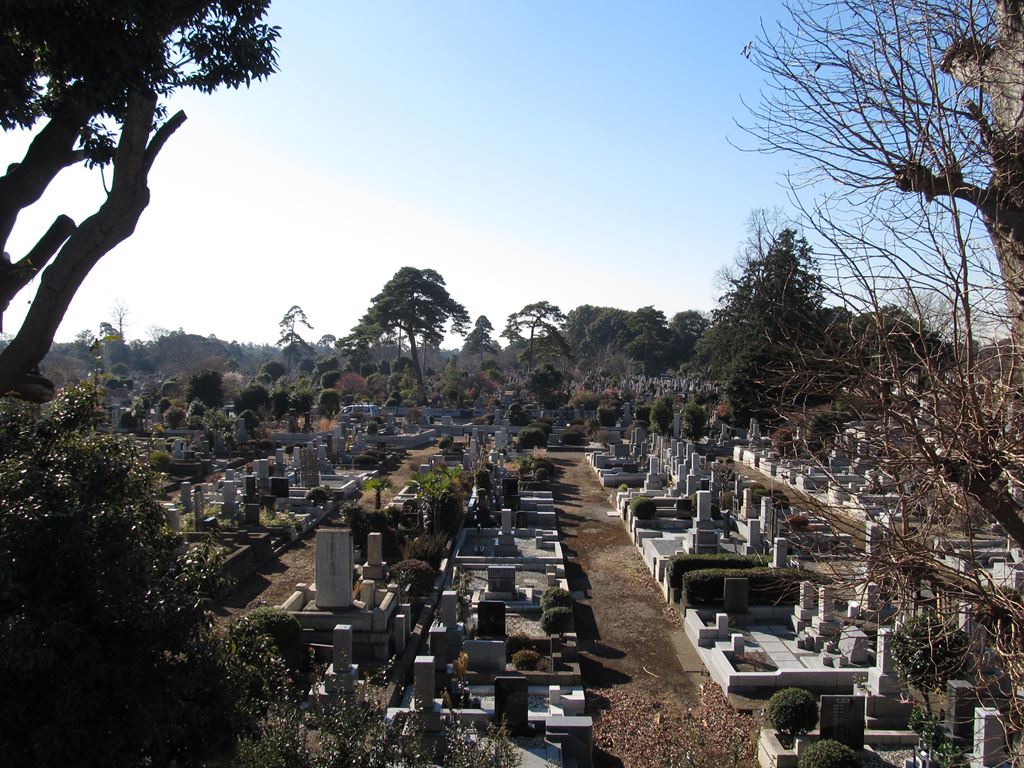
Photo: Fuchu · CC BY-SA 4.0 · Wikimedia Commons
Tama Cemetery is a cemetery in Tokyo, Japan. Opened in the early 1920s on Musashino farmland. The free Lokali audio guide runs 7 minutes.
✓ Published October 2026 · how we write these guides
Visitor facts
| Lokali audio guide | 7 min · free |
|---|---|
| Type | Park |
| Location | Koganei, Japan |
| Coordinates | 35.6853, 139.5097 |
| Official website | tokyo-park.or.jp |
| Languages | 50+, in the Lokali app |
The story
Listen first. Gravel shifts under your shoes. A crow calls from somewhere high in the pines. Beyond the trees, very faintly, a train passes. Then the quiet comes back. This is Tama Cemetery, on the western edge of Tokyo. It covers a large stretch of land across Koganei and its neighbour, Fuchu. Wide avenues run between the plots, and the canopy overhead is thick enough to cool the air on a summer afternoon.
The first surprise is the scale. Tama Cemetery covers more than one hundred hectares. It is one of the largest cemeteries in Japan's capital, and it feels less like a graveyard than a forest with stones in it. You could walk here for an hour and meet only a gardener and a family carrying a bucket of water. Many Tokyo residents never notice how large it is. They pass it on the train and see only a long line of trees.
Why is it out here, so far from the old city centre? In the early twentieth century, Tokyo was growing fast. The temple graveyards of the inner city were full, and the city needed new burial ground. Planners looked west, to the open farmland of the Musashino plateau. Musashino is the name of the broad, flat upland west of central Tokyo. It was once famous for its grasslands and woods. The cemetery opened here in the early 1920s, on land that was still mostly fields.
The second surprise is the design. Tama was planned as a park cemetery, and it is widely described as the first of its kind in Japan. Traditional Japanese graveyards sit tightly around a Buddhist temple. Stones stand close together on narrow paths. Here, the planners chose a different model. They laid out broad tree-lined roads, open lawns, and gentle curves. The idea was a place where the living could walk, breathe, and spend time, not only a place to bury the dead.
Look at the graves themselves as you walk. Most follow a familiar Japanese form. A tall rectangular stone carries the family name, often with the word for family grave below it. In front, there is a small basin for water and a holder for incense sticks. Behind many stones stand thin wooden boards, painted with Buddhist names and prayers. When the wind moves, these boards knock gently together. That soft wooden clatter is one of the sounds of a Japanese cemetery.
Notice the buckets, too. Near the water taps, you will often see rows of wooden or plastic buckets with small ladles. Families take one to the grave, pour water over the stone, and wipe it clean. The water cleans the stone, and it is also a gesture of care, like offering a drink to a guest. The busiest days come at the spring and autumn equinoxes and during Obon in summer. Obon is the Buddhist season when families welcome the spirits of their ancestors home.
Tama is also a quiet register of modern Japanese history. Many people who shaped the country in the twentieth century are buried here. Among them is Admiral Togo Heihachiro, the naval commander celebrated in Japan for the victory over the Russian fleet in 1905. Not far away lies Admiral Yamamoto Isoroku, who planned the attack on Pearl Harbor and died in 1943. To stand between these graves is to stand at both ends of Japan's naval story in that century.
Writers rest here as well. The novelist Mishima Yukio is buried in his family's grave, under his birth surname, Hiraoka. Visitors sometimes miss it for that reason. The poet Yosano Akiko, whose passionate verse shocked readers in the early 1900s, lies here too. So does Edogawa Ranpo, the father of Japanese detective fiction. He chose his pen name as a play on the name of Edgar Allan Poe. Say it slowly, and you can hear the echo.
Another name may be familiar from your wallet, if you have handled older Japanese money. Nitobe Inazo, the educator and author of the book Bushido, appeared on the five-thousand-yen note for many years. He also worked at the League of Nations, the international body created after the First World War. His grave is here as well. Many famous graves have small signboards nearby, so look for these as you walk the main avenues.
Now, a word about how to move through this place. The cemetery is divided into numbered sections, and the map boards near the entrances help you find a name. Distances are long, so give yourself time. Remember that this is an active cemetery. Families still come every week. Keep your voice low, stay on the paths, and do not touch the stones or the offerings. If someone is praying at a grave, simply pass by quietly.
The seasons change this place completely. In spring, cherry trees along the avenues bloom white and pale pink, and petals collect in the gravel. Some locals come just for that, with a thermos and a quiet walk. In early summer, the green becomes dense and the cicadas start. Their sound can fill the whole cemetery. In autumn, the leaves turn and the light comes in low and gold between the trunks. Winter is bare, clear, and very still.
There is also something here for anyone who studies cities. Tama shows how Tokyo thought about death and public space a century ago. The planners treated the cemetery as green infrastructure, a lung for a growing city. Today, the trees here form one of the larger green areas in western Tokyo. Birds use it. Joggers and walkers use it. The dead and the living share the same shade.
Before you leave, stop for a moment wherever you are. Look down the nearest avenue. Count the stones you can see, and then remember that each one holds a family, not a single person. Listen again for the wooden boards in the wind, the crows, the far-off train. As you walk back toward the gate, notice how the city sounds slowly return. The quiet stays behind you, under the trees.
Key facts
What to look for
Practical tips
Common questions
Is there a free audio guide to Tama Cemetery?
Yes — the Lokali app narrates Tama Cemetery free of charge in 50+ languages. The guide runs about 7 minutes, covers the history, what to look for on site and practical tips, and works offline once downloaded.
Where is Tama Cemetery?
Tama Cemetery is near Koganei, Japan, at 35.6853, 139.5097. Tap the map link on this page for directions from where you are.
What is Tama Cemetery known for?
Opened in the early 1920s on Musashino farmland. Widely considered Japan's first park-style cemetery.
What should you look for at Tama Cemetery?
Thin wooden prayer boards standing behind family gravestones. Rows of water buckets and ladles beside the taps. Small signboards marking the graves of famous people.
What should you know before visiting Tama Cemetery?
Check the map boards at entrances for famous grave sections. Wear comfortable shoes; distances between sections are long.
When is the best time to visit Tama Cemetery?
Visit in early April to walk under the cherry trees.
On the map
Opens directions to Tama Cemetery from your location.
More to see near Tama Cemetery



Hear Tama Cemetery in your language
The full story, narrated, in 50+ languages. Download it before you go and it plays offline, at your own pace, with no ticket and no tour group.