
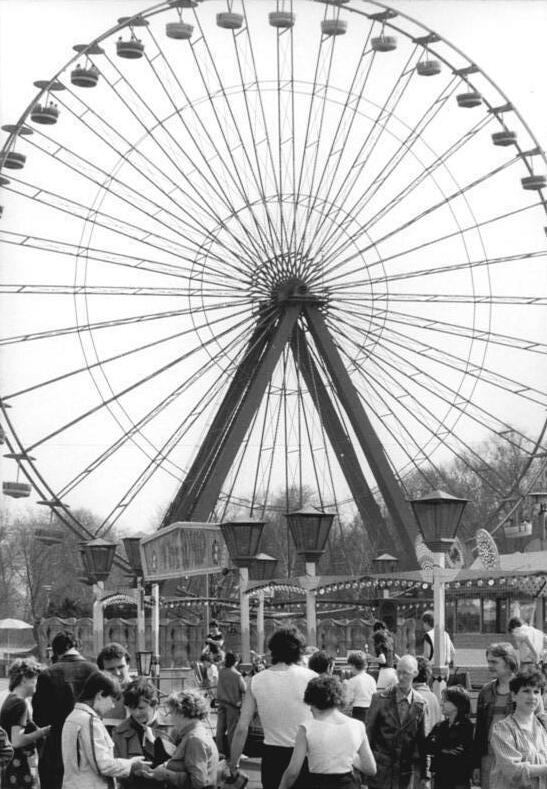
Photo: KleinerWeltenbummler · CC BY-SA 3.0 · Wikimedia Commons
Tierpark Berlin is a zoo in Germany. Tierpark Berlin opened to the public in 1955. The free Lokali audio guide runs 6 minutes.
✓ Published October 2026 · how we write these guides
Visitor facts
| Lokali audio guide | 6 min · free |
|---|---|
| Type | Zoo |
| Location | Lichtenberg, Germany |
| Coordinates | 52.5003, 13.5325 |
| Official website | tierpark-berlin.de |
| Languages | 50+, in the Lokali app |
The story
Listen for a moment. Gravel crunches under your shoes. Somewhere beyond the trees, a bird calls that does not belong to a northern European park. The air smells of cut grass and damp bark. Here the paths are wide and the sky feels large. You may forget that you are inside a capital city at all.
This is Tierpark Berlin, in the Friedrichsfelde neighbourhood of the Lichtenberg district, in the east of the city. It is one of the largest zoos in Europe by area, laid out across roughly 160 hectares of old parkland. That size shapes everything. Animals here often live in open landscapes rather than small cages. Visitors walk long distances between enclosures, through meadows, woodland and along quiet ponds.
To understand why this place exists, you need to remember the divided city. After the Second World War, Berlin's older zoo stood in the western half. The eastern half, the capital of the German Democratic Republic, had no major zoo of its own. In the 1950s, the East German authorities decided to build one. The Tierpark opened to the public in 1955, and it became a point of pride for East Berliners.
Here is a detail many visitors miss. Ordinary residents helped build this park. Thousands of East Berliners gave unpaid hours in volunteer work programmes of that era. They dug ditches, moved earth and shaped enclosures with their own hands. For many families, the zoo was not only a place to visit. It was something they had made together, in a city that was still clearing rubble.
The park also needed a leader with vision. That leader was Heinrich Dathe, a zoologist who directed the Tierpark for several decades. Dathe favoured a landscape style — animals set into wide, natural-looking spaces, with ditches and water instead of bars where possible. He also became a well-known public voice for animals in East Germany. His name is still connected with this place, and many older Berliners remember him fondly.
Now, a second surprise. This zoo was not built on empty ground. It was laid out in the grounds of Friedrichsfelde Palace, a baroque country house that is far older than the zoo itself. Baroque, for listeners unfamiliar with the term, means the grand, ornamented style of European architecture from roughly the late seventeenth and eighteenth centuries. The palace park, with its old trees and long views, became the frame for the new zoo.
If you find the palace, stop and look at it carefully. It is a pale, elegant building, calm and symmetrical, with tall windows. It feels a little unexpected here, between animal houses and visitor paths. The palace has been restored and is used today for exhibitions and cultural events, including concerts. A short walk from the elephants, you can stand in front of an aristocratic house that is centuries old.
One of the best-known buildings in the park is the Alfred Brehm House, named after a nineteenth-century German zoologist and writer. It opened in the 1960s and was designed for big cats and tropical animals. Inside, the air is warm and humid. A large hall holds plants, birds and water. For many years it was one of the most ambitious zoo buildings in Europe, and it still carries the confident spirit of its era.
The elephants are another highlight. The Tierpark has long been known for its elephants, and their house is a large building that dates from the late East German period. Watch the herd if you can. Elephants are social animals, and you may see young ones staying close to the adults. The scale of the enclosure gives you a sense of how much space these animals need.
The story changed again after 1990. When Germany reunified, Berlin suddenly had two large zoos, one in the west and one here in the east. Some people asked whether the city could afford both. In the end, both survived. Today the Tierpark and the Berlin Zoo work under shared management. The western zoo is compact and urban. The Tierpark is spacious and green. Together they cover very different experiences.
In recent years, parts of the park have been renewed and redesigned. Some older enclosures have been rebuilt with more space and more natural surroundings. As you walk, you may notice the mix of eras. A modern viewing area might stand next to concrete from the 1960s. That mix is part of the character here. You can read the history of the park in its building materials, layer by layer.
A practical word about walking. Because the park is so large, it rewards a plan. Pick a few areas that matter most to you. Leave time to sit on a bench, too. Some of the best moments here are slow ones — a flock of birds crossing a pond, or an animal walking along the far edge of its meadow. Rushing from enclosure to enclosure can make you miss them.
Notice the people around you as well. You may hear Berlin families who have come here for generations. For some grandparents, this was the zoo of their childhood in the East. For their grandchildren, it is simply a large green place with giraffes and elephants. The same paths carry very different memories, and that layering is one of the quiet pleasures of a visit.
Before you move on, pause where you are. Look up at the old trees. Many of them were growing here long before the first animals arrived. Listen again to the gravel, the birds and the voices. As you leave, you might notice how quickly the ordinary city returns — the tram, the traffic, the apartment blocks. Behind you, the park stays open and green, a large piece of Berlin's past that still lives in its present.
Key facts
What to look for
Practical tips
Common questions
Is there a free audio guide to Tierpark Berlin?
Yes — the Lokali app narrates Tierpark Berlin free of charge in 50+ languages. The guide runs about 6 minutes, covers the history, what to look for on site and practical tips, and works offline once downloaded.
Where is Tierpark Berlin?
Tierpark Berlin is near Lichtenberg, Germany, at 52.5003, 13.5325. Tap the map link on this page for directions from where you are.
What is Tierpark Berlin known for?
Tierpark Berlin opened to the public in 1955. Covers roughly 160 hectares in Friedrichsfelde, Lichtenberg.
What should you look for at Tierpark Berlin?
The pale baroque facade of Friedrichsfelde Palace. Warm humid tropical hall inside the Alfred Brehm House. Ditches and water barriers instead of cage bars.
What should you know before visiting Tierpark Berlin?
Choose a few priority areas before you start walking. Wear comfortable shoes for long distances between enclosures.
On the map
Opens directions to Tierpark Berlin from your location.
More to see near Tierpark Berlin



Hear Tierpark Berlin in your language
The full story, narrated, in 50+ languages. Download it before you go and it plays offline, at your own pace, with no ticket and no tour group.