
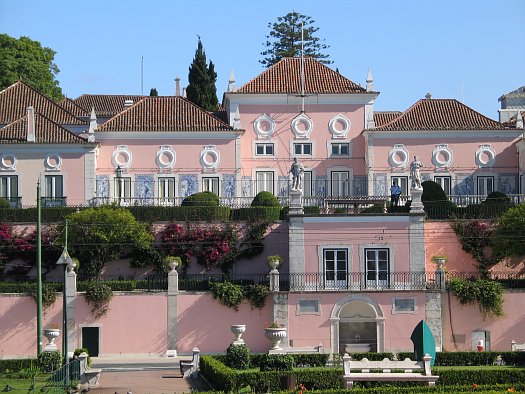
Photo: Kent Wang · CC BY 4.0 · Wikimedia Commons
Palace of Queluz is a former royal palace and current national palace at Queluz, Sintra, Portugal. Construction began in 1747 for Dom Pedro, later King Peter the Third. The free Lokali audio guide runs 7 minutes.
✓ Published October 2026 · how we write these guides
Visitor facts
| Lokali audio guide | 7 min · free |
|---|---|
| Type | Palace |
| Location | Lisbon, Portugal |
| Coordinates | 38.7505, -9.2582 |
| Official website | pnqueluz.imc-ip.pt |
| Languages | 50+, in the Lokali app |
The story
Listen first. Gravel shifts under your shoes, and somewhere a fountain drips into a stone basin. The walls in front of you are a soft pink, trimmed with white. Nothing here looks heavy or severe. Even on a grey day, the façade seems light, almost like a sugared cake left out in the garden. This is the Palace of Queluz, on the edge of Lisbon. It was never built to impress an enemy. It was built for pleasure, for music, and for long summer evenings.
The story begins in the middle of the eighteenth century. In 1747, work started on a country retreat for Dom Pedro, a younger son of the Portuguese royal family. At first, this was a modest hunting lodge. Over the following decades, it grew wing by wing into the palace you see now. Dom Pedro later married his niece, who became Queen Maria the First. As her husband, he took the title King Peter the Third. Queluz became their favourite home away from the formal court.
The main architect was a Portuguese builder named Mateus Vicente de Oliveira. Later, a French designer, Jean-Baptiste Robillion, shaped much of the gardens and one elegant wing. Their style is called Rococo — a late form of Baroque that prefers curves, shells, gilding, and playful decoration over grand weight. Notice how the palace stays low and spreads sideways. It does not tower. It invites you to walk along it, from one pavilion to the next.
Here is the first surprise. Queluz is often compared to Versailles, the vast French palace near Paris. The comparison makes sense in spirit, but not in size. Queluz is much smaller and more intimate. Many visitors expect endless corridors. Instead, they find rooms that feel almost domestic, connected in a chain. You can imagine a royal family actually living here, arguing at breakfast, and hearing music drift in from the next hall.
Inside, the most dazzling space is the Throne Room. It also served as a ballroom. Look for the tall mirrors, the gilded carvings, and the crystal chandeliers. In candlelight, the mirrors would have multiplied every flame. Picture the floor full of silk, powdered wigs, and the sound of a small orchestra. Close by is the Music Room, where the royal family held concerts. Music was central to life at Queluz. Opera and chamber music filled these rooms on summer nights.
The second surprise waits in a quieter part of the palace, in the Don Quixote Room. The walls and ceiling carry scenes from the famous Spanish novel about a dreaming knight. In this room, in 1798, a prince named Pedro was born. He later became the first emperor of an independent Brazil, and also king of Portugal. In 1834, he returned to Queluz, and he died in this same room. Few people are born and die beneath the same painted ceiling.
Queluz also holds a sadder chapter. After the deaths of her husband and her eldest son, Queen Maria the First suffered a severe mental illness. She spent much of her later life here, away from public view. Visitors at the time reported hearing her cries through the palace. Her son, the future King John the Sixth, ruled in her place. It is worth remembering this quieter grief when you walk through such cheerful, decorated rooms.
In 1807, the history of Queluz changed suddenly. French armies under Napoleon were advancing into Portugal. The royal family and much of the court sailed to Brazil, then a Portuguese colony. They stayed there for many years. The palace lost its role as a lively summer home. Later in the nineteenth century, the court moved on to other residences. In the twentieth century, Queluz passed to the state, and it opened to visitors as a museum.
The building was also damaged by a serious fire in the 1930s. Some interiors had to be restored with great care. So, as you look at ceilings and wall panels, keep in mind that some surfaces are original and others are careful reconstruction. Today, part of the palace still has an official use. One pavilion has hosted foreign heads of state during visits to Portugal. Queluz is still a working stage for diplomacy, not only a museum.
Now step outside into the gardens. They are laid out in a formal French style, with clipped box hedges, gravel paths, and geometric beds. The Hanging Garden sits close to the palace and is raised above the ground. Around it stand statues and urns. Many of the garden sculptures are made of lead and came from the workshop of an English sculptor, John Cheere. Look closely, and you will see figures from myth and allegory, some softened by centuries of weather.
Further out, look for one of the most unusual features in any European palace garden: a canal lined with painted tiles. In Portugal, these glazed tiles are called azulejos. They line the walls of the canal with blue and white scenes of ships, harbours, and daily life. The royal family took small boats along this water during festivities. Imagine music, lanterns, and laughter echoing off the tiles. On a sunny day, the water throws moving light onto the painted ships.
As you walk, notice how sound changes from place to place. Inside, your footsteps ring on polished floors. In the gardens, the gravel crunches, birds call from the hedges, and the traffic of the modern town hums faintly beyond the walls. Queluz is now surrounded by suburbs, apartment blocks, and busy roads. That contrast is part of its charm. Behind one gate, the noise of the present day almost disappears, and the eighteenth century takes over again.
Before you leave, pause for a moment in the gardens and turn back towards the palace. Look at the pink walls, the white trim, and the long, low lines of the façade. Think about the concerts, the boat rides, the birth and death of an emperor, and a queen in her quiet sorrow. Then listen again — to the fountain, to the gravel under your feet. These are the same small sounds the royal family heard on their summer evenings here.
Key facts
What to look for
Practical tips
Common questions
Is there a free audio guide to Palace of Queluz?
Yes — the Lokali app narrates Palace of Queluz free of charge in 50+ languages. The guide runs about 7 minutes, covers the history, what to look for on site and practical tips, and works offline once downloaded.
Where is Palace of Queluz?
Palace of Queluz is near Lisbon, Portugal, at 38.7505, -9.2582. Tap the map link on this page for directions from where you are.
What is Palace of Queluz known for?
Construction began in 1747 for Dom Pedro, later King Peter the Third. Main architect was Portuguese builder Mateus Vicente de Oliveira.
What should you look for at Palace of Queluz?
Tall gilded mirrors lining the Throne Room walls. Don Quixote scenes painted across walls and ceiling. Blue and white tiles showing ships along the canal.
What should you know before visiting Palace of Queluz?
Walk the gardens after the interiors to rest your eyes. Wear comfortable shoes for long gravel paths outside.
On the map
Opens directions to Palace of Queluz from your location.
More to see in Lisbon


Hear Palace of Queluz in your language
The full story, narrated, in 50+ languages. Download it before you go and it plays offline, at your own pace, with no ticket and no tour group.