
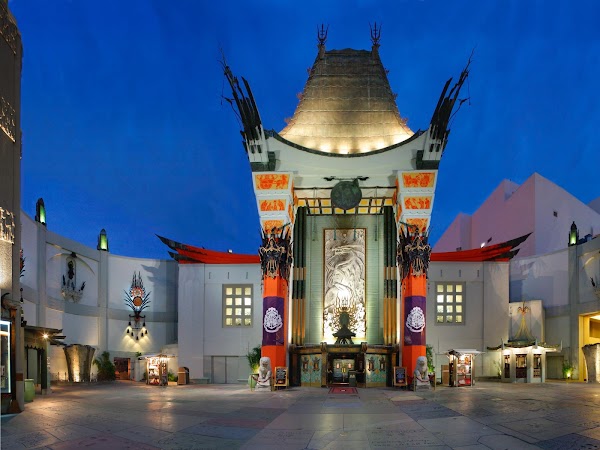
Photo: File:Dolby_Theatre.jpg: Adam Fagen from Washington, DC, USA derivative work: Jullit31 · CC BY-SA 2.0 · Wikimedia Commons
Dolby Theatre is a live entertainment theatre in Los Angeles, California, United States. Opened in 2001 as the Kodak Theatre. The free Lokali audio guide runs 6 minutes.
✓ Published October 2026 · how we write these guides
Visitor facts
| Lokali audio guide | 6 min · free |
|---|---|
| Type | Theatre |
| Location | Los Angeles, United States |
| Coordinates | 34.1028, -118.3403 |
| Official website | dolbytheatre.com |
| Languages | 50+, in the Lokali app |
The story
Stand still for a moment on Hollywood Boulevard. Under your feet, brass and pink terrazzo stars from the Walk of Fame are worn smooth by millions of shoes. Around you there are tour-bus guides calling out, the hiss of traffic, and maybe a costumed superhero posing for tips. Then look toward the wide entrance that rises from the pavement. This is the Dolby Theatre, the room where the Academy Awards happen.
Most visitors expect something grander from the outside. That surprise is part of the story. The theatre does not stand alone like an opera house. It sits inside a large shopping and entertainment complex, once called Hollywood and Highland and now known as Ovation Hollywood. You can buy a coffee or a pair of sunglasses a few steps from the stage where film history is made each year.
The theatre opened in 2001. At first it carried the name of Kodak, the photography company that had paid for the naming rights. The building was designed from the start with one job in mind: to give the Oscars a permanent home. Before this, the ceremony had moved between several Los Angeles venues, including the Shrine Auditorium and the Dorothy Chandler Pavilion downtown.
The first Academy Awards held here took place in March 2002. Since then, the ceremony has returned almost every year. In 2012, after Kodak went through bankruptcy, the name changed. Dolby Laboratories, the company known for cinema sound, took over the naming rights. So the name you see today honours sound rather than film. For a building devoted to the movies, both names make a kind of sense.
Now look at the entrance walkway. Along it, you will find tall panels inscribed with the titles of films that won Best Picture. Read a few of them as you walk. Here is the first surprise many people miss: some of the panels are still empty. They wait for winners that have not been chosen yet, and films that have not been made. Each year, a new title joins the list.
On Oscar night, this stretch of the boulevard changes completely. The street closes to traffic. Workers cover the pavement with the long red carpet and build stands for photographers and fans. Stars arrive by car and walk the carpet slowly, stopping for interviews and cameras. The grand staircase leading up into the complex becomes a stage of its own. For one evening, an ordinary shopping street becomes the most photographed walkway in the world.
Inside, the auditorium holds roughly 3,400 seats. That sounds enormous, but the room was designed to feel close. The balconies stack upward rather than stretching far back, so even distant seats look down toward the stage. The stage itself is among the largest in the United States. It needs to be big. Award shows bring orchestras, dancers, elaborate sets, and dozens of camera positions, and all of it must change quickly during a live broadcast.
Here is the second surprise. When you watch the Oscars on television, the room looks full of famous faces. But stars leave their seats often — to present an award, to step outside, or to visit the bar. So the organisers use seat fillers. These are people in formal clothes whose job is to sit in empty chairs, so the cameras never show a gap. It is one of the quiet tricks behind a polished broadcast.
The theatre is not only for the Academy Awards. Through the rest of the year, it hosts concerts, comedy shows, touring productions, and other televised events. For several seasons, the singing competition American Idol held its finales here. The Cirque du Soleil show called Iris, a tribute to cinema, also ran on this stage for a time. So the room you see is a working theatre, busy far beyond one night in early spring.
If you want to see inside, guided tours often run when no show or rehearsal is taking place. Guides usually take visitors through the lobby areas and into the auditorium. They share stories about seating plans and about life backstage. Check in advance, because the schedule changes. In the weeks around the Oscars, access becomes very limited while crews build the ceremony.
While you are here, walk up through the complex to the upper levels. Look at the courtyard with tall columns topped by carved elephants. The design draws on a famous silent film from 1916 called Intolerance, directed by D. W. Griffith, which had huge sets showing ancient Babylon. From these upper terraces, look north toward the hills. On a clear day, you can see the Hollywood Sign, white letters against brown slopes.
There is one more connection worth knowing. Across the boulevard stands the Hollywood Roosevelt Hotel. The very first Academy Awards ceremony took place there in 1929. It was a short, private dinner, nothing like the global broadcast of today. So within one short walk, you can stand between the beginning of the Oscars and the place where they live now. Next door, the TCL Chinese Theatre, with its handprints in cement, completes the picture.
Before you move on, take one more look at the entrance and the empty panels waiting for future titles. Listen to the street — the mix of languages, the music from a busker, the cars rolling past. This is a working city block, not a museum. Each year it changes for a single night, then returns to this. Somewhere in that list of empty panels, a film not yet imagined is already waiting for its name.
Key facts
What to look for
Practical tips
Common questions
Is there a free audio guide to Dolby Theatre?
Yes — the Lokali app narrates Dolby Theatre free of charge in 50+ languages. The guide runs about 6 minutes, covers the history, what to look for on site and practical tips, and works offline once downloaded.
Where is Dolby Theatre?
Dolby Theatre is in Los Angeles, United States, at 34.1028, -118.3403. Tap the map link on this page for directions from where you are.
What is Dolby Theatre known for?
Opened in 2001 as the Kodak Theatre. Permanent home of the Academy Awards since 2002.
What should you look for at Dolby Theatre?
Panels listing Best Picture winners along the entrance. Blank panels waiting for future Best Picture winners. Carved elephants on columns in the upper courtyard.
What should you know before visiting Dolby Theatre?
Book a guided tour to see the auditorium itself. Avoid visiting in the weeks before the Oscars.
When is the best time to visit Dolby Theatre?
Come early morning before Walk of Fame crowds build.
On the map
Opens directions to Dolby Theatre from your location.
More to see in Los Angeles


Hear Dolby Theatre in your language
The full story, narrated, in 50+ languages. Download it before you go and it plays offline, at your own pace, with no ticket and no tour group.