
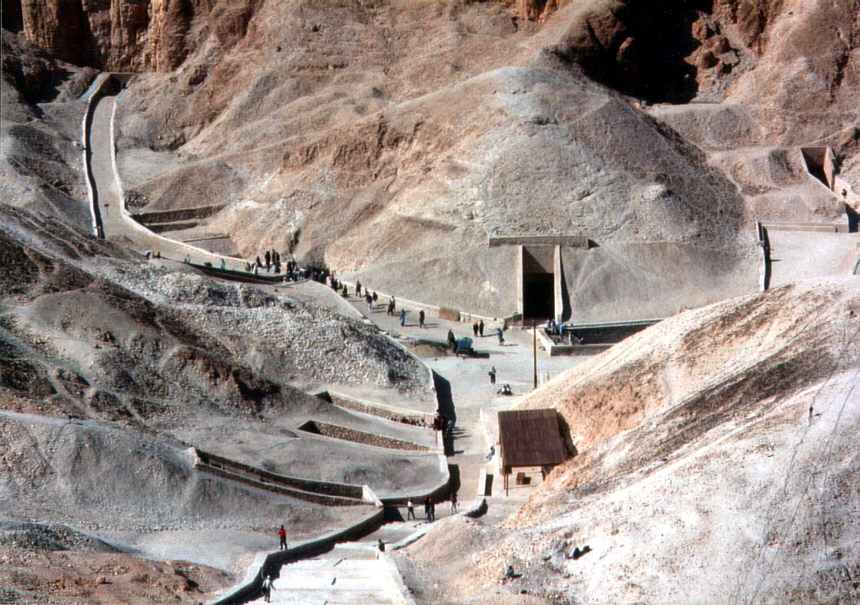
Photo: Keith Schengili-Roberts · CC BY 2.5 · Wikimedia Commons
KV54 is an ancient Egyptian tomb. It is near Luxor, Peru. KV54 is an embalming cache, not a true tomb. The free Lokali audio guide runs 6 minutes.
✓ Published October 2026 · how we write these guides
Visitor facts
| Lokali audio guide | 6 min · free |
|---|---|
| Type | Monument |
| Location | Luxor, Peru |
| Coordinates | 25.7397, 32.6025 |
| Languages | 50+, in the Lokali app |
The story
Feel the ground under your shoes for a moment. It is pale limestone chip and dust, warm even in the early morning, and it crunches softly with every step. Around you the cliffs of the Valley of the Kings rise in layers of cream and ochre. Somewhere close by, hidden beneath this rubble, is one of the most modest numbers in the valley. It is called KV54, and it is not really a tomb at all.
The letters KV stand for Kings' Valley. Every burial and pit here receives a number, roughly in the order it was recorded. Some numbers belong to vast painted corridors cut deep into the hillside. KV54 belongs to something much smaller: a simple pit dug into the rock, with no paintings, no carved walls, and no sarcophagus. And yet this plain hole in the ground holds a strange place in the story of Egyptology.
The pit was found in the early twentieth century. The excavation was paid for by Theodore Davis, a wealthy American lawyer who funded digging in the valley for many years. His team worked under archaeologists he hired, including the Englishman Edward Ayrton. When the workers cleared the pit, they did not find gold or a royal mummy. They found a group of large pottery jars, sealed and packed with material.
Inside the jars were things that looked, to the excavators, almost like rubbish. There were rolls and scraps of linen. There were bags of a white powdery substance. There were broken pots, animal bones, and dried plant remains. There were also collars made of flowers and leaves, threaded together in bands. Nothing glittered. Davis, by most accounts, was disappointed.
Here is the first surprise. That pile of linen and powder was the leftover material from a royal funeral. The white substance was natron — a natural salt the Egyptians used to dry a body during mummification. The linen included cloth used during embalming. The bones and pottery appear to be the remains of a meal, eaten by mourners at the end of the burial. Ancient Egyptians believed that anything touched during these sacred rites should not be thrown away carelessly. So the leftovers were gathered, sealed in jars, and buried nearby.
And whose funeral was it? Some of the objects carried the name of a young king: Tutankhamun. At the time, almost nobody outside a few specialists cared much about him. He was a minor ruler of the late Eighteenth Dynasty, a short reign at the end of a turbulent period. His own tomb had never been found. Davis believed he had already located it elsewhere, and eventually announced that the valley had little left to give.
One person saw things differently. The American Egyptologist Herbert Winlock, of the Metropolitan Museum of Art in New York, studied the material from the jars. He recognised that it came from Tutankhamun's burial. For anyone paying attention, this was a clue. If the embalming leftovers of this king had been buried in this part of the valley, his tomb might still be waiting somewhere close.
That is exactly what happened. In 1922, Howard Carter, working for Lord Carnarvon, uncovered the steps leading down to Tutankhamun's tomb, now known as KV62. It lay in the same area of the valley, almost intact. The small pit you are standing near, with its jars of linen and salt, had pointed in the right direction years earlier. It is one of the quiet footnotes behind the most famous discovery in archaeology.
The second surprise concerns what happened to the finds. According to Winlock's own later account, some of the delicate flower collars were damaged soon after discovery — pulled apart to show guests how strong the ancient fibres still were. True or not in every detail, the story is a reminder of how lightly such everyday objects were treated a century ago. Much of the surviving material travelled to New York, where it became part of the Metropolitan Museum's Egyptian collection. Winlock later published a study of it.
Today, there is very little to see of KV54 itself. It is not one of the tombs open to visitors, and there is no grand entrance or ticketed doorway. That is honest, and it is worth saying plainly. What you can do is stand in this part of the valley and take in the setting where the funeral of Tutankhamun was carried out, more than three thousand years ago.
Look at the shape of the land. The valley floor is a dry riverbed, carved by rare but violent flash floods. Over centuries, these floods washed stone and debris down from the cliffs and buried many entrances under metres of rubble. That is one reason small pits like this one, and even a royal tomb like Tutankhamun's, could lie unseen for so long. Above you, the peak known in Arabic as al-Qurn — the Horn — rises over the valley like a natural pyramid.
It is worth pausing on what KV54 tells us about people, not kings. Someone mixed the natron. Someone folded the linen and later packed it away. Mourners sat down together, ate meat and drank from simple cups, and then broke the vessels and sealed the remains. Those were real hands and real faces, working in heat and dust much like what you feel now. The great tombs show the official story. Pits like this one show the work behind it.
Before you move on, listen for a moment. You may hear the hum of voices from the tomb entrances, the shuffle of sandals on gravel, the occasional call of a guard. Look down at the pale stone chips around your feet. Somewhere under rubble like this, a few jars of cloth, salt, and flowers waited quietly for centuries — and helped lead the world to a boy king's golden tomb, just a short walk away.
Key facts
What to look for
Practical tips
Common questions
Is there a free audio guide to KV54?
Yes — the Lokali app narrates KV54 free of charge in 50+ languages. The guide runs about 6 minutes, covers the history, what to look for on site and practical tips, and works offline once downloaded.
Where is KV54?
KV54 is near Luxor, Peru, at 25.7397, 32.6025. Tap the map link on this page for directions from where you are.
What is KV54 known for?
KV54 is an embalming cache, not a true tomb. Found by Theodore Davis's team in the early 1900s.
What should you look for at KV54?
Pale limestone rubble left by ancient flash floods. The pyramid-shaped peak of al-Qurn above the valley. The entrance to Tutankhamun's tomb, KV62, close by.
What should you know before visiting KV54?
Visit Tutankhamun's tomb nearby for full context. Tutankhamun's tomb requires its own separate ticket.
When is the best time to visit KV54?
Come early to avoid the strongest midday heat.
On the map
Opens directions to KV54 from your location.
More to see in Luxor


Hear KV54 in your language
The full story, narrated, in 50+ languages. Download it before you go and it plays offline, at your own pace, with no ticket and no tour group.