
KV5, Tomb of the Sons of Ramesses II
25.7407° N · 32.6021° E · Memorial
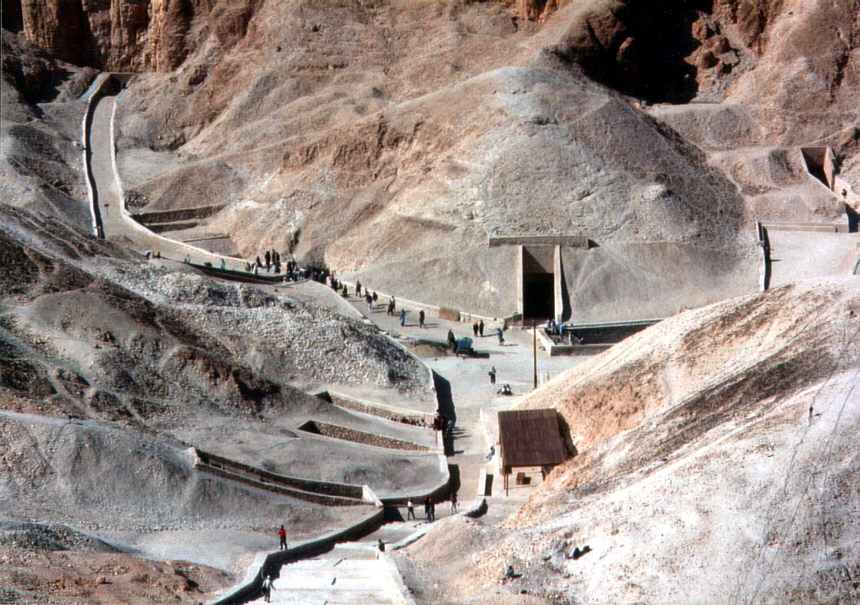
Photo: R.F.Morgan · CC BY-SA 3.0 · Wikimedia Commons
KV5, Tomb of the Sons of Ramesses II is an ancient Egyptian tomb. It is near Luxor, Egypt. KV5 is the largest tomb known in the Valley. The free Lokali audio guide runs 7 minutes.
✓ Published October 2026 · how we write these guides
Visitor facts
| Lokali audio guide | 7 min · free |
|---|---|
| Type | Memorial |
| Location | Luxor, Egypt |
| Coordinates | 25.7407, 32.6021 |
| Languages | 50+, in the Lokali app |
The story
Stand still for a moment near the mouth of the Valley of the Kings. The ground under your feet is pale and gritty, a mix of limestone chips and dust that crunches when you shift your weight. Heat comes up from the rock as well as down from the sky. Close to the main path, near the entrance of the valley, there is an opening in the hillside that many people walk past without a second look. That opening is KV5. It is one of the most remarkable discoveries ever made in this valley.
First, the name. Every tomb here carries a number, in the order it was recorded. KV means Kings' Valley, and the five tells you this tomb was among the first catalogued. For a long time it seemed modest, almost forgettable. Early explorers looked inside, found rooms choked with rubble, and moved on. For more than a century and a half, almost nobody gave it serious attention. That neglect is part of the story... because what lay behind the rubble was enormous.
In the 1820s, the British explorer James Burton crawled into the front chambers. He was working in difficult conditions. Debris filled the rooms almost to the ceiling, and he could only see a small part of the tomb. He made notes, and later visitors left the tomb largely alone. The entrance gradually disappeared under flood debris and spoil from other excavations. By the twentieth century, its exact position was uncertain, and the tomb was close to being forgotten.
Then came a modern threat. In the 1980s, there were plans to widen the road and build a parking area near the valley entrance, where tour buses would stop. The American Egyptologist Kent Weeks, who led a long project to map the whole Theban necropolis, wanted to make sure nothing important lay under the planned construction. In 1987, his team located the entrance of KV5 again. They saved it, just in time, from being buried under tarmac and buses.
What Weeks found over the following years changed the understanding of this valley. In 1995, his team announced that the tomb was far larger than anyone had imagined. Beyond the first rooms, corridors ran deep into the hillside. Doorways opened off them on both sides, dozens of them. Today, the known plan includes more than one hundred corridors and chambers. That makes KV5 the largest tomb ever found in the Valley of the Kings — and exploration has never been fully completed.
So who was buried here? The answer lies in the inscriptions on the walls. The texts name sons of Ramesses the Second, the pharaoh who ruled Egypt for more than sixty years in the thirteenth century before Christ. Ramesses the Second had a very large family. His monuments list dozens of sons and daughters. Many of his sons died before him, because he lived so long. This tomb appears to have been built as a shared resting place for at least several of those princes.
The idea of a family tomb was unusual. Most tombs in this valley were made for a single king. Here, a pharaoh planned something different: one vast underground complex for his children. Among the names recorded on the walls is Amun-her-khepeshef, one of the eldest sons, who held the position of crown prince for a time. Several other princes are also named. The excavators also found human remains of several individuals, but not every burial can be linked to a specific name.
Now think about where you are standing. The tomb of Ramesses the Second himself, known as KV7, lies very close by. The father and his sons rest only a short walk apart. It is easy to picture the old king planning both projects together, choosing this low ground near the valley entrance. Unfortunately, that same low ground made both tombs vulnerable. Flash floods, rare but violent, have swept through this valley many times over the centuries.
Those floods are the reason KV5 was so hard to understand. Each storm carried mud, sand, and stone into the open tomb. Over time, the debris hardened almost like concrete. The excavators had to remove it carefully, often by hand, basket by basket. The water also damaged the painted plaster and weakened the rock. Much of the decoration that once covered the walls survives only in fragments. Ceilings in some chambers have cracked or collapsed.
Inside, the layout is surprising. Just beyond the entrance, there is a large hall supported by many square pillars, cut directly from the bedrock. Further in, a long corridor runs straight back, with small chambers opening off each side in neat rows. At the end of one corridor, the team found a figure of Osiris carved into the rock. Osiris was the Egyptian god of the dead and of rebirth. Placing him here put the princes under his protection.
Here is something many visitors do not realise. Some corridors appear to run downward and continue beneath other parts of the tomb, on more than one level. The full extent of the complex is still not certain. It is possible that more rooms lie beyond the areas cleared so far. In a valley that people often think has been completely explored, KV5 is a reminder that the rock can still hold surprises.
The tomb is not normally open to the public. The rock is fragile, the passages are unstable in places, and conservation work continues. So, for most visitors, KV5 is a place to stand outside and imagine. That is still worth doing. Look at the cliff face above the entrance and the slope of the ground around it. Notice how close everything sits to the paths, the shelters, and the busy area where visitors arrive.
Think about how much effort went into this place. Workers with copper chisels and stone hammers cut more than a hundred rooms into this hillside, working by the light of oil lamps. They did it for princes, not for a king. Then the tomb was robbed, flooded, filled, and forgotten. For a long time, it was little more than a damp hole near a road. Its true scale stayed hidden almost until our own time.
Before you move on, take one more look at that unremarkable opening. Listen to the voices of other visitors, the footsteps on the gravel, the wind moving along the valley floor. Somewhere under your feet, long corridors run into the dark, and the names of a pharaoh's sons are still written on their walls. As you walk deeper into the valley, remember that the plain entrances can sometimes lead to the largest stories.
Key facts
What to look for
Practical tips
Common questions
Is there a free audio guide to KV5, Tomb of the Sons of Ramesses II?
Yes — the Lokali app narrates KV5, Tomb of the Sons of Ramesses II free of charge in 50+ languages. The guide runs about 7 minutes, covers the history, what to look for on site and practical tips, and works offline once downloaded.
Where is KV5, Tomb of the Sons of Ramesses II?
KV5, Tomb of the Sons of Ramesses II is near Luxor, Egypt, at 25.7407, 32.6021. Tap the map link on this page for directions from where you are.
What is KV5, Tomb of the Sons of Ramesses II known for?
KV5 is the largest tomb known in the Valley. Built for sons of Ramesses the Second.
What should you look for at KV5, Tomb of the Sons of Ramesses II?
The low entrance close to the valley's main path. Flood-worn limestone on the slope around the opening. The nearby entrance of KV7, Ramesses the Second's tomb.
What should you know before visiting KV5, Tomb of the Sons of Ramesses II?
Visit early in the morning before the valley heat builds. Pair this stop with the nearby tomb of Ramesses the Second.
When is the best time to visit KV5, Tomb of the Sons of Ramesses II?
Visit early in the morning before the valley heat builds.
On the map
Opens directions to KV5, Tomb of the Sons of Ramesses II from your location.
More to see in Luxor



Hear KV5, Tomb of the Sons of Ramesses II in your language
The full story, narrated, in 50+ languages. Download it before you go and it plays offline, at your own pace, with no ticket and no tour group.