
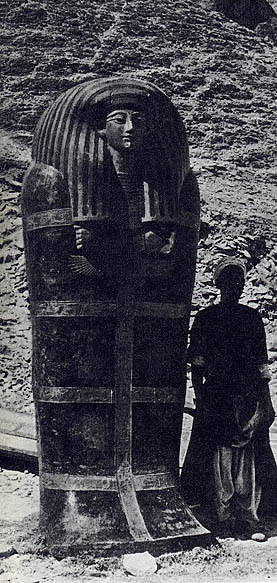
Photo: R.F.Morgan · CC BY-SA 3.0 · Wikimedia Commons
KV60 is an ancient Egyptian tomb. It is near Luxor, Egypt. Howard Carter discovered KV60 in 1903. The free Lokali audio guide runs 7 minutes.
✓ Published October 2026 · how we write these guides
Visitor facts
| Lokali audio guide | 7 min · free |
|---|---|
| Type | Memorial |
| Location | Luxor, Egypt |
| Coordinates | 25.7408, 32.6022 |
| Languages | 50+, in the Lokali app |
The story
Feel the gravel shift under your shoes. This part of the Valley of the Kings is all pale limestone chips, sun-bleached and loose, and the cliffs throw back the heat like an open oven door. Look down near the path, close to the larger tomb of a prince known as KV19. There is very little to see. A low, closed entrance cut into the bedrock. No columns, no painted gateway, no queue of visitors. And yet this modest opening has caused more argument among Egyptologists than many of the grand tombs around it.
The name KV60 is simply a catalogue number. KV stands for Kings' Valley, and sixty means it was the sixtieth tomb recorded here. Numbers like this tell you the order of discovery, not the importance of the owner. Some of the most decorated royal tombs carry low numbers because travellers noticed them centuries ago. KV60 was found much later, and it was found almost by accident, in the busy early years of modern excavation.
In 1903, a young Howard Carter was working in the valley. This was nearly twenty years before he would find the tomb of Tutankhamun. While clearing the area in front of KV19, he came across the cut of this small tomb. Inside, he found a simple layout... a short stairway, a corridor, and a single rough chamber. There were no wall paintings. The tomb had been robbed in antiquity, and the floor was a mess of broken coffin pieces and scattered debris.
Among that debris lay two mummies of women. One rested in the lower part of a wooden coffin. The other lay directly on the floor, with no coffin at all. Carter made only brief notes. He took some mummified geese, which were food offerings for the dead, and then he closed the tomb again. Over the following years, its exact position slipped out of memory. For decades, the scholars who knew about KV60 could not say exactly where it was.
A few years after Carter, another excavator, Edward Ayrton, returned to the tomb. He removed the woman in the coffin and sent her to the Egyptian Museum in Cairo. Her coffin carried an inscription that named a royal nurse called Sitre, also known as In. That name matters. Sitre was the nurse of Hatshepsut — one of the most remarkable rulers Egypt ever had. The second woman, the one on the floor, stayed behind in the dark.
Here is a little background on Hatshepsut. She lived in the fifteenth century before Christ, in the period that historians call the New Kingdom. She was a king's daughter and a king's wife. Then she did something very unusual. She took the full title of pharaoh and ruled Egypt in her own name for about two decades. Her statues often show her with the false beard and the clothing of a male king.
After her death, many of her images were damaged and her name was removed from monuments. For a long time, historians read this as revenge by her successor, Thutmose the Third. Today, many scholars think the story is more complicated, and that the damage came later in his reign. Whatever the reason, her memory was partly erased. Her own large tomb, KV20, lies elsewhere in this valley, but no body was ever found inside it.
In 1989, an American archaeologist named Donald Ryan relocated KV60 and cleared it properly for the first time. He found the woman on the floor still waiting. She was heavy-set and middle-aged. Ryan noticed something about her pose. Her left arm was bent across her chest, with the hand closed, and her right arm lay straight at her side. Some scholars link this arm position with royal women of this period. It was a small detail... but it raised a large question.
So who was she? For years, the idea that she might be Hatshepsut herself was only a theory. Then, in 2007, an Egyptian team led by Zahi Hawass studied several unidentified female mummies with CT scans. The scans are three-dimensional X-ray images. They focused on a small wooden box that carried Hatshepsut's name. Inside the box, along with preserved organs, was a single tooth.
According to the team, that tooth fitted a gap in the jaw of the woman from KV60. On that basis, they announced that she was Hatshepsut. Many people accepted the result. Some specialists still ask for caution, and they point out that dental matching alone cannot settle every doubt. So the fairest way to say it is this. The woman found on the floor of this plain tomb is widely believed to be Egypt's great female pharaoh.
Think about the distance between those two ideas. A ruler who built one of the most elegant temples in Egypt, on the far side of these very cliffs at Deir el-Bahari. And a body found lying on bare rock, with no coffin, in an undecorated room. How she came to rest here is still unknown. Ancient priests moved many royal mummies to protect them from robbers, and she may have been hidden here during one of those reburials.
Today, the woman believed to be Hatshepsut no longer lies in KV60. After the 2007 study she went to Cairo, and she later travelled with other royal mummies to the National Museum of Egyptian Civilization. The tomb itself is not open to visitors. What remains for you is the place — the setting, the stone, and the knowledge of what lay beneath this patch of ground for more than three thousand years.
Take a moment before you move on. Notice how close KV60 sits to the walking path, and how easily you would pass it without a second look. That is part of its lesson. In this valley, the size of a tomb does not tell you the size of the story. Listen to the voices of other visitors heading toward the famous painted tombs. Feel the heat rising from the stones. Then, as you walk away, let your eyes drift to the cliffs above. Somewhere behind them, her temple faces the morning sun.
Key facts
What to look for
Practical tips
Common questions
Is there a free audio guide to KV60?
Yes — the Lokali app narrates KV60 free of charge in 50+ languages. The guide runs about 7 minutes, covers the history, what to look for on site and practical tips, and works offline once downloaded.
Where is KV60?
KV60 is near Luxor, Egypt, at 25.7408, 32.6022. Tap the map link on this page for directions from where you are.
What is KV60 known for?
Howard Carter discovered KV60 in 1903. Inscribed coffin named Sitre, Hatshepsut's royal nurse.
What should you look for at KV60?
The small closed entrance cut into pale bedrock. Loose limestone chips covering the ground around the path. The decorated doorway of nearby tomb KV19.
What should you know before visiting KV60?
Look for KV60 near the entrance of tomb KV19. Visit early morning to avoid the valley's strongest heat.
When is the best time to visit KV60?
Visit early morning to avoid the valley's strongest heat.
On the map
Opens directions to KV60 from your location.
More to see in Luxor


Hear KV60 in your language
The full story, narrated, in 50+ languages. Download it before you go and it plays offline, at your own pace, with no ticket and no tour group.